OTT
When to Replatform Your OTT Service: Key Indicators
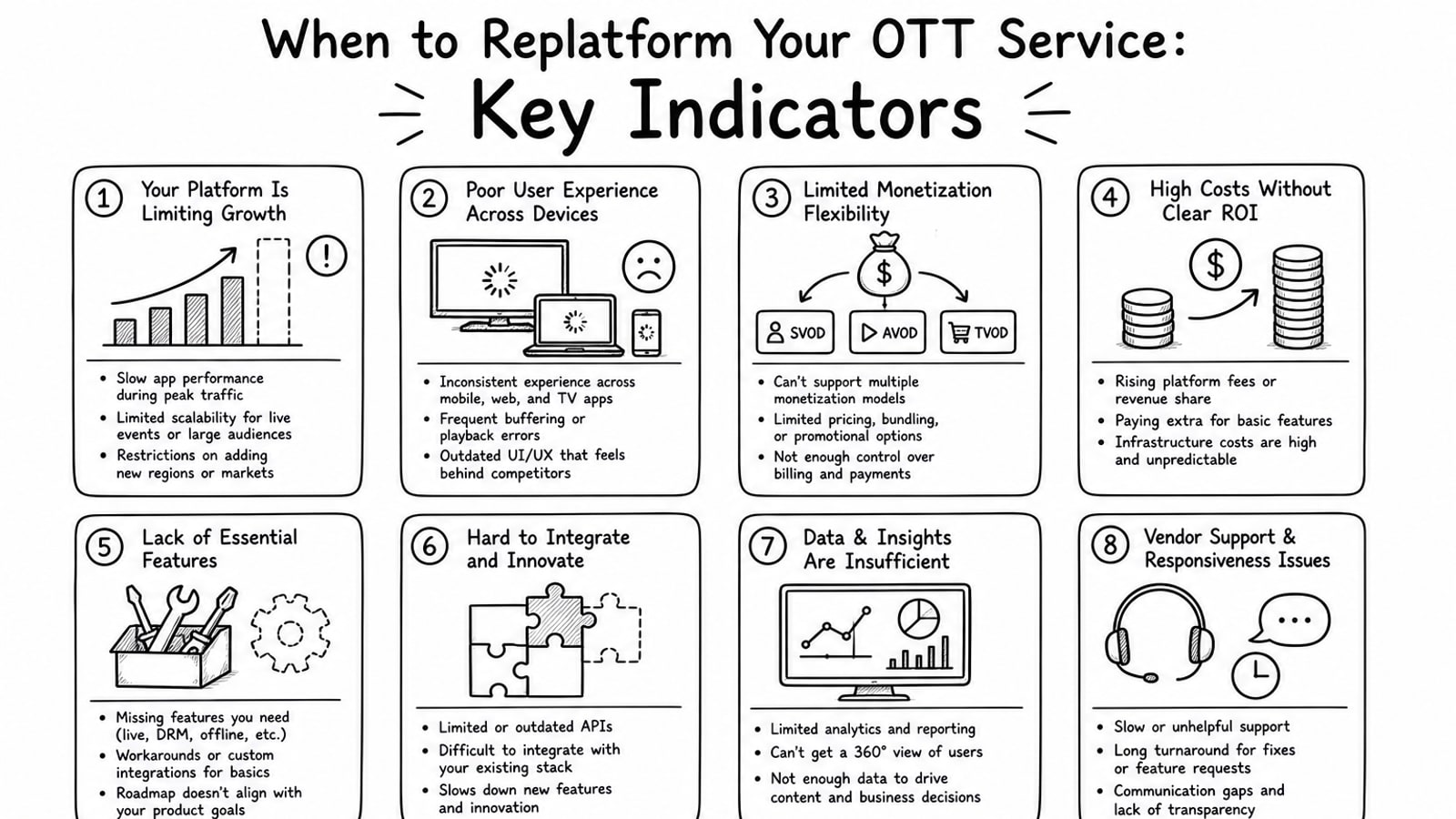
Knowing when to replatform your OTT service is less about chasing a new stack and more about recognizing when your current platform is slowing growth, raising costs, or limiting the viewer experience. If product launches take too long, infrastructure spend keeps climbing, or vendor restrictions are blocking roadmap decisions, those are strong signals that your platform may no longer fit the business you are trying to build.
Quick Answer
You should consider replatforming your OTT service when your current setup creates recurring friction in delivery, monetization, customer experience, or cost control. The strongest indicators are slow product changes, unstable playback, rising third-party fees, weak analytics, app maintenance issues, and platform limitations that prevent your team from owning key parts of the viewer journey.
Key Takeaways
Replatforming is usually justified when business constraints repeat, not when a single outage or delay happens once.
Costs matter, but operational speed and control often become the bigger reason to move.
A good replatforming decision starts with measurable problems such as churn, failed releases, support tickets, or vendor-related delays.
The right next platform should improve flexibility, cost visibility, and ownership of key infrastructure.
Why OTT Teams Replatform
Most OTT teams do not replatform because a newer vendor looks interesting. They replatform because the current platform stops matching the business model, audience expectations, or pace of execution. What worked during launch can become a bottleneck later, especially when a service expands into more apps, more regions, more subscription complexity, or more operational dependence on outside providers.
Signs Your OTT Platform Is Reaching Its Limits
1. Product updates are too slow
If even small changes require vendor tickets, long release windows, or custom workarounds, your platform may be hurting product velocity. OTT businesses often need to adjust pricing, bundles, landing flows, entitlements, promotions, and app experiences quickly. When routine changes take weeks instead of days, the platform stops supporting the business and starts governing it.
2. Costs keep rising without clear value
A growing OTT service should expect some infrastructure growth, but the warning sign is when platform fees, storage charges, encoding costs, or usage markups increase faster than the value you are getting back. This becomes especially important when your platform bundles services in ways that make it hard to see what you are really paying for and what you could manage more efficiently yourself.
3. Viewer experience issues are becoming common
Frequent buffering complaints, poor startup times, playback failures, inconsistent app behavior, or weak content discovery all point to platform fit problems. Not every viewer issue means you need a new stack, but repeated quality issues across devices usually mean the current architecture, tooling, or release process is no longer strong enough for the service you operate.
4. Vendor lock-in is shaping your roadmap
One of the clearest signs that it is time to replatform your OTT service is when roadmap decisions are being made around vendor limitations instead of user or business needs. If you cannot choose your preferred video pipeline, analytics stack, image workflow, or infrastructure accounts, you may be paying for convenience with a long-term loss of control.
5. Your team cannot get the data it needs
Replatforming should be on the table when analytics are incomplete, delayed, or disconnected across products and channels. OTT operators need reliable insight into subscriber behavior, playback quality, acquisition sources, churn patterns, and revenue performance. When data is fragmented or hidden behind vendor abstractions, decision-making gets slower and less precise.
A Simple Replatforming Decision Framework
Before making a move, pressure-test the problem from four angles: business impact, technical impact, operational impact, and switching effort. Replatforming is easier to justify when the current platform is repeatedly harming revenue, retention, launch speed, or cost control, and when those problems are unlikely to be solved with small fixes.
Business impact: Are platform limits affecting revenue, conversion, retention, or expansion plans?
Technical impact: Are reliability, playback quality, integrations, or app release cycles deteriorating?
Operational impact: Is the team spending too much time managing vendors, workarounds, or support issues?
Switching effort: Can the move be phased in without unacceptable risk to current subscribers and revenue?
Common Mistakes to Avoid
Replatforming because of hype instead of measured business pain.
Underestimating migration work for content, subscriptions, apps, and analytics.
Choosing another opaque platform that recreates the same lock-in problem in a different form.
Focusing only on launch cost and ignoring long-term operating flexibility.
What to Look for in a New OTT Solution
The next platform should solve the problems that pushed you toward change in the first place. In practice, that usually means clearer infrastructure ownership, better integration flexibility, faster release cycles, stronger data visibility, and pricing that maps more closely to real usage. If you are evaluating partners, ask who controls the underlying accounts, where media and images live, how easy it is to switch vendors later, and which fees remain variable versus fixed.
If cost transparency and control are important, Bitbyte3 can fit this discussion because its OTT solution is positioned around a BOYA model, or bring your own account. Based on the details provided, that means each client can use its own service accounts for core media needs instead of being restricted by bundled platform fees or platform-owned storage. For teams that want more control, this type of setup can be useful when services such as video delivery and image handling need to stay tied to the client's own infrastructure choices.
That structure can be especially relevant when an OTT business wants a more flexible cost model and wants to avoid unnecessary markups while still using a managed solution layer. The key question is not whether one model is always better, but whether account ownership, pricing structure, and operational freedom are aligned with your long-term streaming strategy.
How to Prepare for Replatforming
Audit the current stack, including apps, content workflows, billing, analytics, support tooling, and vendor dependencies.
List the exact problems that the new platform must solve, with business and technical success metrics.
Separate must-have capabilities from nice-to-have features so the evaluation stays focused.
Plan the migration in phases to reduce risk for current subscribers and revenue operations.
Methodology and Editorial Note
This article is an editorial decision guide built from common OTT operating scenarios such as release delays, cost opacity, infrastructure lock-in, app maintenance pressure, and viewer experience issues. It avoids unsupported statistics and does not present vendor performance claims as verified fact. Any final buying decision should be checked against your own platform data, subscriber behavior, app performance metrics, and vendor documentation.
Conclusion
The right time to replatform your OTT service is usually visible before a full crisis arrives. When platform friction shows up repeatedly in product speed, cost visibility, vendor control, or viewer experience, the better decision is often to evaluate alternatives early and migrate deliberately. A replatforming decision should create more control, better economics, and a stronger foundation for growth, not just replace one dependency with another.
FAQ
How do I know if my OTT platform problem is serious enough to justify replatforming?
The problem is serious when it repeats across multiple parts of the business, such as launch delays, rising operating costs, app instability, weak analytics, or vendor restrictions. A single isolated issue usually does not justify a full move, but repeated friction often does.
What is the biggest mistake companies make when replatforming an OTT service?
The most common mistake is switching platforms without defining the exact business and technical problems the migration needs to solve. That usually leads to a costly move with little strategic improvement.
Is cost alone a good reason to replatform?
Cost can be a strong reason, especially when charges are opaque or growing too quickly, but it is usually best evaluated together with control, release speed, reliability, and vendor flexibility.
What does bring your own account mean in an OTT setup?
Bring your own account means the client uses its own underlying service accounts for parts of the stack instead of being fully locked into platform-owned infrastructure. Depending on the provider model, that can improve cost visibility, account ownership, and flexibility.
How long does OTT replatforming usually take?
The timeline depends on app complexity, content migration, subscription systems, integrations, and testing requirements. The safest approach is usually phased migration rather than a single cutover.
What should I compare when evaluating a new OTT platform?
Compare infrastructure ownership, pricing clarity, app support, analytics access, workflow flexibility, migration effort, and how much control your team keeps over critical services and accounts.
About the Author
M. Jorani — LinkedIn
Software Engineer & Technical Writer
M. Jorani is a software engineer and technical writer with hands-on experience building streaming infrastructure, video pipelines, and OTT platforms. He writes about encoding, delivery architecture, and the engineering decisions that shape how audiences watch content across devices.
More from the blog
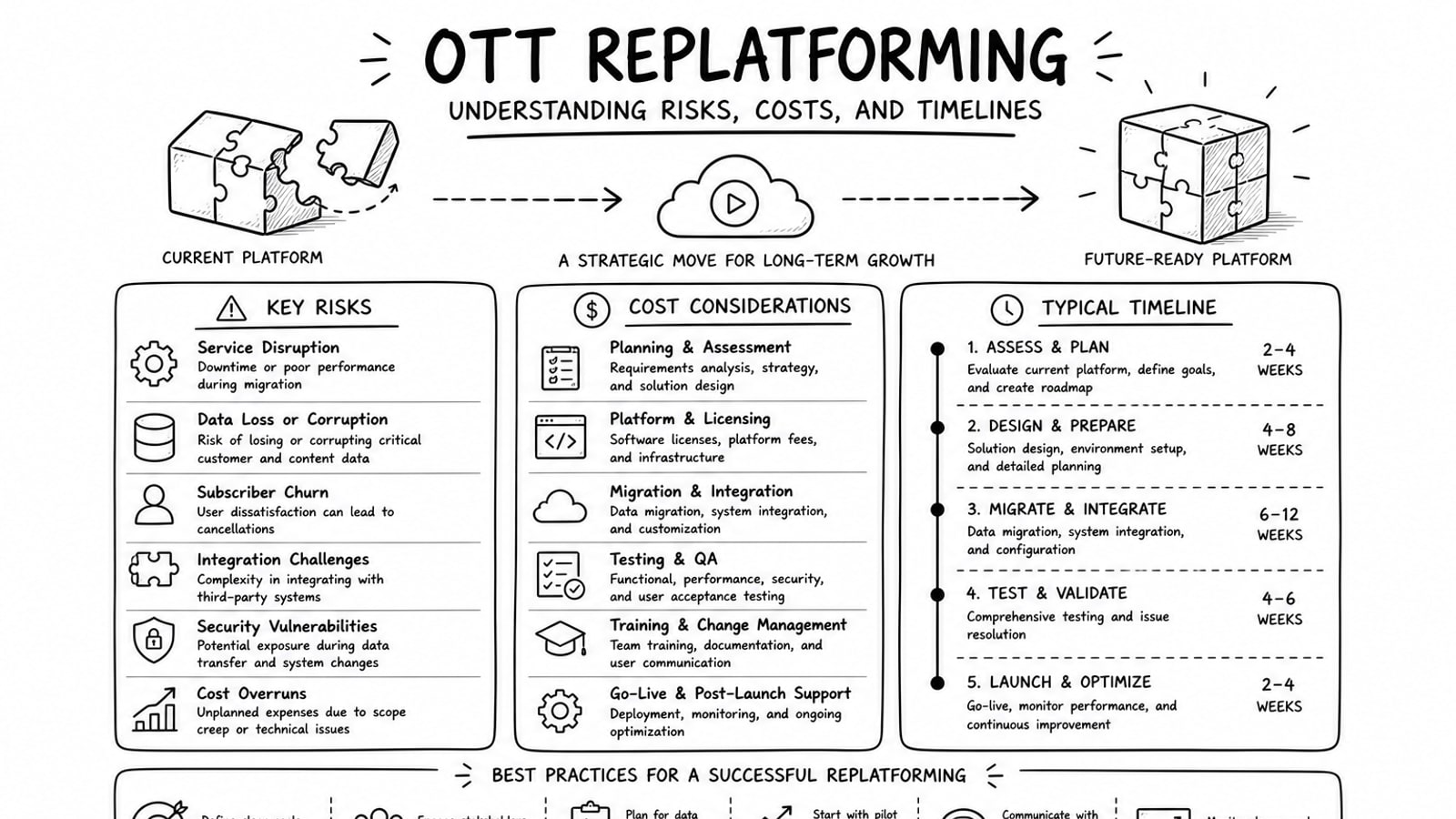
OTT Replatforming: Understanding Risks, Costs, and Timelines
A practical guide to OTT replatforming that explains why teams migrate, what usually drives risk and cost, how long projects tend to take, and where a BYOA delivery model can reduce lock-in.
Read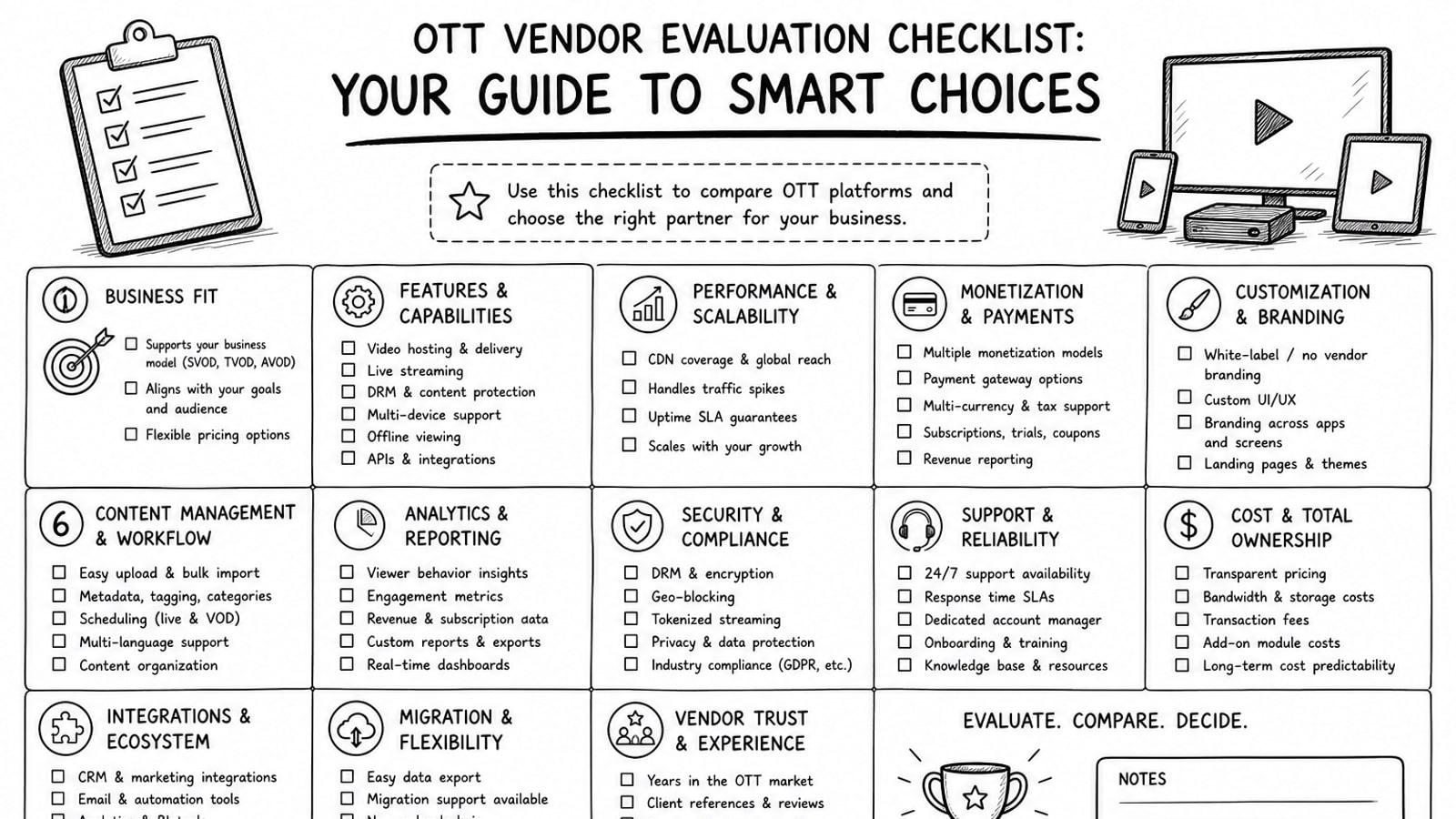
OTT Vendor Evaluation Checklist: Your Guide to Smart Choices
A practical guide to evaluating OTT vendors, with a clear checklist for delivery, security, workflow, cost, ownership, and long-term platform fit.
Read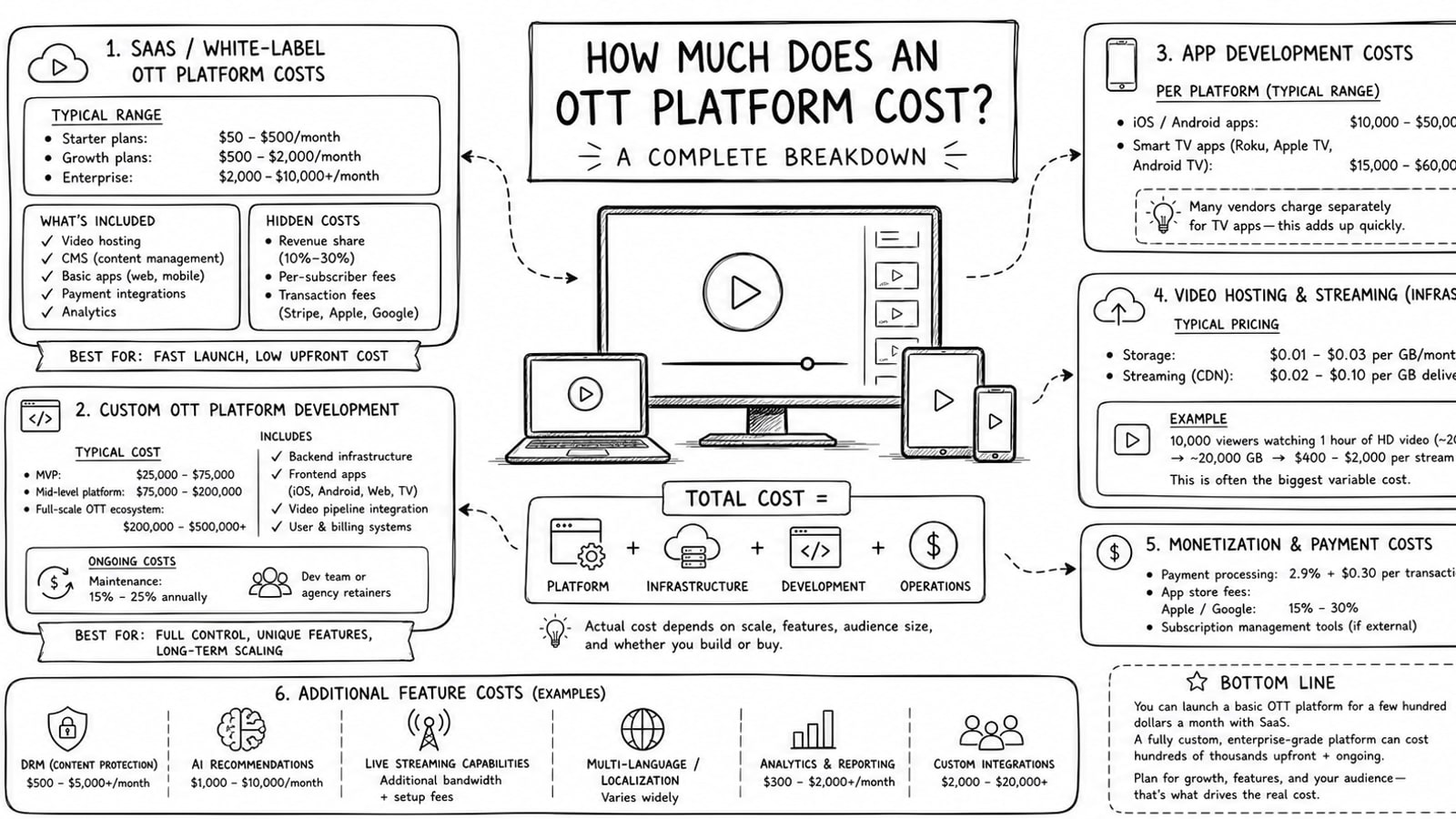
How Much Does an OTT Platform Cost? A Complete Breakdown
A practical breakdown of OTT platform costs, including launch expenses, recurring infrastructure costs, live and on-demand pricing examples, and how a BYOA model can improve cost control.
Read