OTT
OTT vs. VOD: Understanding the Key Differences
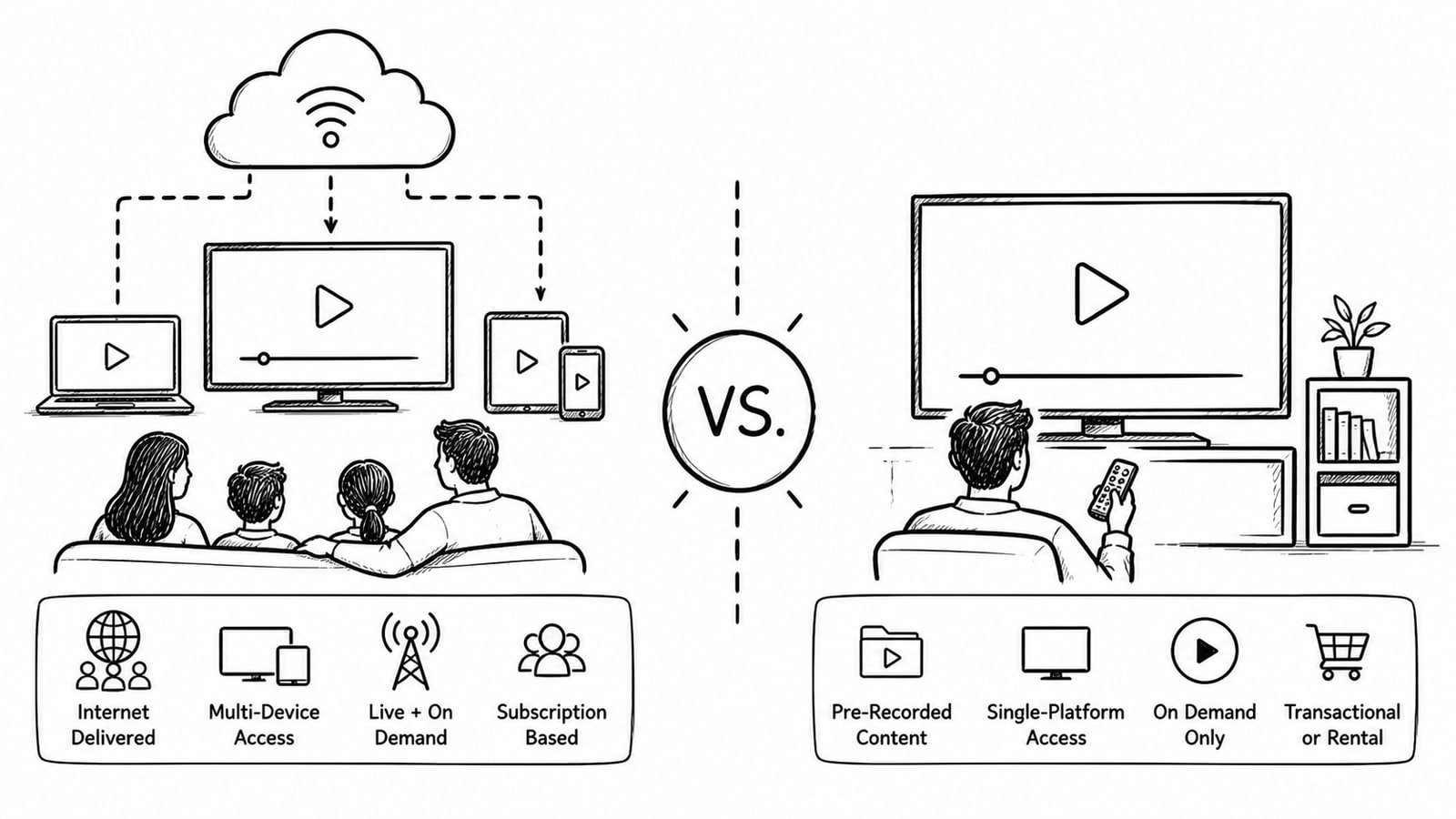
OTT vs VOD is a common point of confusion because the terms are related, but they do not mean the same thing. OTT describes how content is delivered over the internet, while VOD describes how viewers access content whenever they choose. A service can be OTT and offer VOD at the same time, which is why people often use the terms interchangeably.
Quick Answer
OTT stands for over-the-top delivery, meaning video reaches viewers through the public internet instead of traditional cable or satellite distribution. VOD stands for video on demand, meaning viewers can play prerecorded content when they want. In simple terms, OTT is the delivery model and VOD is the viewing format.
Key Takeaways
OTT refers to internet-based content delivery, not a specific content format.
VOD refers to prerecorded content that users can watch on their own schedule.
Most modern streaming services combine both concepts, which is why OTT and VOD are often mixed up.
A platform may support multiple business models, including subscriptions, ads, rentals, and one-time purchases.
For businesses building a streaming product, the real decision is usually not OTT or VOD, but which OTT features should include VOD, live streaming, or both.
What Is OTT?
OTT, short for over-the-top, refers to video or media delivered directly over the internet rather than through traditional broadcast, cable, or satellite systems. Viewers typically access OTT services through smart TVs, mobile apps, streaming devices, game consoles, or web browsers.
Netflix, Disney+, and many branded streaming apps are OTT services because they distribute content through the public internet. OTT can include live channels, catch-up TV, subscription libraries, ad-supported streams, and on-demand video catalogs.
What Is VOD?
VOD, or video on demand, is a content format that lets users watch prerecorded videos whenever they want instead of following a scheduled broadcast. The viewer chooses the title, starts playback on demand, and often gets pause, rewind, resume, and watch-later flexibility.
A VOD library can include movies, TV episodes, training content, event replays, product demos, educational modules, or private media libraries. VOD can exist inside an OTT platform, but it can also exist in other digital environments, such as e-learning portals or internal company media systems.
OTT vs VOD: The Core Difference
The simplest way to understand OTT vs VOD is this: OTT explains the delivery path, while VOD explains the user experience. OTT tells you how the content reaches the viewer. VOD tells you how the viewer consumes that content.
That means OTT and VOD are not opposites. They often work together. An OTT service may offer VOD, live streaming, or both. Likewise, VOD is usually one feature within a broader streaming strategy rather than a complete platform category on its own.
OTT vs VOD Comparison Table
Definition: OTT is internet-based content delivery. VOD is watch-anytime access to prerecorded video.
Primary focus: OTT focuses on distribution and platform access. VOD focuses on playback flexibility and content availability.
Content types: OTT can include live, linear, and on-demand experiences. VOD includes prerecorded videos only.
Typical devices: OTT runs on smart TVs, mobile apps, browsers, and streaming devices. VOD can appear anywhere users can choose and play stored video.
Example: A branded streaming app is OTT. Its movie library or replay catalog is VOD.
Why People Confuse OTT and VOD
The confusion happens because many well-known streaming services are both OTT services and VOD products. For example, when a user opens a streaming app on a smart TV and watches a film from a content library, they are using an OTT platform to access VOD content.
Teams also use the terms loosely in product planning. A business might say it wants to build an OTT app when it really means it wants a subscription VOD platform. Another team might say it needs VOD when it actually needs a full OTT stack that includes apps, identity, billing, playback, analytics, and content delivery.
When OTT Includes VOD, Live Streaming, or Both
An OTT platform is usually broader than a single playback mode. It may include a VOD catalog for prerecorded content, live streaming for events or channels, and catch-up or replay features for viewers who missed the live broadcast.
This matters for business planning because technology choices often change depending on whether the priority is a large on-demand library, scheduled linear programming, premium live events, or a mixed media experience.
How to Choose the Right Model for Your Business
If your goal is to launch a branded streaming service, think in layers. First decide whether you need OTT distribution across web, mobile, and TV apps. Then decide whether your content experience should include VOD, live streaming, or both.
Map your audience devices and regions.
Decide whether the core experience is on-demand, live, or hybrid.
Choose a monetization model such as subscription, ads, pay-per-view, or transactional rentals.
Review storage, streaming, and transcoding costs before you commit to a vendor model.
Plan for analytics, user management, content workflows, and future channel expansion.
Where BitByte3 Fits
For companies that want to launch or manage an OTT solution, BitByte3 offers services at https://bitbyte3.com/. One angle that may appeal to cost-conscious teams is its BYOA approach, which the company describes as Bring Your Own Account. In that model, the client uses its own infrastructure accounts for services such as video or image delivery, rather than being locked into pooled platform fees or shared storage limits inside a vendor-controlled account.
A setup like this can be useful for organizations that want more direct control over usage, billing visibility, storage allocation, and vendor flexibility. For example, a team may prefer to connect its own Cloudflare Stream account for video workflows instead of routing everything through a bundled reseller structure. Exact commercial benefits, implementation details, and pricing depend on the final project scope and provider configuration.
Common Mistakes to Avoid
Treating OTT and VOD as competing terms instead of related concepts.
Choosing a platform before defining whether your product is on-demand, live, or hybrid.
Focusing only on front-end apps while underestimating storage, encoding, analytics, and account ownership.
Assuming a VOD feature automatically solves monetization, content rights, and playback performance.
Ignoring how pricing changes when usage scales across storage, encoding, and delivery.
Methodology and Editorial Note
This article is written as an educational explainer. Definitions and technical framing are based on industry and platform documentation about internet video delivery, video-on-demand workflows, and streaming infrastructure. Product-specific statements about BitByte3 reflect the information supplied for this draft and should be reviewed against final commercial materials before publication.
FAQ
Is OTT the same as VOD?
No. OTT refers to delivery over the internet, while VOD refers to watching prerecorded content on demand.
Can an OTT platform offer live and on-demand content?
Yes. Many OTT platforms support live streaming, VOD libraries, and replay content in the same product.
Is Netflix OTT or VOD?
Netflix is an OTT service that largely delivers VOD content. The service uses internet delivery, and the viewer accesses titles on demand.
What does VOD mean in streaming?
VOD means video on demand. It describes prerecorded video that users can choose and play whenever they want.
What is the business advantage of a BYOA model?
A Bring Your Own Account model can give clients more direct ownership of infrastructure accounts, usage visibility, and provider relationships. The practical benefit depends on how the solution is implemented and billed.
How do I know whether I need OTT, VOD, or both?
If you need internet distribution across devices, you need OTT capabilities. If you want viewers to access prerecorded videos on their own schedule, you need VOD. Many businesses need both.
Conclusion
OTT vs VOD becomes much easier to understand once you separate delivery from playback. OTT is the internet-based distribution layer. VOD is the on-demand viewing experience. Businesses planning a streaming product usually need to think beyond the labels and design the right mix of apps, infrastructure, monetization, and content access for their audience. If you are evaluating an OTT build with flexible account ownership, BitByte3 may be worth reviewing as part of that conversation.
Sources and Further Reading
AWS Solutions Library: Video on Demand on AWS
AWS for Media Blog: OTT streaming explained in internet-delivered video workflows
Cloudflare Stream documentation and pricing pages
Nielsen guidance on OTT, CTV, and streaming terminology
About the Author
M. Jorani — LinkedIn
Software Engineer & Technical Writer
M. Jorani is a software engineer and technical writer with hands-on experience building streaming infrastructure, video pipelines, and OTT platforms. He writes about encoding, delivery architecture, and the engineering decisions that shape how audiences watch content across devices.
More from the blog
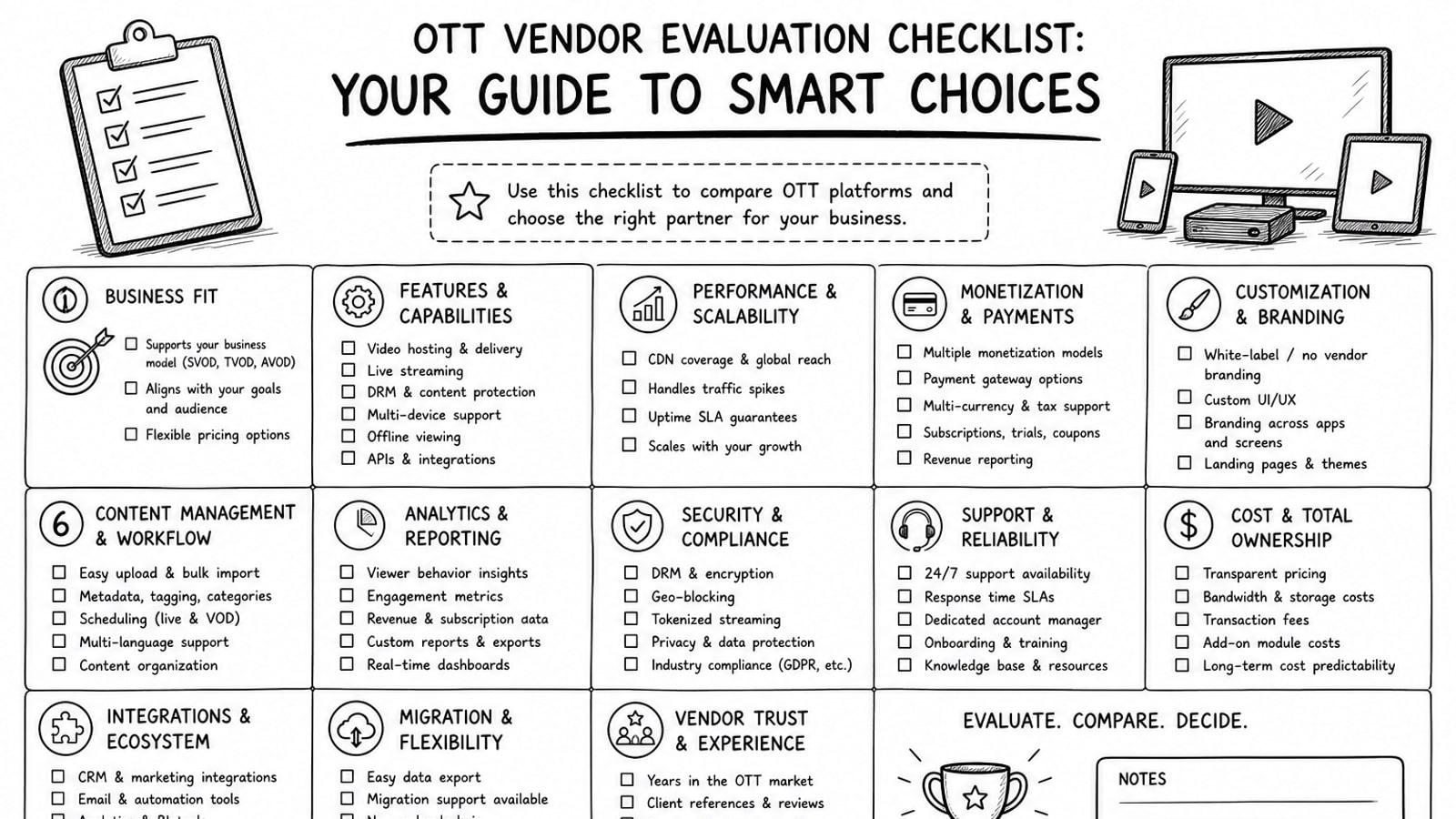
OTT Vendor Evaluation Checklist: Your Guide to Smart Choices
A practical guide to evaluating OTT vendors, with a clear checklist for delivery, security, workflow, cost, ownership, and long-term platform fit.
Read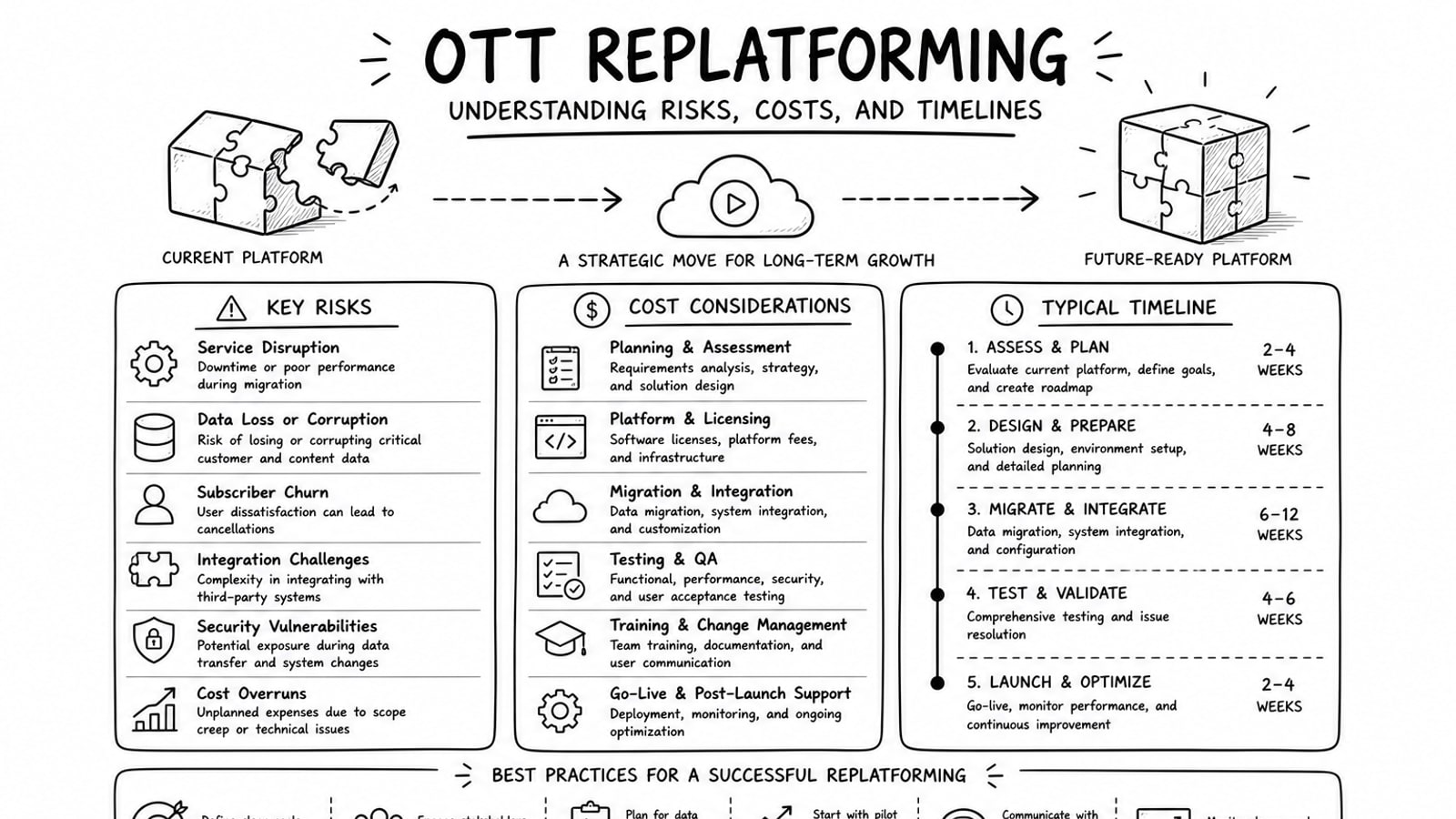
OTT Replatforming: Understanding Risks, Costs, and Timelines
A practical guide to OTT replatforming that explains why teams migrate, what usually drives risk and cost, how long projects tend to take, and where a BYOA delivery model can reduce lock-in.
Read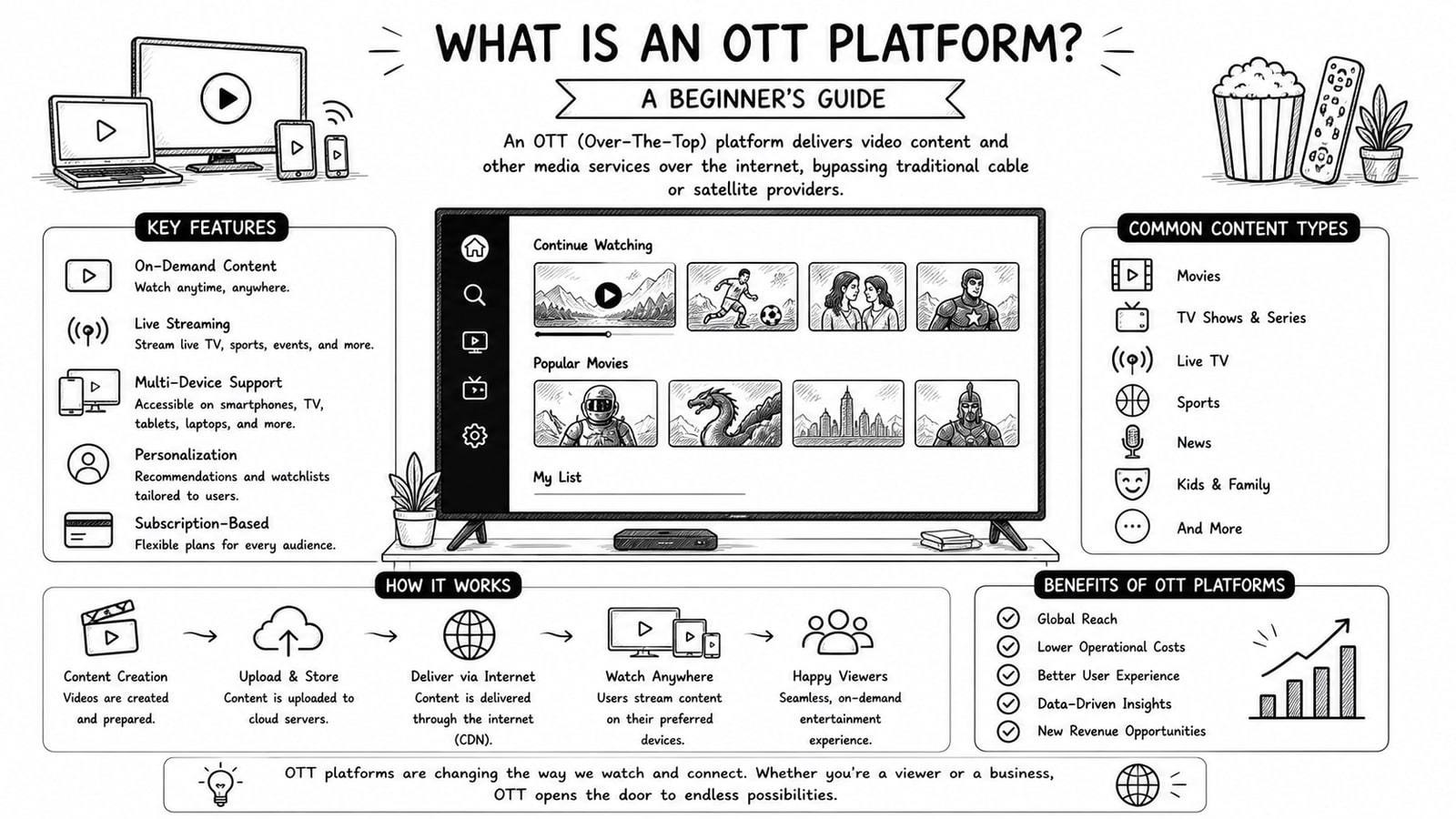
What Is an OTT Platform? A Beginner's Guide
A beginner-friendly guide to OTT platforms, how they work, key components, business models, and what to evaluate before choosing a solution.
Read