OTT
OTT Platform Development Cost in 2026: What to Expect
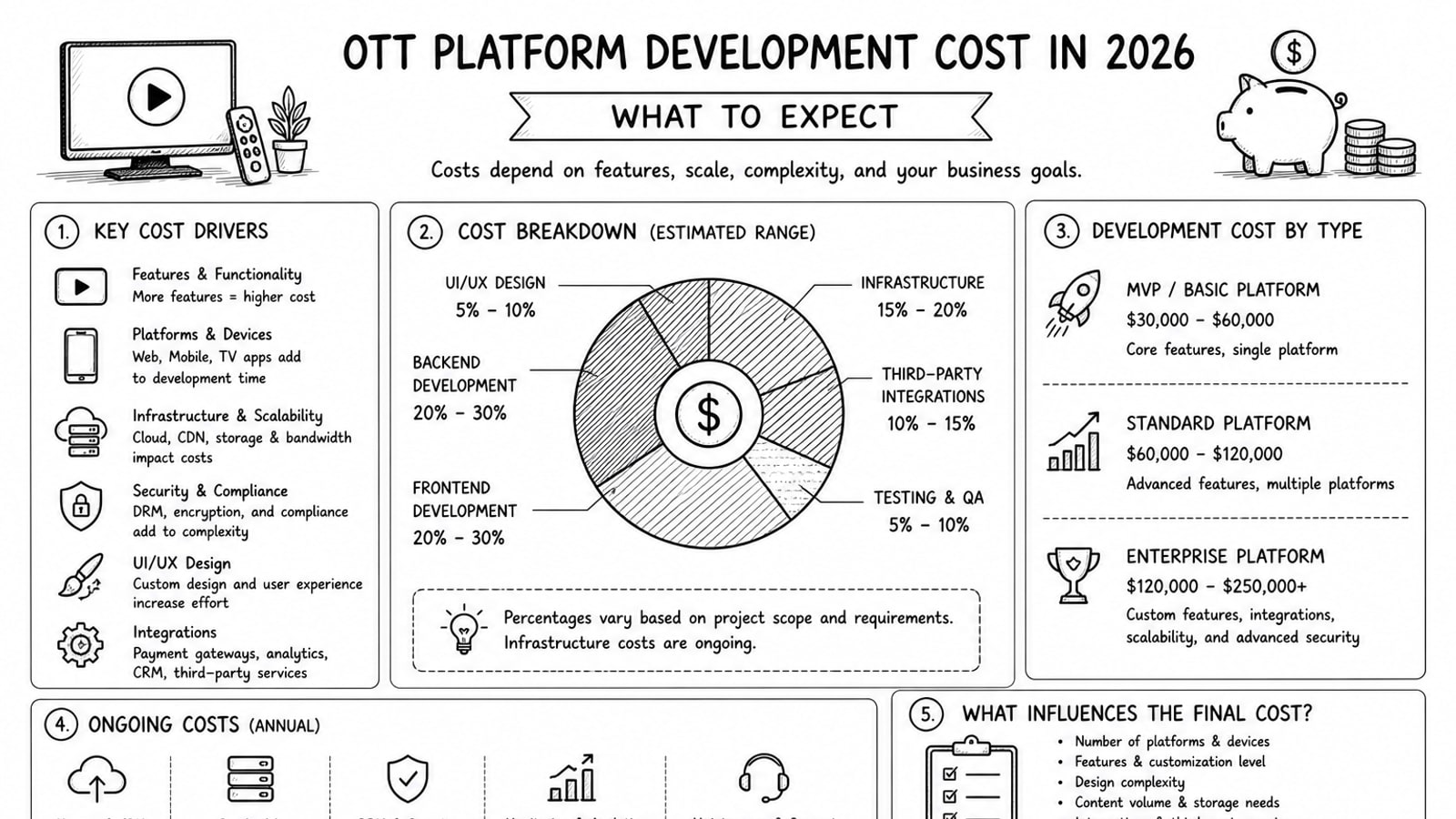
OTT platform development cost in 2026 will usually depend less on one headline quote and more on how you balance product scope, content volume, viewing minutes, multi-platform delivery, and operational ownership. For most teams, the realistic planning range is around $30,000 to $80,000 for a lean MVP, $80,000 to $200,000 for a growth-stage product, and $200,000 to $500,000 or more for a feature-rich platform with custom apps, live streaming, advanced analytics, DRM, and deeper integrations.
Quick Answer
If you are budgeting for an OTT product in 2026, expect your total spend to include two separate layers: build cost and run cost. Build cost covers product design, backend, player work, CMS, mobile and TV apps, QA, and launch. Run cost covers encoding, storage, video delivery, support, maintenance, analytics, app store fees, and future releases. Teams that separate those two layers early usually make better platform decisions and avoid surprise overruns.
Key Takeaways
A simple OTT MVP often starts around $30,000 to $80,000, while broader multi-platform builds commonly move into the $80,000 to $200,000 range.
Ongoing infrastructure can become the larger long-term cost if your catalog, resolution, or watch time grows faster than expected.
Live streaming, smart TV apps, DRM, recommendation features, and payment workflows are some of the fastest cost multipliers.
A Bring Your Own Account model can improve financial control because storage and delivery bills stay in the client's own cloud accounts instead of being wrapped inside opaque vendor markups.
The cheapest quote is not always the cheapest operating model. Ownership, portability, and billing transparency matter just as much as launch price.
What OTT Platform Development Cost Means in 2026
In 2026, OTT platform development cost is no longer just a question of building a website and adding a player. Buyers now expect mobile apps, connected TV support, adaptive streaming, subscriptions, secure access, better analytics, and a smoother content operations workflow. That shifts budgeting from a one-time software project to a product and infrastructure planning exercise.
A useful way to estimate cost is to break it into six buckets: product planning, UI and UX, backend and CMS, video infrastructure, client apps, and post-launch operations. Once those buckets are visible, teams can choose where they want custom work and where managed services make more sense.
OTT Platform Development Cost by Product Scope
Lean MVP: $30,000 to $80,000. Usually includes a web app, admin panel, basic authentication, a manageable content catalog, VOD playback, and simple analytics.
Growth-stage OTT product: $80,000 to $200,000. Often includes iOS and Android apps, subscription billing, user profiles, search, content scheduling, more robust analytics, and stronger moderation or operations tools.
Advanced platform: $200,000 to $500,000+. This tier usually adds smart TV apps, live streaming, multi-tenant architecture, DRM, personalization, ad workflows, regionalization, and enterprise integrations.
These are editorial planning ranges, not vendor quotes. Actual cost will move up or down based on team rates, delivery timeline, whether you reuse an existing platform core, and how much of the workflow is custom versus configured.
The Biggest Cost Drivers
1. Platform Coverage
Web only is the least expensive route. Adding iOS and Android increases QA, release management, and account compliance work. Adding smart TV platforms such as Android TV, Apple TV, Fire TV, Roku, or Samsung TV usually raises both launch and maintenance cost because each screen has its own UX patterns, playback edge cases, and certification requirements.
2. Video Infrastructure Choices
Encoding, storage, thumbnails, live ingest, playback delivery, captions, and DRM can all sit with different vendors. That architecture decision changes your monthly bill shape. A provider with low launch friction may still become expensive at scale if delivery or storage pricing is not transparent.
3. Monetization and Access Control
Subscriptions, pay-per-view, coupons, regional access rules, family plans, and B2B entitlements all add logic. Payment implementation is rarely just a checkout screen. It touches tax handling, refunds, plan migration, trial logic, receipts, app store requirements, and customer support operations.
4. Content Operations
Catalog management, metadata editing, playlists, scheduling, creators, internal review workflows, and localization often consume more effort than buyers expect. If your team publishes often, the admin experience can save or waste hundreds of hours over a year.
5. Reliability and Compliance
Analytics, monitoring, backups, logging, privacy workflows, abuse controls, and release management do not always show up in an early estimate, but they become essential once real users arrive. Regulated or enterprise environments also need stronger auditing and access controls, which pushes cost upward.
Expected Ongoing Costs After Launch
Post-launch spend is where OTT economics become real. A platform that looks affordable on day one can become much more expensive once watch minutes grow. In 2026, most teams should budget for a monthly operating stack that includes video processing, storage, delivery, observability, support, updates, and app distribution overhead.
Maintenance and release work: often 15% to 30% of the original annual build budget, depending on app count and update cadence.
Video usage charges: usually tied to minutes encoded, stored, and delivered, with the exact formula varying by vendor and resolution.
App distribution and billing: Apple Developer Program membership is $99 per year, and Google Play Console requires a $25 one-time registration fee.
Store commissions and payment fees: these vary by program, billing flow, and business model, so they should be modeled separately from software build cost.
What Current Vendor Pricing Signals for 2026 Budgets
Even if you do not choose these exact vendors, public pricing pages help explain how OTT infrastructure cost behaves.
Cloudflare Stream publicly states pricing at $5 per 1,000 minutes stored and $1 per 1,000 minutes delivered, with ingress and encoding included. That makes it easy to estimate baseline VOD economics from expected catalog size and viewing minutes.
Mux shows how resolution and quality settings change costs. Its pricing documentation separates input, storage, and delivery, with the first 100,000 delivered minutes free each month and higher costs for higher resolutions and premium quality tiers.
AWS Elemental MediaConvert pricing illustrates another important pattern: transcoding cost rises with resolution, frame rate, codec, and quality settings. That means 4K and premium processing choices can materially change the economics of your library.
The larger lesson is simple: the most important cost question is not just who builds your OTT app. It is who owns the recurring infrastructure bill and whether you can inspect that bill line by line.
A Practical Budgeting Framework
Define the first release clearly: channels, platforms, monetization, and launch geography.
Estimate monthly video volume: uploaded hours, average bitrate targets, expected watch minutes, and live versus VOD mix.
Separate one-time build from recurring operations. Put them in different rows, with different owners.
Model at least three scenarios: conservative, expected, and high-growth. OTT costs often look calm until usage spikes.
Ask every vendor where the cost can compound: additional apps, storage duplication, delivery overages, encoding tiers, or hidden support fees.
How Bitbyte3 May Fit
If your goal is to keep upfront development realistic without locking yourself into inflated ongoing media bills, Bitbyte3 may fit this conversation. Based on the details provided, Bitbyte3 offers an OTT solution with a Bring Your Own Account model. In practice, that means the client can use its own accounts for services such as Cloudflare Stream for video and image handling instead of paying for storage and delivery that are hidden inside a vendor-controlled account.
That model can be attractive for teams that care about billing clarity, portability, and long-term control. It may also reduce the risk of fee restrictions tied to a third-party platform account because the infrastructure relationship stays under the client's ownership. Pricing and savings will still depend on scope and usage, so exact commercial claims should be confirmed directly with Bitbyte3 before publication.
Common Mistakes That Inflate OTT Cost
Trying to launch every platform at once instead of prioritizing the highest-value screens.
Treating infrastructure pricing as an afterthought rather than part of the product architecture.
Underestimating admin workflows, metadata management, and QA across devices.
Ignoring post-launch maintenance, app updates, and operating support.
Comparing proposals only on initial build price without checking who owns the media stack and recurring usage bill.
Methodology and Editorial Note
This article uses a forward-looking 2026 planning lens. Cost ranges are editorial estimates based on common OTT build components, current public infrastructure pricing references, and standard software delivery scope differences between MVP, growth-stage, and advanced platforms. They should be treated as budgeting guidance, not as fixed quotations.
Company-specific claims about Bitbyte3's commercial model are based on the client brief used for this draft. Replace or confirm any final commercial wording, price comparison language, author details, and case study proof before publishing.
First-Hand Experience and Outcomes
Add a real Bitbyte3 or client example here only if verified. Include platform scope, launch timeline, operational setup, and measurable outcomes such as reduced infrastructure overhead, improved content publishing speed, or better cost visibility.
FAQ
How much does it cost to build an OTT platform in 2026?
A lean OTT MVP may start around $30,000 to $80,000, while a broader multi-platform product often lands between $80,000 and $200,000. More advanced OTT platforms with smart TV apps, live features, DRM, and custom workflows can exceed $200,000.
What makes OTT platform development cost increase the fastest?
The biggest accelerators are multi-platform app coverage, live streaming, 4K workflows, DRM, subscription billing complexity, advanced analytics, and high monthly watch volume.
Is OTT development a one-time cost?
No. OTT products have both build cost and operating cost. Operating cost usually includes encoding, storage, delivery, support, analytics, security, maintenance, and app updates.
Why does account ownership matter in OTT pricing?
When the vendor controls the infrastructure account, clients may have less visibility into storage, delivery, and media processing charges. A Bring Your Own Account approach can improve transparency and make migration easier later.
Can a smaller team launch an OTT product without enterprise-level cost?
Yes. Many teams start with a web-first or mobile-first release, use managed video infrastructure, keep the feature set tight, and add connected TV apps or advanced workflows after they validate audience demand.
How should teams compare OTT proposals?
Compare scope, app coverage, maintenance terms, infrastructure ownership, observability, roadmap flexibility, and recurring usage assumptions. The lowest build quote can still become the most expensive option over time.
Sources and Further Reading
Conclusion
In 2026, the right OTT budget is not the smallest number on a proposal. It is the number that matches your content strategy, expected viewership, product scope, and operating model. Teams that plan around both launch cost and infrastructure ownership usually make better decisions, grow with fewer surprises, and keep more control over their platform economics.
If you are evaluating options, the smartest next step is to map your product scope against your expected monthly video usage, then compare vendors on both build effort and recurring billing transparency. For teams that want tighter control over infrastructure ownership, that is also the point where a model such as Bitbyte3's Bring Your Own Account approach becomes worth reviewing.
About the Author
R. Jabar
Marketing Strategist
R. Jabar is a marketing strategist who helps streaming and OTT brands turn complex product stories into clear, growth-driven messaging. She writes about audience acquisition, content monetization, and the marketing frameworks that help video platforms scale.
More from the blog
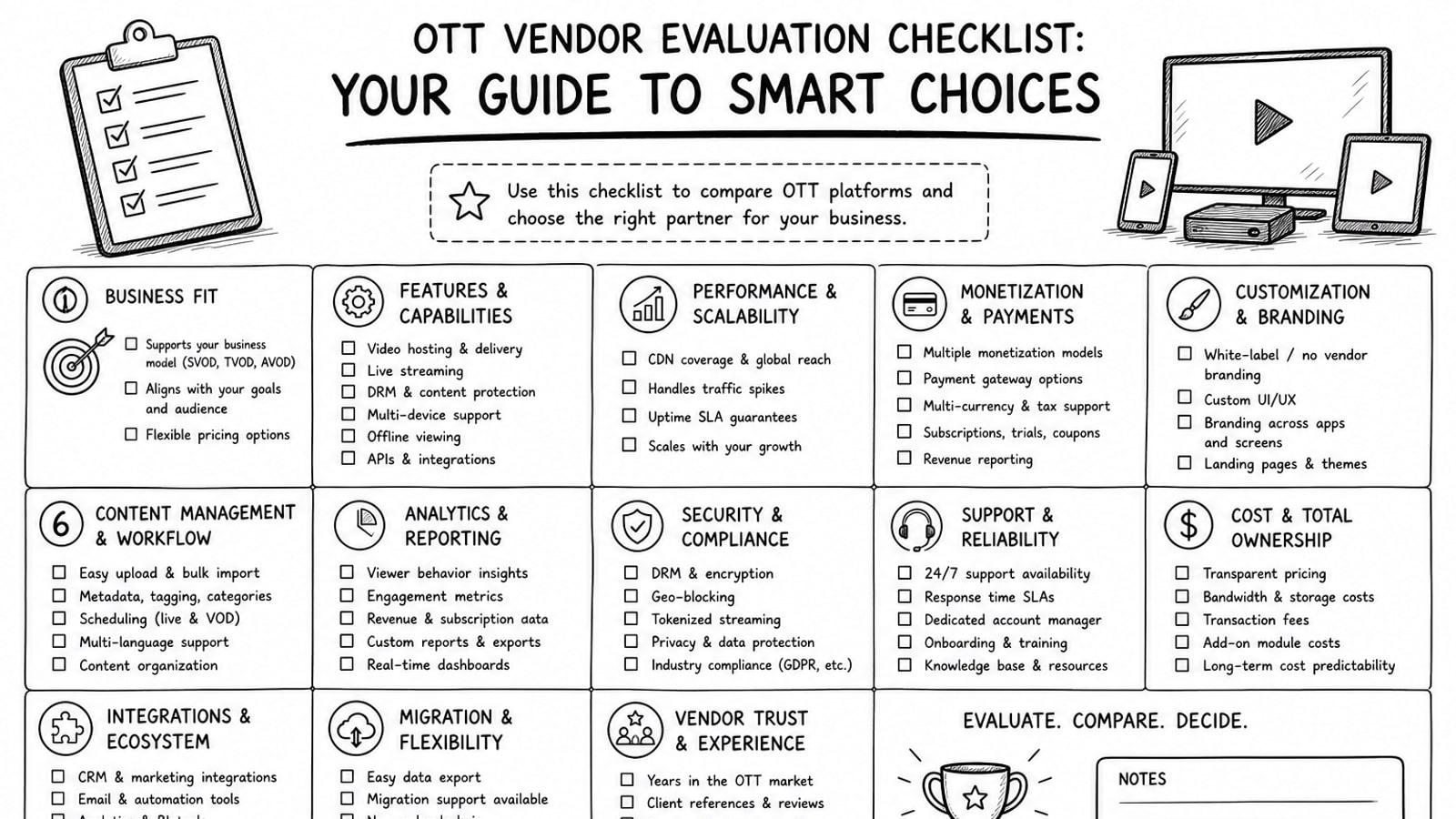
OTT Vendor Evaluation Checklist: Your Guide to Smart Choices
A practical guide to evaluating OTT vendors, with a clear checklist for delivery, security, workflow, cost, ownership, and long-term platform fit.
Read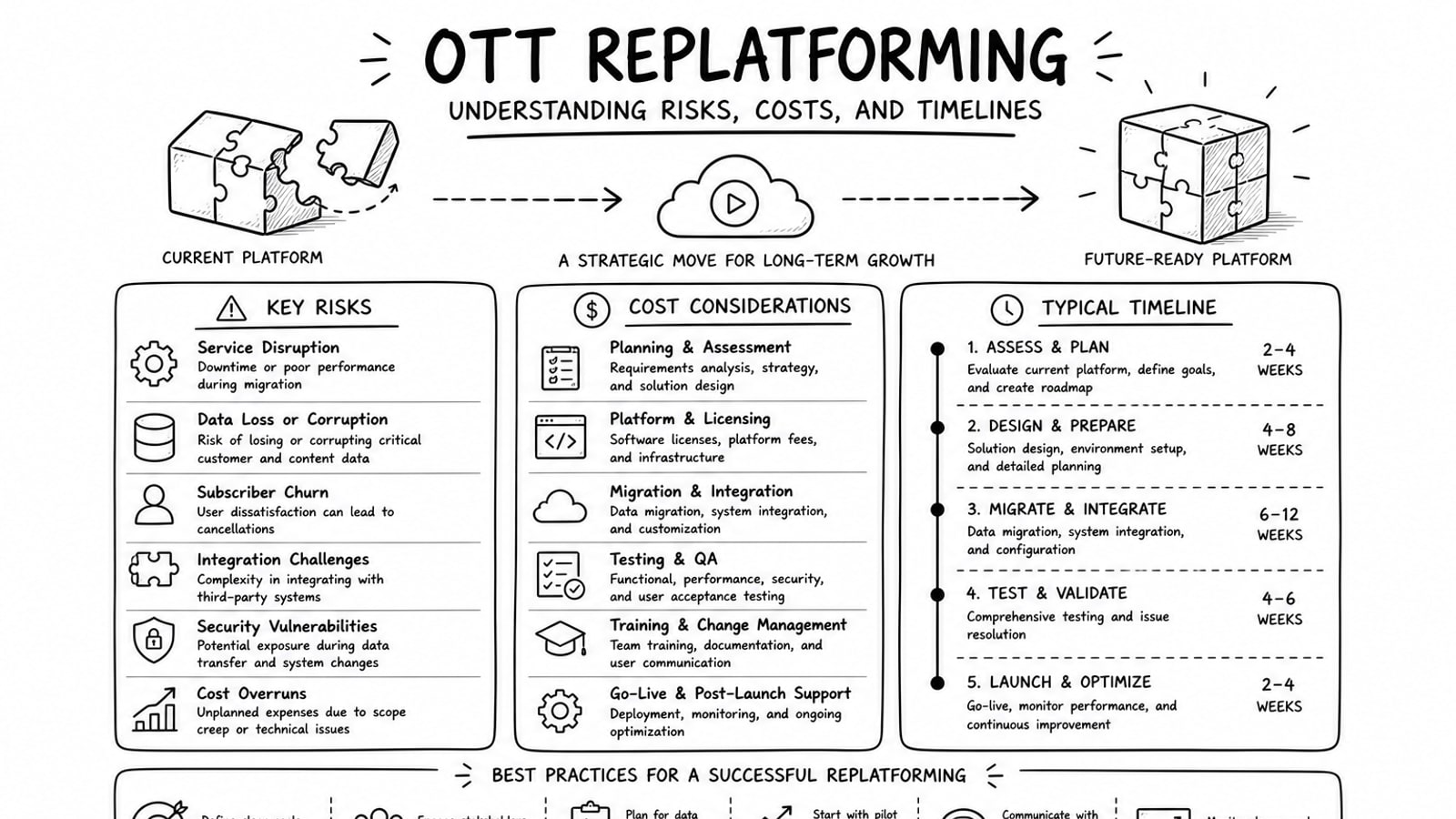
OTT Replatforming: Understanding Risks, Costs, and Timelines
A practical guide to OTT replatforming that explains why teams migrate, what usually drives risk and cost, how long projects tend to take, and where a BYOA delivery model can reduce lock-in.
Read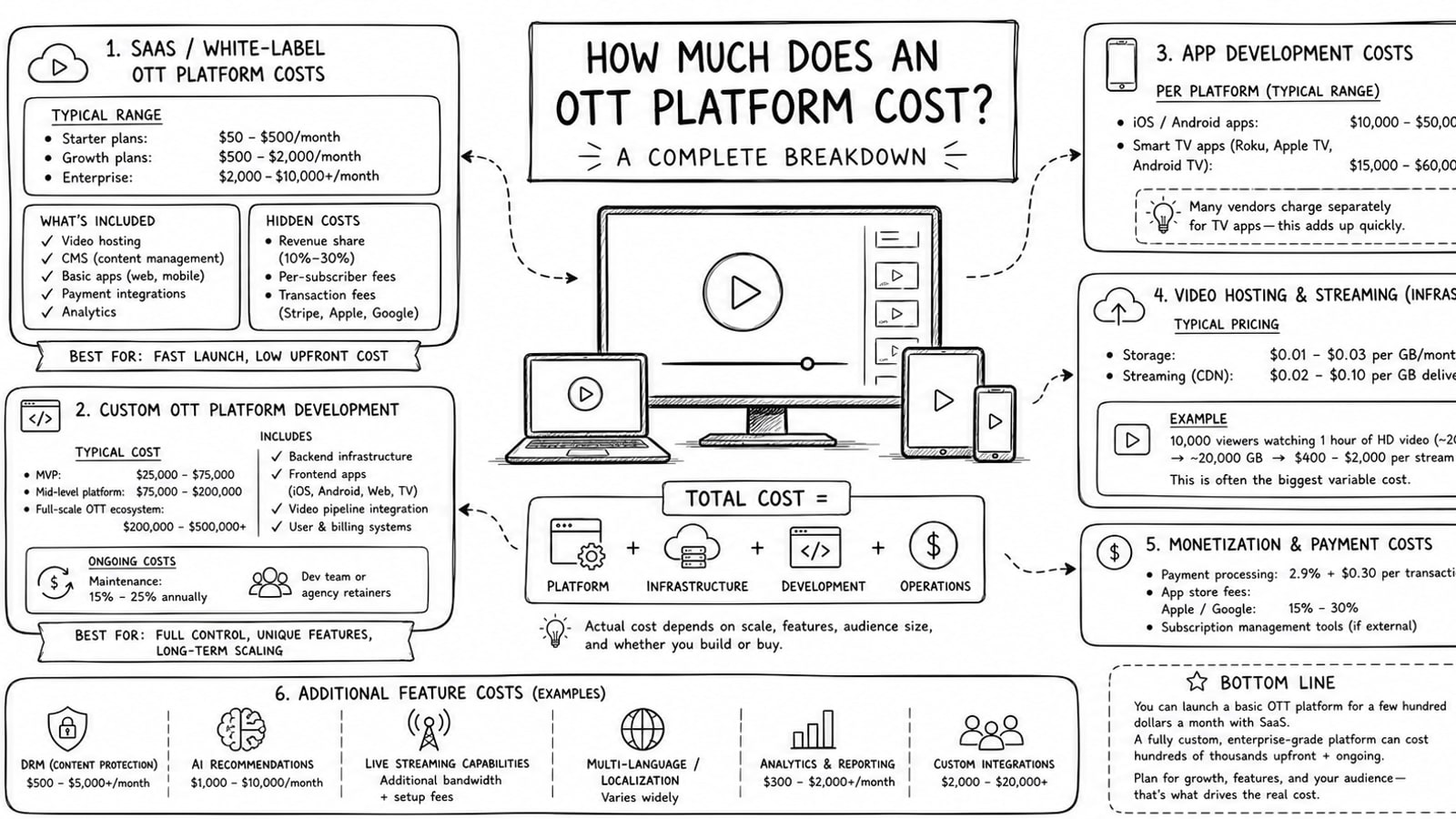
How Much Does an OTT Platform Cost? A Complete Breakdown
A practical breakdown of OTT platform costs, including launch expenses, recurring infrastructure costs, live and on-demand pricing examples, and how a BYOA model can improve cost control.
Read