OTT
How Much Does an OTT Platform Cost? A Complete Breakdown
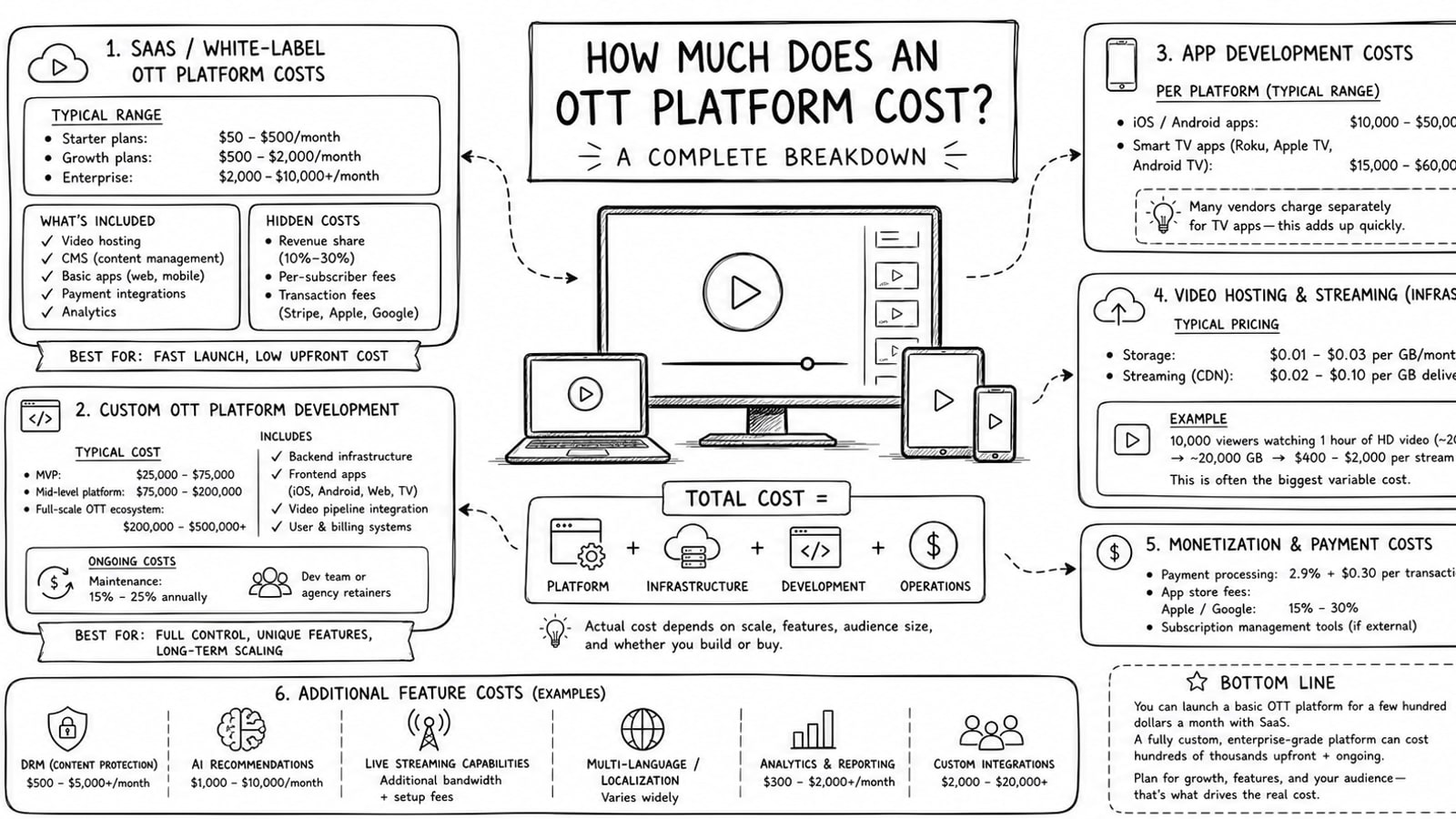
OTT platform cost can range from a lean, few-hundred-dollar monthly stack to a much larger investment once you add custom apps, content operations, live streaming, subscriber billing, and support. The real answer depends less on the label "OTT" and more on what you are actually building: a basic VOD library, a multi-device subscription service, or a live-plus-on-demand media business.
This breakdown explains where the money goes, what costs are one-time versus recurring, and how to estimate a realistic budget without guessing.
Quick Answer
A small OTT launch can stay relatively affordable if you keep scope tight and use pay-as-you-go infrastructure. Costs rise quickly when you need custom mobile and TV apps, DRM, multi-region delivery, recommendation features, analytics, subscriber support, and ongoing release work. In practice, you should think about OTT platform cost in four layers: product build, media infrastructure, distribution, and operations.
Key Takeaways
Your largest one-time cost is usually product and app development, not raw video delivery.
Your largest recurring cost is often video delivery to viewers, especially when watch time grows.
Live OTT economics work differently from on-demand because input, output, and sometimes chat or real-time features are billed separately.
A BYOA model can improve transparency because infrastructure charges stay in the client's own vendor accounts instead of being bundled into an opaque platform bill.
The best OTT budget is a usage model, not a flat guess. Forecast stored minutes, delivered minutes, app count, and support needs before signing anything.
What Drives OTT Platform Cost
Most teams underestimate OTT pricing because they think only about hosting videos. In reality, an OTT platform includes the user-facing product, the video pipeline, content workflows, payments, subscriber management, app distribution, and the people needed to keep it running.
Scope: web only costs less than web plus iOS, Android, Android TV, Apple TV, Roku, and Smart TV apps.
Monetization: subscriptions, rentals, ads, and hybrid models each add workflow and reporting complexity.
Video usage: storage is usually predictable, but viewer delivery can scale fast when watch time grows.
Compliance and protection: DRM, geo-blocking, moderation, and account security all have cost implications.
Operations: support, QA, analytics, release management, and vendor administration continue long after launch.
One-Time Launch Costs
Product, Design, and UX
Before you stream a single video, you need product definition, information architecture, subscription flows, content browsing logic, and a viewing experience that feels stable on every screen. This is usually the first budget bucket and often the most underestimated one.
Frontend Apps
Every additional platform increases development, testing, and maintenance effort. A browser-based MVP is simpler. Native or TV app support raises the budget because each store, device family, and playback environment introduces separate QA and release work.
Backend, CMS, Billing, and Identity
Your OTT stack also needs admin tools, role permissions, content metadata, entitlement logic, coupon or pricing management, authentication, payment workflows, and reporting. Even if the video pipeline is outsourced, these application layers still require engineering and testing.
Launch Preparation
Plan for app store submission work, legal pages, analytics setup, support workflows, release checklists, and post-launch monitoring. These items look small on paper but they tend to be the difference between a clean launch and a messy one.
Recurring Monthly OTT Platform Costs
Recurring OTT platform cost usually comes from infrastructure and operations. This is where usage-based billing matters most.
Video storage, encoding, and delivery: for example, Cloudflare Stream bills by minutes stored and minutes delivered.
Image delivery and transformation: artwork, thumbnails, banners, and creator assets usually need a separate image pipeline.
Object storage and media operations: if you store source files, backups, or image assets in object storage, read and write patterns affect cost.
App store and payment fees: mobile purchases and in-app subscriptions can add platform commissions or payment processing charges.
Support and product maintenance: bug fixes, app updates, observability, moderation, and release work are ongoing costs, not launch-only costs.
A Practical Cost Framework
Base product layer: design, frontend apps, backend, CMS, QA, launch.
Media layer: video ingest, transcoding, storage, streaming delivery, image pipeline.
Commerce layer: subscriptions, coupons, invoicing, tax handling, store commissions, payment processor fees.
Operations layer: monitoring, support, moderation, updates, content operations, vendor management.
Sample OTT Platform Cost Scenarios
The examples below are planning models, not vendor quotes. Infrastructure math uses current public pricing from the cited provider pages, while app, product, and operations budgets should be validated against your actual scope.
Scenario 1: Lean VOD Launch
Assume a small library with 200 videos at 20 minutes each, which equals 4,000 stored minutes. If that library generates 50,000 delivered viewing minutes in a month, the Cloudflare Stream portion would be about $20 for storage and $50 for delivery based on public pricing of $5 per 1,000 stored minutes and $1 per 1,000 delivered minutes.
If the same service also serves 10,000 remote images in two sizes, that creates 20,000 transformations. With Cloudflare Images, the first 5,000 are included and the remaining 15,000 would be billed at $0.50 per 1,000, or about $7.50, plus any underlying storage cost if assets live in R2.
In other words, the raw media infrastructure for a lean VOD launch can stay modest. The larger cost is usually the software product around that media stack.
Scenario 2: Growing Subscription OTT Service
Now assume 20,000 stored video minutes and 2,000,000 delivered viewer minutes per month. Using the same Cloudflare Stream pricing model, that is roughly $100 for stored minutes and $2,000 for delivered minutes before you add product engineering, billing, support, analytics, and marketing tools.
For image-heavy catalogs, Cloudflare Images adds its own usage-based layer. On the paid plan, stored images are billed at $5 per 100,000 images per month and delivered images at $1 per 100,000 per month. That may still be small compared with video delivery, but it should be modeled instead of ignored.
Scenario 3: Live OTT Event
Live economics are different because billing can include both stream input and viewer output. Amazon IVS states that low-latency streaming charges for video input sent to a channel and video output delivered to viewers. Its own pricing example shows a two-hour event with an advanced HD channel and 200 viewers at a total of $12.50 under the example assumptions on the official pricing page.
That kind of pricing structure is why live OTT cost planning should start with average concurrent viewers, watch duration, and target video quality, not just a monthly subscription fee from a platform vendor.
How BYOA Can Change OTT Platform Pricing
One of the biggest pricing decisions is whether your platform provider bundles infrastructure under its own account or lets you use your own vendor accounts. Bitbyte3 describes its OTT offer around a BYOA model, meaning Bring Your Own Account. In that setup, a client can use its own services, such as Cloudflare Stream for video and image delivery, so infrastructure charges stay visible in the client's own account.
That model can be attractive for teams that want cost transparency, direct control over storage and usage, and less concern about hidden media markups. It does not automatically make every project cheaper, but it often makes the cost structure easier to understand and forecast.
Real-World Example Placeholder
[Add a verified Bitbyte3 OTT case study here: launch scope, number of apps, content volume, monthly watch time, and the cost difference between bundled infrastructure and BYOA.]
Common Mistakes That Make OTT Platform Cost Spike
Launching too many device platforms too early.
Buying a flat-fee platform without understanding what usage, storage, or overage costs sit underneath it.
Ignoring image, backup, and source-file storage because video feels like the only meaningful media cost.
Skipping support and release budgets after launch.
Treating app store or payment fees as an afterthought.
Forecasting views, not watch time. In OTT, minutes watched are often the more important unit.
How to Estimate Your OTT Budget Accurately
Define launch scope by platform: web only, web plus mobile, or full TV rollout.
Model content volume: stored minutes, average file sizes, thumbnail counts, and upload frequency.
Model audience usage: expected monthly watch minutes, live event concurrency, and region mix.
Separate one-time build cost from recurring operating cost so you do not compare unlike numbers.
Ask whether your platform vendor uses bundled infrastructure or a BYOA structure.
Validate the forecast against a six-month view, not just month one, because OTT usage patterns tend to change after launch.
Conclusion
If you are asking how much an OTT platform costs, the most honest answer is this: it depends on scope, watch time, and how transparent your infrastructure model is. A simple launch can stay fairly lean, while a multi-device streaming business with live events and subscription operations needs a much fuller budget.
If your priority is cost visibility and control, Bitbyte3's BYOA-style OTT approach may be worth evaluating because it keeps media infrastructure in the client's own account rather than hiding it behind a bundled platform bill. For a serious estimate, map your product scope and usage assumptions first, then price the stack line by line.
FAQ Section
How much does it cost to launch a small OTT platform?
A small OTT platform can start with relatively modest monthly infrastructure costs if the library and watch time are limited, but total launch cost still depends on development scope, app count, payment flows, and support needs.
What is the biggest ongoing OTT expense?
For many services, viewer delivery is the biggest recurring expense because costs increase with watch time and audience size. Support and product maintenance are also significant and often underestimated.
Is OTT platform pricing different for live streaming?
Yes. Live OTT often bills for stream input, viewer output, and sometimes real-time features such as chat or composition. That makes concurrency and quality settings especially important.
What does BYOA mean in OTT?
BYOA means Bring Your Own Account. Instead of consuming media infrastructure through the platform provider's account, the client uses its own account with vendors such as Cloudflare, which can make pricing more transparent.
Do OTT platforms include app store fees?
Not always. Some OTT vendors quote software fees separately from app store commissions or payment processor fees, so you should confirm exactly what is included.
Can I reduce OTT platform cost without reducing quality?
Usually yes. The best levers are tighter scope, phased device rollout, cleaner media workflows, accurate watch-time forecasting, and a transparent infrastructure model.
Methodology / Editorial Note
This article combines product-side cost modeling with current public pricing pages from infrastructure vendors referenced in the sources section. Where exact build pricing depends on scope, the article uses directional planning guidance instead of unsupported fixed quotes. Any Bitbyte3-specific pricing, outcomes, or case study claims should be reviewed and replaced with verified commercial details before publication.
Sources and Further Reading
About the Author
M. Jorani — LinkedIn
Software Engineer & Technical Writer
M. Jorani is a software engineer and technical writer with hands-on experience building streaming infrastructure, video pipelines, and OTT platforms. He writes about encoding, delivery architecture, and the engineering decisions that shape how audiences watch content across devices.
More from the blog
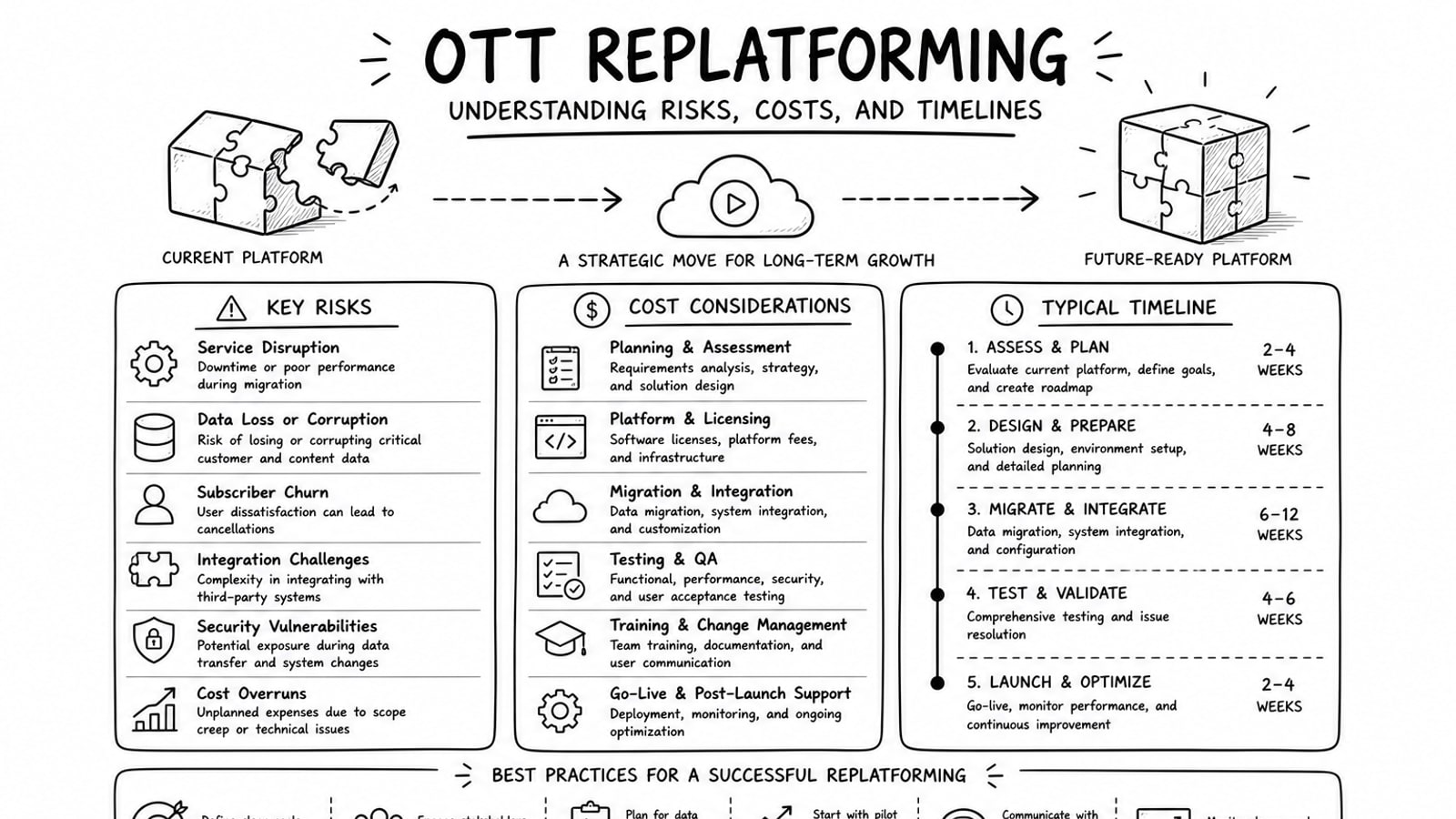
OTT Replatforming: Understanding Risks, Costs, and Timelines
A practical guide to OTT replatforming that explains why teams migrate, what usually drives risk and cost, how long projects tend to take, and where a BYOA delivery model can reduce lock-in.
Read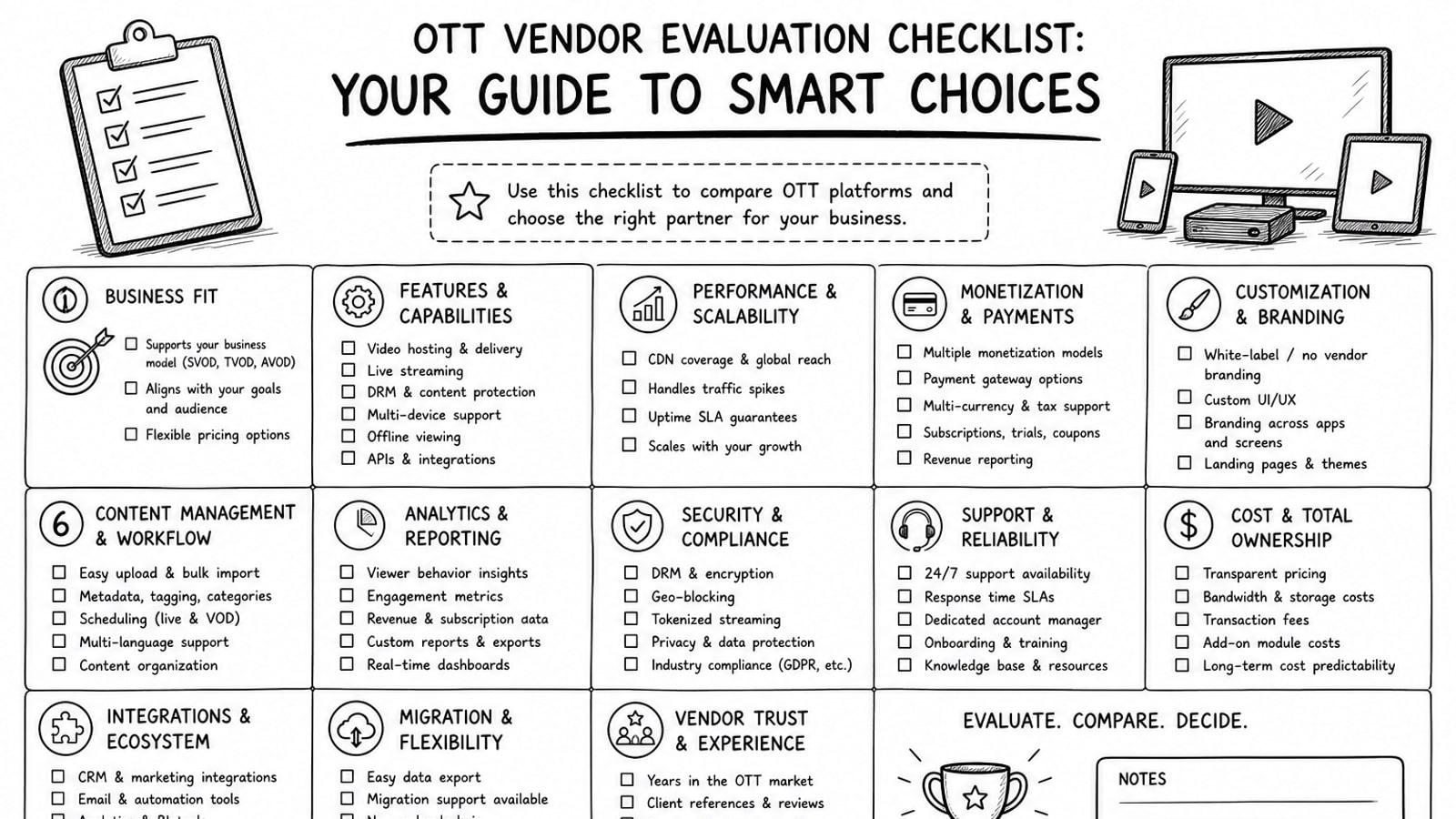
OTT Vendor Evaluation Checklist: Your Guide to Smart Choices
A practical guide to evaluating OTT vendors, with a clear checklist for delivery, security, workflow, cost, ownership, and long-term platform fit.
Read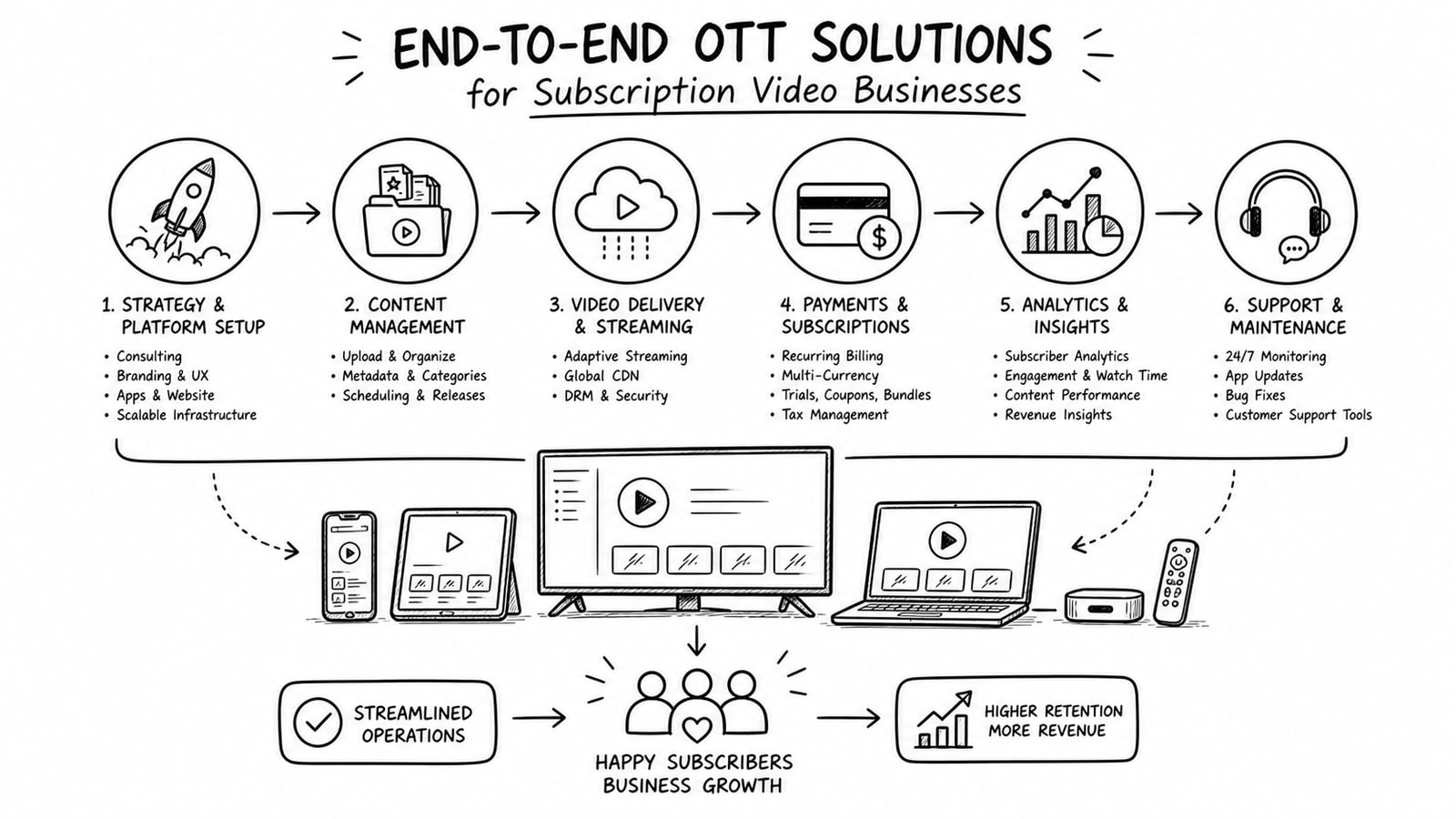
End-to-End OTT Solutions for Subscription Video Businesses: Streamline Your Operations
A practical guide to end-to-end OTT solutions for subscription video businesses, covering the operational layers that reduce complexity and where a bring-your-own-account approach from Bitbyte3 may fit.
Read