OTT
When to Migrate from Vimeo OTT: Key Indicators
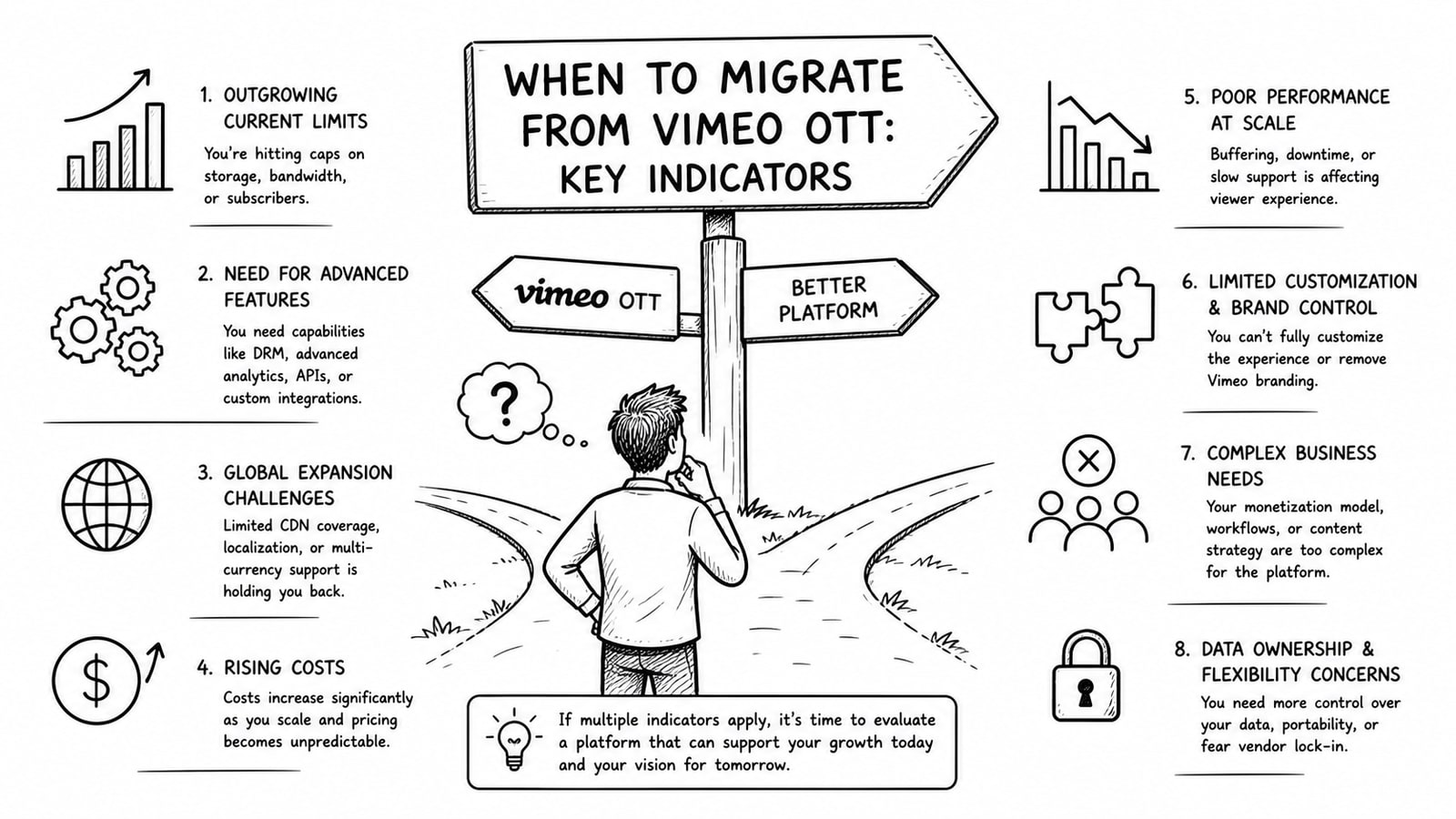
If you are wondering when to migrate from Vimeo OTT, the answer usually comes down to a small group of signals: rising costs, limited control over infrastructure, feature gaps, and a product roadmap that no longer matches your growth plan. A migration is not always urgent, but waiting too long can make costs harder to predict and platform changes harder to absorb.
Quick Answer
You should start planning a Vimeo OTT migration when your platform fees feel harder to justify, your team needs more ownership over apps or media infrastructure, or your audience experience depends on features that are difficult to add within your current setup. The best time to move is usually before these issues become customer-facing problems.
Key Takeaways
Migration timing is usually driven by cost pressure, product limits, or the need for more control.
The earlier you identify the signals, the easier it is to preserve subscribers, content libraries, and app continuity.
A strong migration plan should cover billing, user access, content transfer, app deployment, analytics, and support.
For teams that want lower lock-in, BitByte3 positions its OTT solution around flexible deployment and a bring-your-own-account model for services such as Cloudflare Stream.
Why Teams Start Asking When to Migrate from Vimeo OTT
Vimeo OTT can help creators and media businesses launch subscription or transactional video services quickly. For many teams, that speed is valuable in the early stage. The challenge appears later, when the platform that helped you launch starts to shape your costs, workflows, or product decisions more than you want.
That does not automatically mean you should leave. It means you should assess whether Vimeo OTT still fits your current business model, technical needs, and customer expectations.
Key Indicators It May Be Time to Migrate from Vimeo OTT
1. Your platform costs are rising faster than your revenue
One of the clearest signals is a growing gap between what you pay to operate your OTT product and the value you get from that spend. If fees, revenue share, app-related costs, or add-on requirements are making margins tighter, you may need a model with more predictable economics.
This matters most when your library, subscriber base, or regional reach is expanding, because small cost inefficiencies often become much bigger at scale.
2. You want more control over your infrastructure
Some businesses eventually want direct ownership of the services behind their platform, especially for video delivery, storage, or app publishing. If your team wants to choose the underlying providers and keep those accounts in its own name, that is a serious sign your current setup may be too restrictive.
This is where provider structure matters. BitByte3, for example, promotes an OTT model that can fit teams looking for a bring-your-own-account approach, where each client uses its own account for services such as Cloudflare Stream instead of being tied to a shared vendor account. That can reduce lock-in and make storage or usage costs easier to track.
3. Your roadmap needs features outside the current product boundaries
A migration becomes more likely when your growth plan depends on features that are hard to launch inside your existing platform. That may include deeper CMS flexibility, custom app behavior, payment options, analytics workflows, localization, parental controls, content organization, or a more tailored player experience.
If your roadmap is repeatedly delayed because the platform cannot bend to the product you want to build, the platform is now a bottleneck rather than an accelerator.
4. Your team needs clearer app and account ownership
Ownership becomes more important as a streaming business matures. Teams often start asking who owns the app store accounts, who controls the media pipeline, how quickly changes can be deployed, and what happens if they need to switch vendors later.
If those questions are becoming part of board discussions, partnership conversations, or due diligence, migration planning should probably start now rather than later.
5. Your audience experience is starting to suffer
The strongest reason to move is often not internal. It is customer-facing friction. If users are asking for better navigation, smoother playback flows, more languages, more personalized profiles, improved monetization choices, or better device support, your platform limitations can quickly turn into retention problems.
When audience complaints start repeating, the migration conversation is no longer theoretical. It becomes a growth and retention decision.
6. You are preparing for a larger operational shift
A rebrand, pricing redesign, market expansion, content strategy reset, or app rebuild can be the ideal moment to migrate. These transitions already require coordination across product, content, support, and marketing, which makes it easier to bundle platform change into a single planned rollout.
Waiting until after those initiatives are complete can create duplicated work and a second wave of user disruption.
A Simple Migration Readiness Checklist
You can explain exactly why your current platform no longer fits.
You know which assets must be preserved: subscribers, billing data, content, metadata, apps, and analytics.
You have a replacement platform model that supports your next 12 to 24 months of growth.
You have a communication plan for customers, support, and internal stakeholders.
Comparison Framework: Stay or Migrate?
A practical way to decide is to compare your current state against your next-stage needs. Stay on Vimeo OTT if it still supports your pricing model, app roadmap, and operational structure with acceptable cost visibility. Start migrating if your team needs more control, better economics, or more customization than the platform can reasonably provide.
How to Plan the Migration Without Disrupting Customers
Audit your current setup, including content, subscriber flows, apps, payment dependencies, and support workflows.
Define the non-negotiables for the new platform, especially ownership, cost transparency, and must-have features.
Map customer-impact risks, such as login changes, subscription continuity, playback differences, and app update timing.
Run a staged migration plan with testing before public launch.
Prepare customer communication early so the move feels intentional, not reactive.
Where BitByte3 May Fit
For companies that like the OTT model but want more flexibility, BitByte3 presents itself as a lower-friction alternative focused on web, mobile, and TV streaming deployment. Its public site highlights multi-platform delivery, monetization support, CMS controls, and startup-oriented pricing.
Based on the information provided for this article, BitByte3 can also be positioned for buyers who want a bring-your-own-account setup. In that model, the client uses its own service accounts, such as Cloudflare Stream for video and images, which may help reduce vendor dependency and remove restrictions tied to a provider-managed storage account. Teams considering this route should confirm the exact commercial and technical scope with BitByte3 before committing.
Common Migration Mistakes
Waiting until customers are already feeling the pain.
Focusing only on headline cost instead of ownership, workflow, and long-term flexibility.
Underestimating subscriber migration, app release timing, or support communication.
Assuming every alternative offers the same degree of account ownership or customization.
Methodology and Editorial Note
This article is an informational planning guide, not a legal, financial, or vendor certification document. It is based on publicly available Vimeo OTT help documentation, BitByte3 public pages, and the product positioning provided in the brief. Pricing, feature scope, and migration workflows should be confirmed directly with each vendor before making a platform decision.
FAQ
Is Vimeo OTT still a good fit for some businesses?
Yes. Vimeo OTT can still make sense for teams that want a relatively fast launch path and do not yet need deeper ownership, custom infrastructure decisions, or a broader feature set.
What is the biggest sign it is time to migrate?
The biggest sign is usually a mismatch between your business needs and the platform's limits. That mismatch often shows up in cost pressure, missing features, or the need for more direct control.
Should I migrate only because of price?
Not necessarily. Price matters, but it should be reviewed alongside control, feature fit, customer experience, and the long-term cost of staying on the wrong platform.
What does bring-your-own-account mean in an OTT setup?
It usually means the client owns and manages the third-party service accounts used for parts of the stack, such as video delivery or storage, rather than relying on a vendor-owned shared account.
How early should I start planning a migration?
Start when the warning signs first become visible, not when churn or operational disruption is already happening. Early planning gives you more options and lowers customer risk.
How can I evaluate BitByte3 as an alternative?
Review its current platform features, monetization support, app coverage, CMS flexibility, ownership model, and commercial terms against your migration requirements. Ask for direct confirmation of any bring-your-own-account workflow, app ownership detail, and implementation scope.
Conclusion
The right time to migrate from Vimeo OTT is usually before your costs, limitations, or ownership concerns become visible to customers. If several of the indicators in this guide already apply to your business, now is the right time to compare your options, map the migration risk, and build a platform strategy that matches your next stage of growth.
If your team wants a more flexible OTT setup with more direct account ownership, review your requirements and compare them against solutions such as BitByte3 at https://bitbyte3.com/.
About the Author
R. Jabar
Marketing Strategist
R. Jabar is a marketing strategist who helps streaming and OTT brands turn complex product stories into clear, growth-driven messaging. She writes about audience acquisition, content monetization, and the marketing frameworks that help video platforms scale.
More from the blog
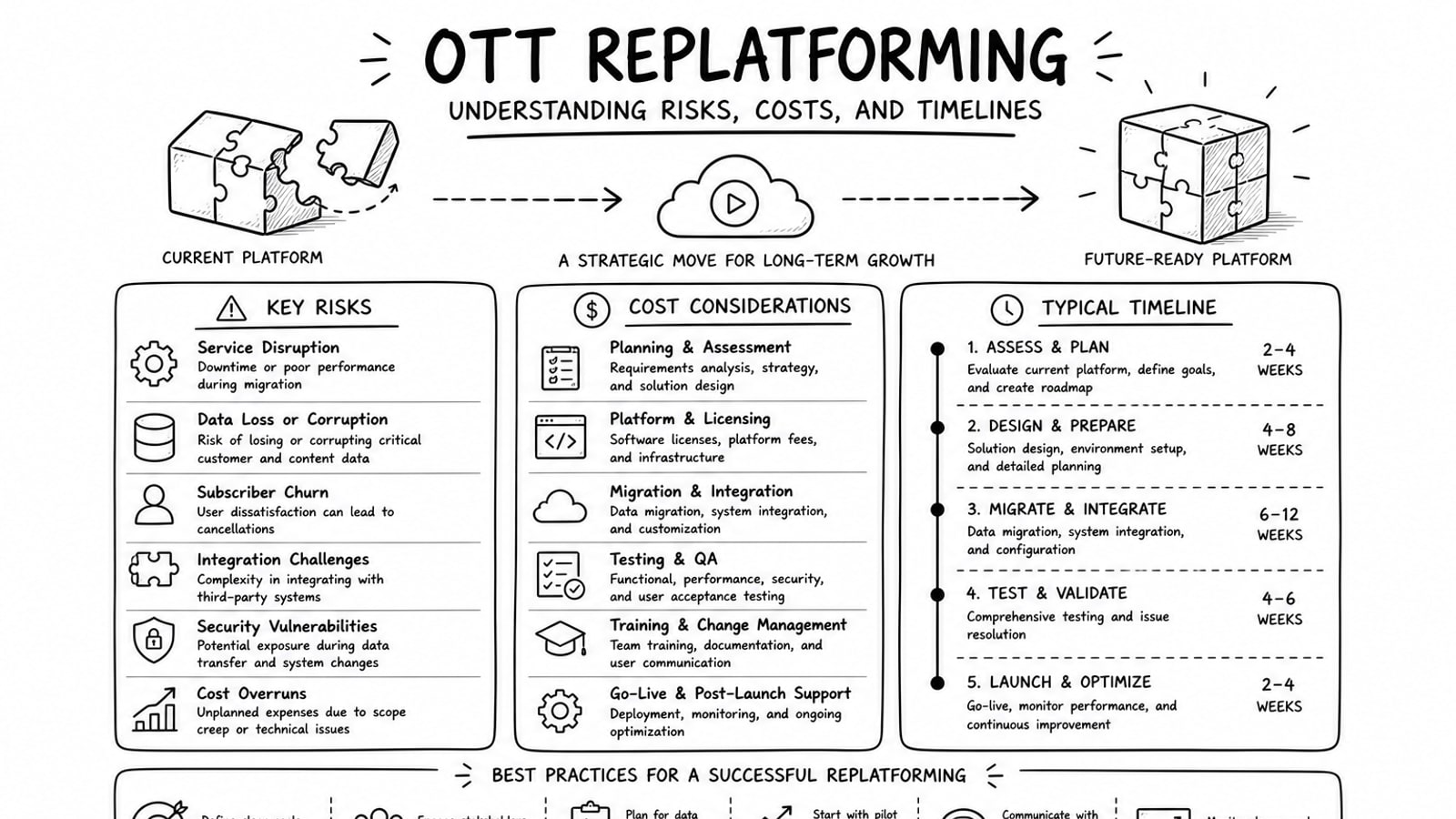
OTT Replatforming: Understanding Risks, Costs, and Timelines
A practical guide to OTT replatforming that explains why teams migrate, what usually drives risk and cost, how long projects tend to take, and where a BYOA delivery model can reduce lock-in.
Read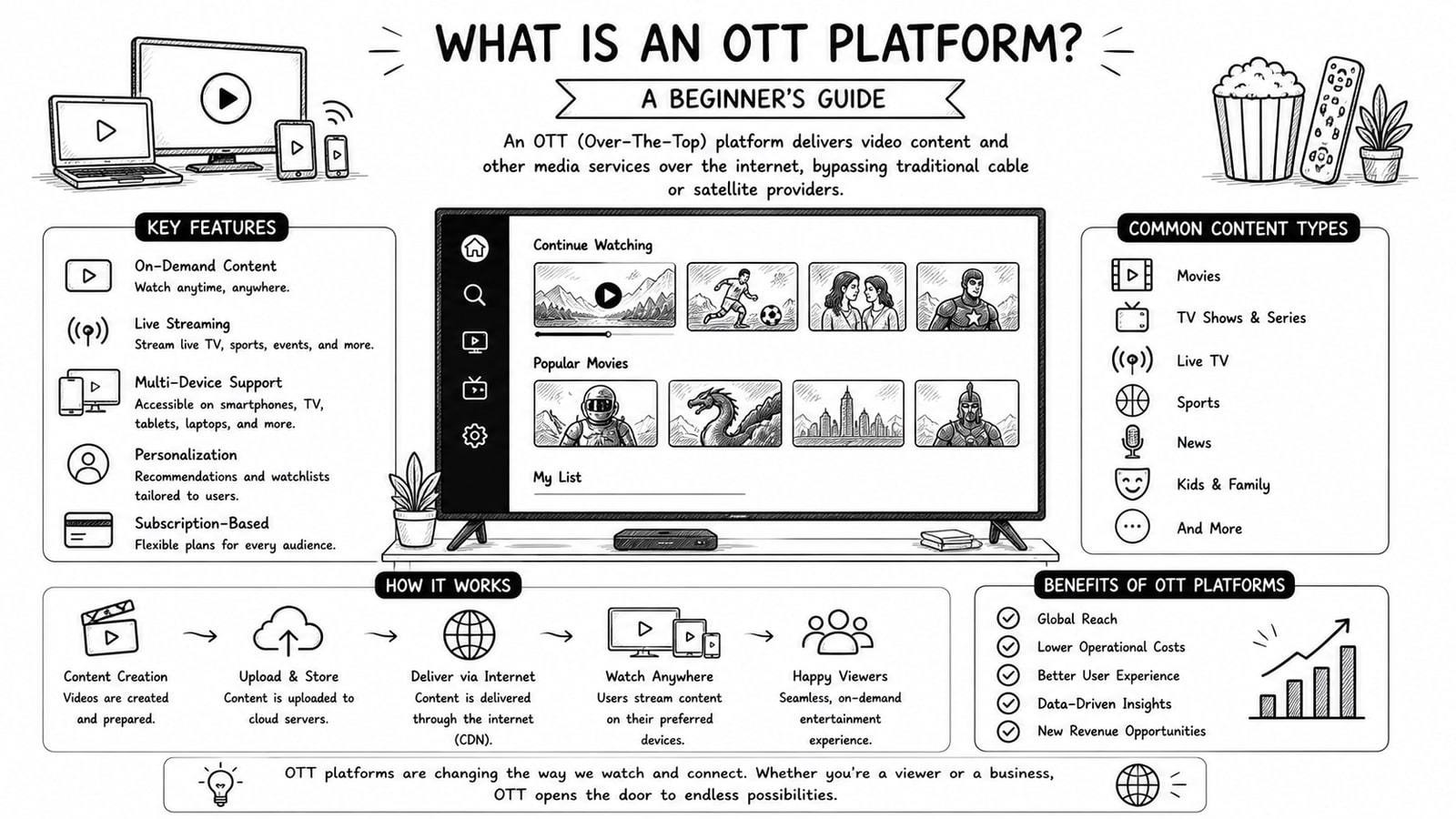
What Is an OTT Platform? A Beginner's Guide
A beginner-friendly guide to OTT platforms, how they work, key components, business models, and what to evaluate before choosing a solution.
Read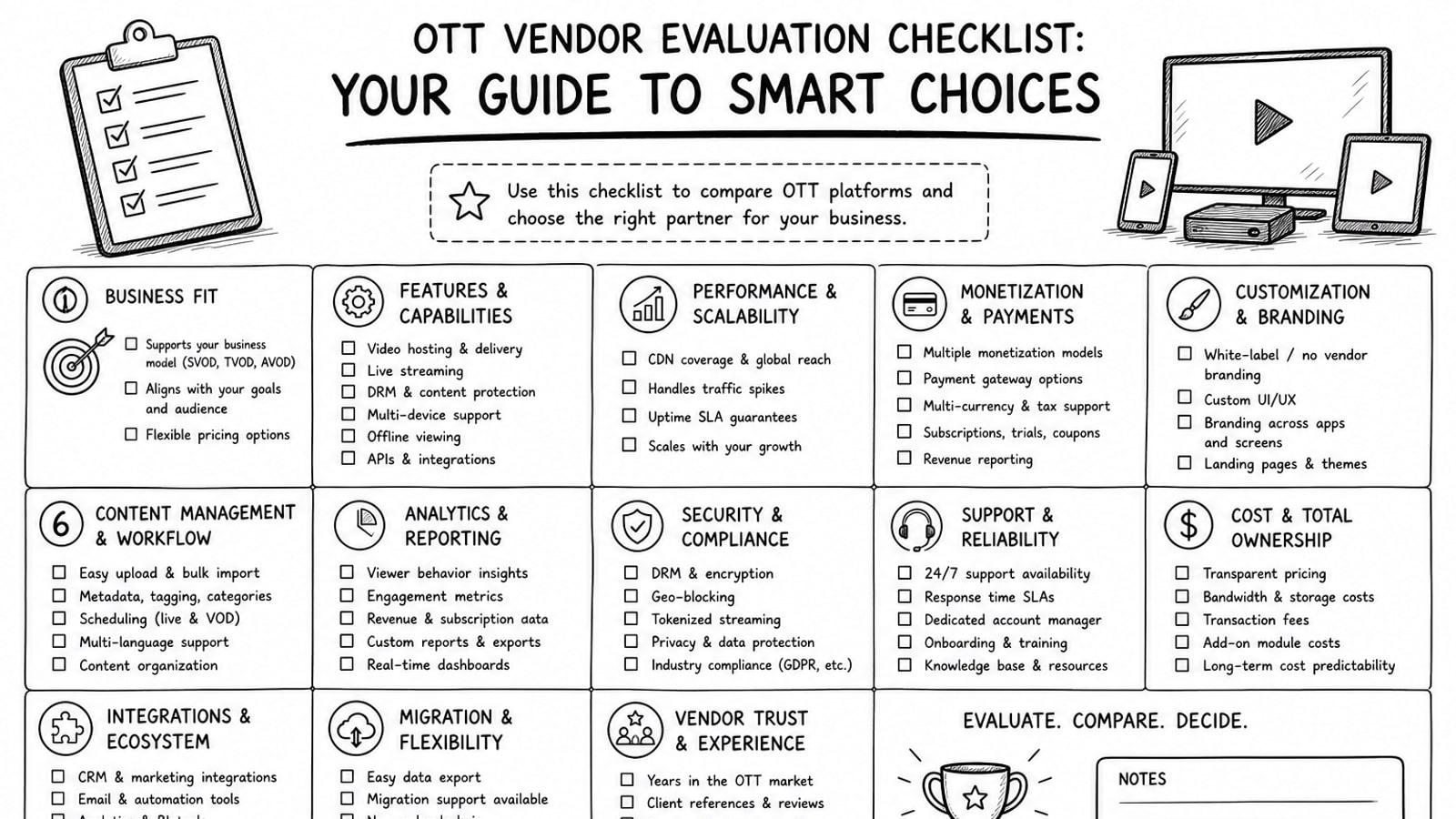
OTT Vendor Evaluation Checklist: Your Guide to Smart Choices
A practical guide to evaluating OTT vendors, with a clear checklist for delivery, security, workflow, cost, ownership, and long-term platform fit.
Read