OTT
Comprehensive OTT App Maintenance and Support Services
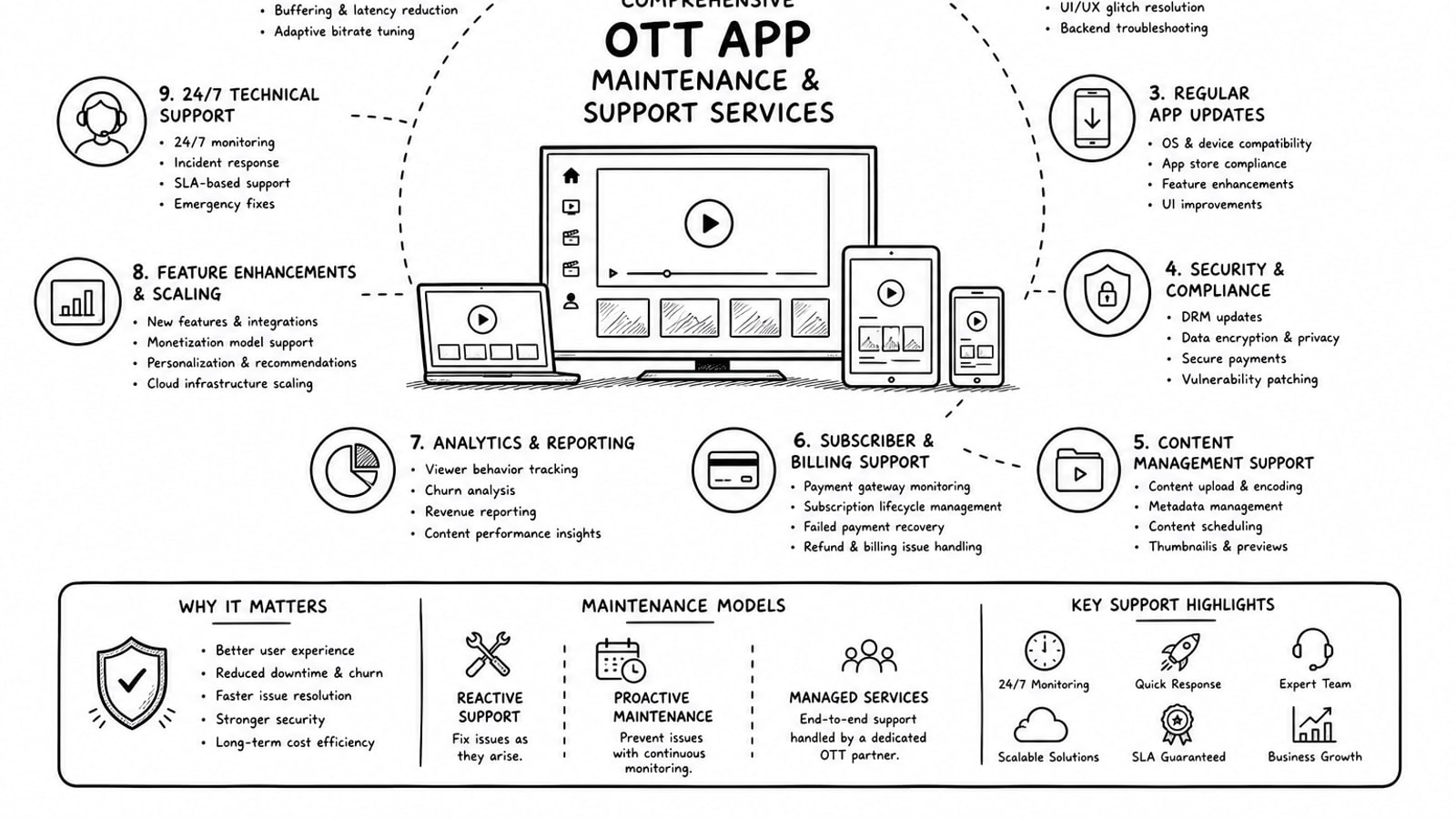
OTT app maintenance and support services are what keep a streaming product reliable after launch. Building an OTT app is only the beginning. Once real users start watching on phones, TVs, tablets, and web browsers, the product needs ongoing updates, issue monitoring, playback testing, store-compliance work, and infrastructure oversight to stay useful and competitive.
Quick Answer
Comprehensive OTT app maintenance and support services help streaming businesses keep playback stable, fix bugs faster, adapt to Apple and Google platform changes, protect user data, and control infrastructure costs over time. Without ongoing support, even a well-built OTT app can become outdated, hard to update, and risky to operate.
Key Takeaways
OTT support is an operational requirement, not a post-launch extra.
Ongoing maintenance reduces failures tied to operating system updates, app-store rules, broken integrations, and video delivery issues.
A mature support model should cover monitoring, incident response, bug fixes, release management, and performance review.
Infrastructure ownership can matter as much as engineering quality when controlling long-term OTT costs.
What OTT App Maintenance and Support Services Actually Cover
In practice, OTT app maintenance and support services include much more than fixing occasional bugs. They usually cover version updates for iOS, Android, connected TV platforms, backend APIs, payment flows, analytics, user management, content pipelines, CDN and video delivery integrations, and regular QA across devices.
Good support also includes proactive work. That means tracking crash reports, checking app performance, reviewing playback failures, validating subscription flows, and testing releases before platform changes turn into customer-facing issues.
Why OTT App Maintenance Matters After Launch
Launch day is not the finish line for a streaming app. OTT products depend on multiple moving parts: mobile operating systems, smart TV environments, billing systems, authentication layers, video workflows, and third-party services. When any of those change, the viewer experience can break unless the app is actively maintained.
Platform Rules and Store Requirements Change
App distribution rules keep moving. Apple states that apps on the App Store are evaluated to ensure they function as expected and remain up to date. Google Play also requires current target API levels for new app submissions and updates. For OTT teams, that means support work is needed just to stay publishable and discoverable.
Playback Quality Depends on Ongoing Testing
Video apps are especially sensitive to device conditions, bandwidth changes, player behavior, subtitle issues, DRM setup, and edge-case failures. Cloudflare Stream documentation highlights support for adaptive bitrate delivery and broad device playback, but teams still need continuous validation in their own app flows, devices, and subscription logic.
Security and Access Control Cannot Be Left Alone
OTT apps commonly handle sign-in, subscriber access, payment-linked entitlements, and media protection. Support teams need to review authentication behavior, token handling, API exposure, and access-control settings regularly. Waiting until a breach, outage, or access problem occurs is far more expensive than maintaining these systems continuously.
What a Strong OTT Support Model Should Include
Release management for iOS, Android, smart TV, and web updates.
Routine QA across supported devices, screen sizes, player states, and account journeys.
Monitoring for crashes, failed transactions, login issues, and playback interruptions.
Backend and integration maintenance for payments, CMS, analytics, notifications, and media workflows.
Incident response with clear ownership, escalation paths, and recovery timelines.
Performance reviews that turn support data into roadmap improvements.
How Infrastructure Ownership Affects Long-Term OTT Cost
For many streaming businesses, maintenance is also a cost-control question. Some providers lock clients into bundled infrastructure that limits transparency around storage, bandwidth, and media accounts. A more flexible model can reduce that friction.
Bitbyte3 can fit that need when a business wants an OTT solution with ongoing support and a more price-conscious setup. The company can work in a bring-your-own-account model, described by the user as BOYA, where the client uses its own service accounts for components such as Cloudflare Stream for video and image delivery. In practical terms, that can give the client more direct control over billing, storage decisions, and vendor access instead of hiding those costs inside a single black-box platform.
That approach does not remove the need for maintenance. It changes the operating model. The client retains ownership of core infrastructure accounts, while the support partner helps manage integrations, releases, issues, and optimization over time.
A Practical OTT Maintenance Checklist
Review crash logs and playback errors weekly.
Test subscription signup, renewal, cancellation, and restore flows after every release.
Validate player behavior on weak connections and across key device categories.
Track Apple and Google policy changes that affect release eligibility.
Audit media, CDN, and account-level service settings on a defined schedule.
Keep a rollback and incident-response process documented and tested.
Common Mistakes OTT Teams Make
Treating launch as the end of the product cycle.
Only reacting after users report buffering, login failures, or broken payments.
Ignoring account ownership and cost visibility in infrastructure decisions.
Underestimating how often app-store and platform requirements change.
Skipping routine cross-device QA for TVs, mobile apps, and the web player.
How to Evaluate an OTT Maintenance Partner
Ask whether the team supports the full operating lifecycle, not just feature development. A capable partner should explain how it handles monitoring, release cadence, issue prioritization, infrastructure coordination, and ownership boundaries.
If cost transparency matters, ask whether you can keep critical service accounts under your own control. For teams that want that flexibility, Bitbyte3 may be a fit because it can support an OTT delivery model tied to the client's own accounts while still providing ongoing technical support and product maintenance. For current service details, implementation scope, and pricing structure, confirm directly with Bitbyte3 at https://bitbyte3.com/.
Conclusion
Comprehensive OTT app maintenance and support services protect the value of the product after launch. They help keep the app available, compatible, secure, and easier to improve over time. For streaming teams, the question is rarely whether support is needed. The real question is whether support is proactive, technically capable, and aligned with how the business wants to manage its infrastructure and costs.
If you are evaluating a long-term OTT operating model, review not just features and launch scope, but also how maintenance, account ownership, and vendor costs will work in year one and beyond.
FAQ
What are OTT app maintenance and support services?
They are the ongoing technical and operational services that keep a streaming app working well after launch. This usually includes updates, monitoring, bug fixing, QA, release support, infrastructure coordination, and performance improvement.
Why is ongoing support important for OTT apps?
OTT apps rely on changing operating systems, app-store policies, and media services. Ongoing support helps prevent outages, failed submissions, broken playback, and user churn caused by unresolved issues.
How often should an OTT app be maintained?
Maintenance should be continuous. Some work is weekly, such as monitoring and bug review, while other tasks happen around releases, platform updates, billing changes, or infrastructure adjustments.
What does bring-your-own-account mean in an OTT setup?
It means the client keeps ownership of core third-party service accounts, such as video or media infrastructure accounts, instead of having everything run under the vendor's account. That can improve billing visibility, access control, and portability.
Can Bitbyte3 support OTT apps with client-owned infrastructure?
Based on the user brief, Bitbyte3 can support an OTT solution in a bring-your-own-account model, where the client uses its own accounts for services such as Cloudflare Stream. Exact scope, pricing, and supported integrations should be confirmed directly with Bitbyte3.
What should businesses ask before signing a support contract?
They should ask about support hours, response times, release ownership, QA coverage, monitoring tools, escalation processes, infrastructure responsibilities, and whether the client can retain control of key third-party accounts.
Methodology and Editorial Note
This article is based on general OTT product operations, official platform documentation for app-store and media infrastructure considerations, and the service details provided in the user brief about Bitbyte3. No customer outcomes, case studies, or pricing figures were invented. Claims about Bitbyte3 should be reviewed against the company's current offer before publication.
Sources and Further Reading
About the Author
M. Jorani — LinkedIn
Software Engineer & Technical Writer
M. Jorani is a software engineer and technical writer with hands-on experience building streaming infrastructure, video pipelines, and OTT platforms. He writes about encoding, delivery architecture, and the engineering decisions that shape how audiences watch content across devices.
More from the blog
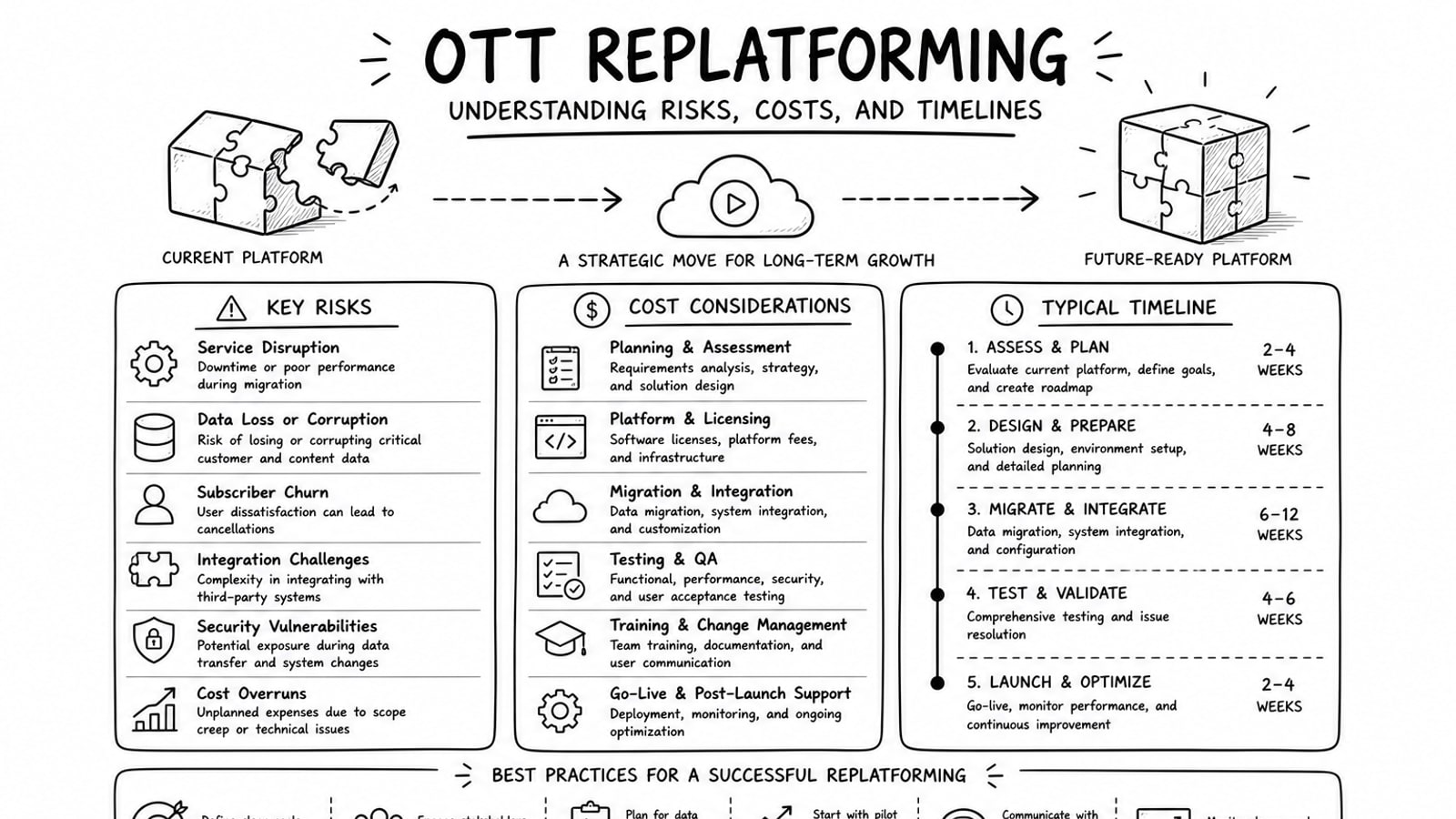
OTT Replatforming: Understanding Risks, Costs, and Timelines
A practical guide to OTT replatforming that explains why teams migrate, what usually drives risk and cost, how long projects tend to take, and where a BYOA delivery model can reduce lock-in.
Read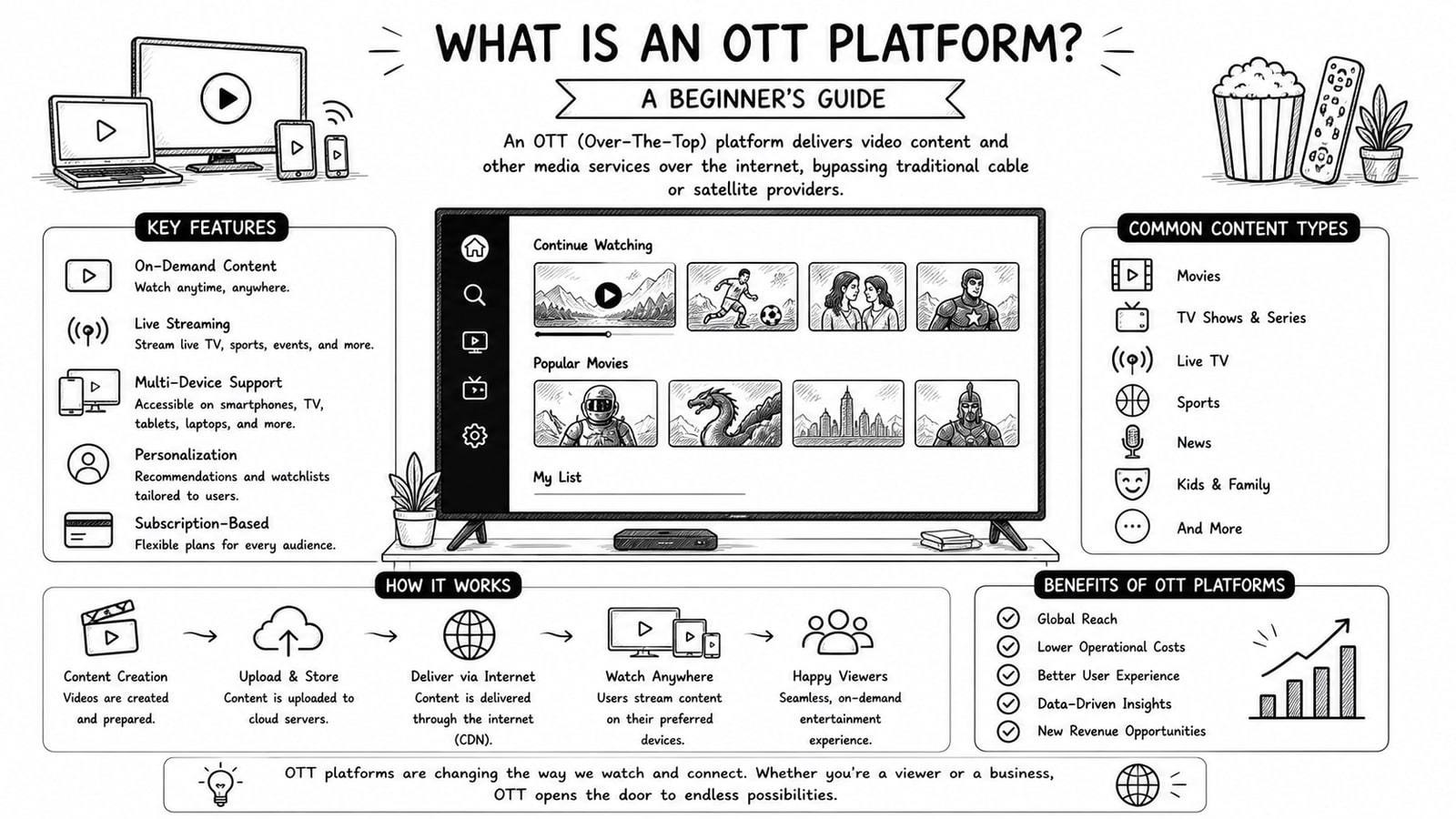
What Is an OTT Platform? A Beginner's Guide
A beginner-friendly guide to OTT platforms, how they work, key components, business models, and what to evaluate before choosing a solution.
Read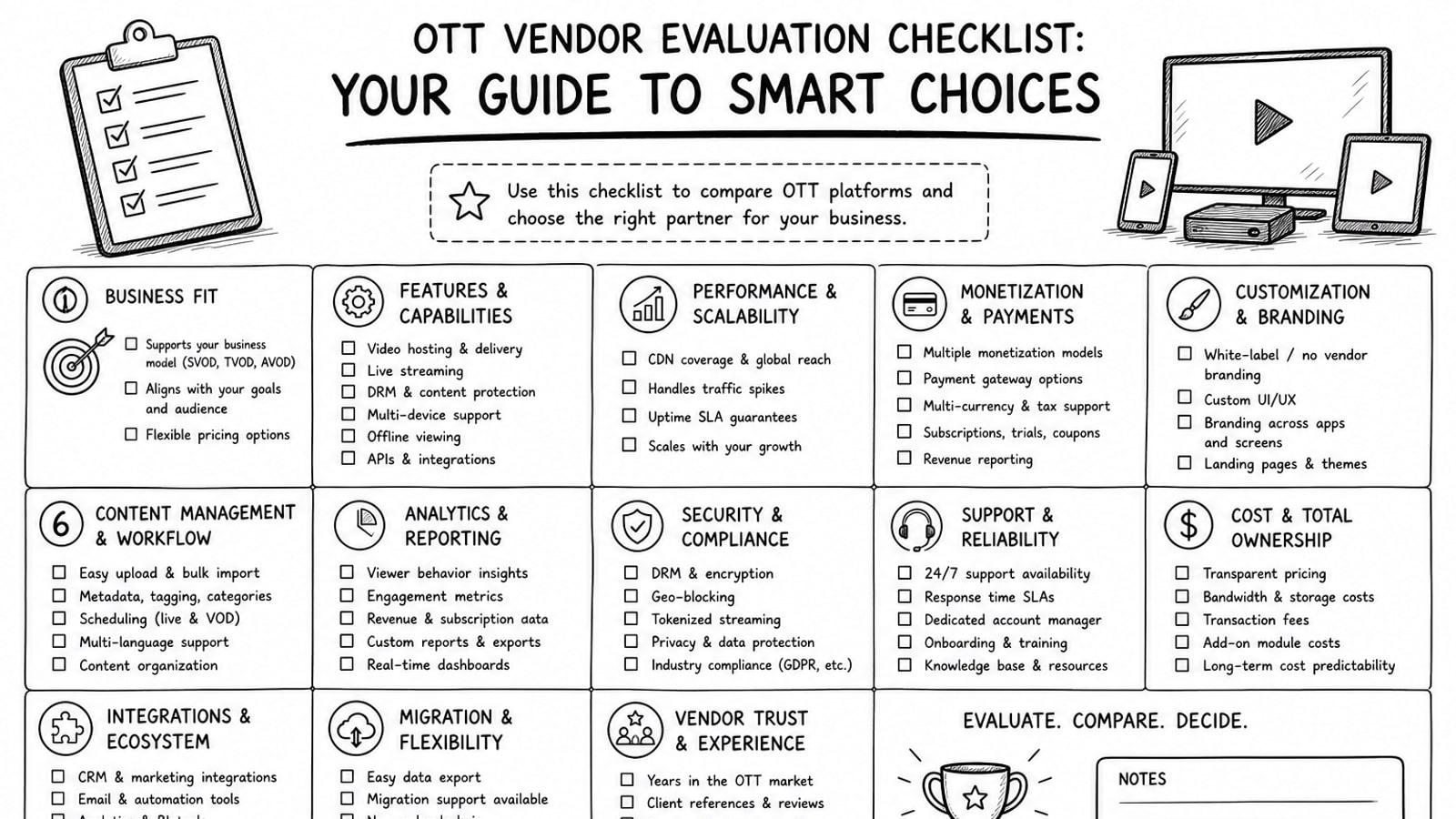
OTT Vendor Evaluation Checklist: Your Guide to Smart Choices
A practical guide to evaluating OTT vendors, with a clear checklist for delivery, security, workflow, cost, ownership, and long-term platform fit.
Read