OTT
Top Features to Prioritize in an OTT Platform
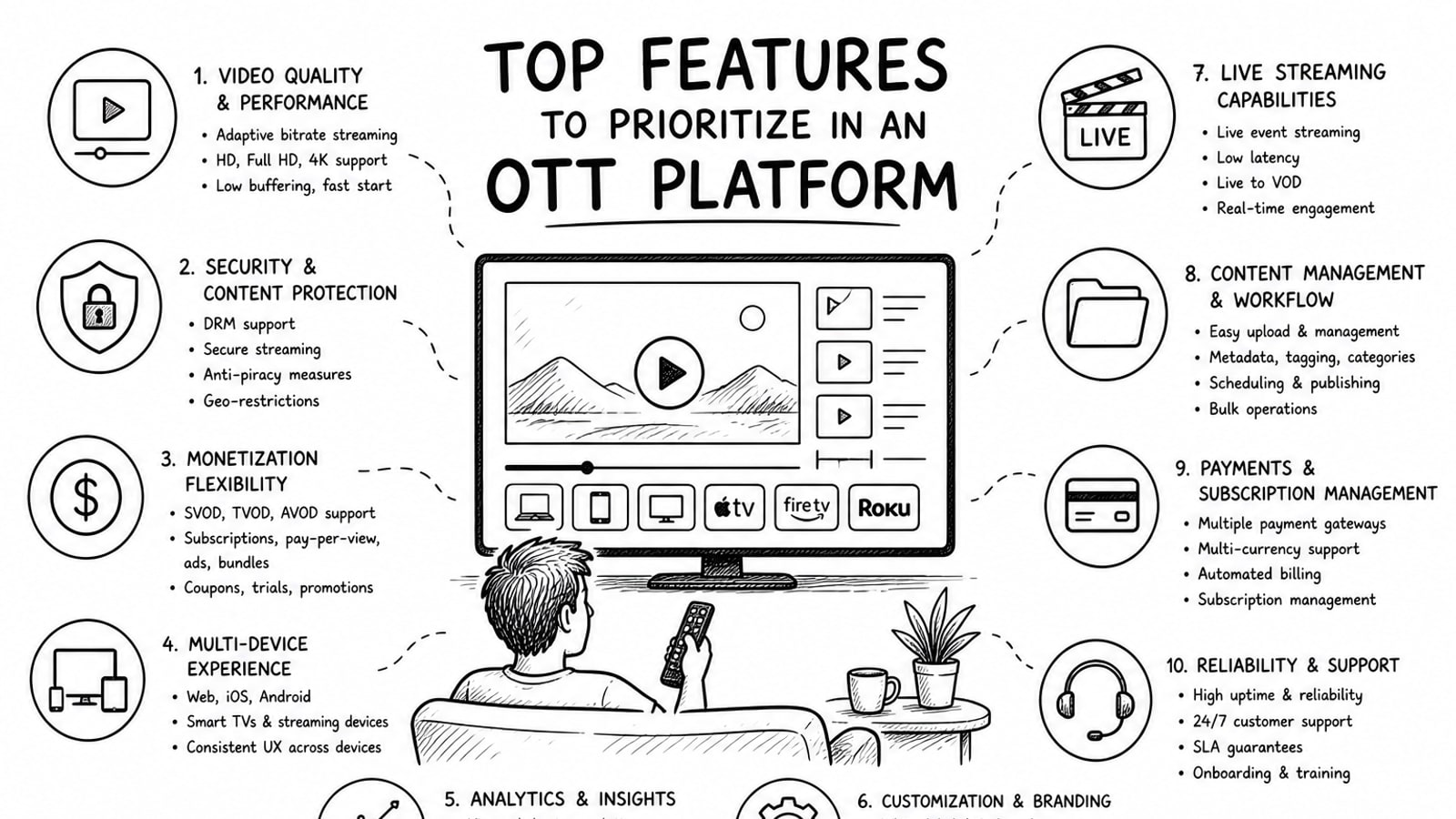
Choosing the right OTT platform features is less about chasing the longest feature list and more about deciding what improves viewer experience, supports your business model, and keeps operations manageable as you grow. If you are comparing vendors or planning a custom build, the strongest starting point is to prioritize the OTT platform features that affect playback reliability, content workflows, monetization, analytics, security, and long-term flexibility.
Quick Answer
The top OTT platform features to prioritize are adaptive streaming, a usable content management workflow, flexible monetization, strong access control, cross-platform app support, analytics, and integrations. Prioritize them in that order if your goal is to launch reliably, learn from real audience behavior, and scale without rebuilding core systems too early.
Key Takeaways
Playback quality and reliability should come before cosmetic features.
Your business model matters: subscription, ad-supported, pay-per-view, and hybrid services need different platform capabilities.
Analytics are not a nice-to-have. They shape retention, content decisions, and monetization strategy.
Infrastructure flexibility can become a major financial and operational advantage for OTT businesses with steady growth.
A good prioritization framework helps teams avoid overspending on low-impact features during early phases.
What Feature Prioritization Means in OTT
OTT platform prioritization is the process of deciding which capabilities directly support launch readiness, audience satisfaction, and business outcomes. In practice, that means separating features that are essential for delivery from features that are convenient but not immediately valuable.
For example, launching with weak playback, limited access control, or poor content workflows will usually create larger business problems than launching without advanced recommendation logic or niche interface customizations. The right sequence matters as much as the features themselves.
Top OTT Platform Features to Prioritize First
1. Adaptive Streaming and Playback Reliability
Reliable playback is the foundation of every OTT service. If viewers cannot start a video quickly or if playback stalls across weak or changing connections, engagement drops fast. Support for adaptive bitrate delivery, modern streaming workflows, and broad device compatibility should sit at the top of the list.
In practical terms, this means evaluating whether the platform can deliver on-demand and live content smoothly across mobile, web, smart TV, and set-top environments. It also means looking at how the platform handles transcoding, playback starts, and stream resilience under real traffic.
2. Content Management and Publishing Workflow
A strong OTT platform is not only a player. It should help teams ingest, organize, schedule, update, and retire content without creating manual chaos. Metadata handling, asset organization, thumbnail management, categorization, release scheduling, and localization workflows can quickly become bottlenecks if they are treated as secondary.
If your team expects a growing library, this area deserves early attention. A weak content workflow often slows operations long before audience growth exposes issues elsewhere.
3. Monetization Flexibility
The best monetization setup depends on your business model, but the platform should not trap you in one. Many OTT services need some mix of subscription access, transactional purchases, bundles, promotions, ad-supported viewing, or partner offers over time.
Prioritize platforms that can support your current model while leaving room for change. If your monetization strategy evolves faster than your platform can adapt, growth gets delayed by product limitations rather than market demand.
4. Access Control, Security, and Entitlements
Paid or restricted content needs clear access rules. At a minimum, you should evaluate signed URLs or token-based playback controls, user authentication, entitlement logic, session handling, and role-based administration. Security is not only about content protection. It also affects account trust and operational risk.
This is especially important for services with premium content, regional access rules, or multiple membership tiers. Weak entitlement design tends to create leakage, support issues, and unnecessary friction.
5. Cross-Platform App Support
Audience reach depends on devices, not only on content. Web and mobile support may be enough for an early launch, but many OTT businesses eventually need smart TV and living-room distribution. The platform should make that expansion feasible without a complete rebuild.
Prioritize feature parity where it affects core behavior such as login, playback, billing, watchlists, and resume-play. A fragmented experience across devices can reduce retention even when content is strong.
6. Search, Discovery, and Navigation
Viewers stay longer when they can easily find what to watch next. Good discovery starts with strong metadata and navigation, then expands into collections, filters, search relevance, continue-watching rows, and recommendation logic.
This does not always need advanced AI at launch. For many services, better categorization, cleaner navigation, and relevant editorial rails create more value than complex personalization systems introduced too early.
7. Analytics and Reporting
Analytics should influence nearly every decision you make after launch. You need visibility into playback quality, completion rates, churn signals, content performance, acquisition sources, subscription behavior, and device usage.
If a platform cannot show what people watch, where they stop, which devices underperform, or which offers convert, you are making roadmap and revenue decisions with limited evidence.
8. Integrations and Long-Term Flexibility
Most OTT businesses do not operate in isolation. They need integrations with payment systems, analytics tools, CRMs, marketing platforms, support tools, CDNs, video pipelines, and internal data stacks. Prioritizing integration readiness early helps prevent costly migration work later.
This is also where architecture choices matter. Some teams want an all-in-one system. Others prefer a more modular setup that gives them more control over costs and infrastructure over time.
A Simple Framework for OTT Platform Prioritization
A useful decision-making framework is to score each feature area against four questions: does it protect playback quality, does it support revenue, does it reduce operational friction, and does it increase future flexibility. Features that score high across several of these categories usually belong in phase one.
List the features your team wants, without filtering.
Group them into viewer experience, business model, operations, and architecture.
Mark which features are required for launch, which improve retention, and which can wait until phase two.
Estimate effort, cost impact, and dependency risk for each item.
Build phase one around the smallest set of features that creates a stable, measurable viewer experience.
When a BYOA Model Can Make Sense
For some OTT businesses, infrastructure control is itself a feature priority. Bitbyte3 offers an OTT solution that can fit teams looking for this kind of flexibility, including a Bring Your Own Account model. In that setup, the client uses its own service accounts for media tooling such as Cloudflare Stream, rather than being fully locked into a vendor-owned storage and delivery layer.
That model can help when you want direct visibility into media usage, ownership of the underlying account relationship, and more control over how storage and delivery are billed. Whether it is a better financial fit depends on your usage pattern, provider pricing, and operating preferences, but it is a useful option to evaluate if avoiding bundled infrastructure markups matters to your business.
Common Mistakes Teams Make
Overvaluing design extras while underestimating playback and workflow issues.
Choosing a platform around today's monetization model with no room for change.
Ignoring analytics until after launch.
Treating infrastructure ownership and cost transparency as technical details instead of strategic decisions.
Underestimating how much device support affects retention and support overhead.
Methodology and Editorial Trust Note
This article is written as a practical decision-making guide, not a claim that one feature stack fits every OTT business. Recommendations are based on common streaming product requirements, official streaming protocol documentation, and current platform documentation from infrastructure providers. Where pricing or architecture fit is mentioned, readers should validate against their own traffic patterns, product roadmap, and provider terms.
Conclusion
The best OTT platform features are the ones that help you launch with confidence and grow without unnecessary rework. Start with playback quality, content operations, monetization, access control, device support, and analytics. Then evaluate infrastructure flexibility and integrations based on your actual growth path. If you are comparing approaches and want more control over the underlying media stack, Bitbyte3 is one option to review, especially if a Bring Your Own Account model matches your operational and cost goals.
FAQ
What are the most important OTT platform features at launch?
At launch, the most important features are reliable playback, content management, user access control, monetization support, analytics, and support for the devices your audience already uses.
Why is adaptive streaming so important for OTT?
Adaptive streaming improves playback across changing network conditions by serving different quality levels based on available bandwidth. That helps reduce buffering and keeps the viewing experience more stable.
Should OTT platforms prioritize monetization or user experience first?
User experience should come first, because monetization depends on people actually watching and returning. In practice, teams should design both together, but playback reliability and access flow should not be compromised for monetization complexity.
What does Bring Your Own Account mean in an OTT setup?
Bring Your Own Account means the client uses its own third-party infrastructure or service accounts, such as a media delivery account, instead of relying entirely on a vendor-managed account layer. This can improve control, transparency, and account ownership.
How do analytics affect OTT platform decisions?
Analytics help teams understand what viewers watch, where playback fails, which devices matter most, and which commercial offers convert. That makes analytics essential for both roadmap decisions and revenue optimization.
How should teams prioritize OTT platform features when budgets are limited?
Limited budgets call for a phased approach. Start with the smallest feature set that supports reliable playback, a clear content workflow, secure access, a workable business model, and measurement. Advanced personalization and lower-impact extras can follow later.
About the Author
M. Jorani — LinkedIn
Software Engineer & Technical Writer
M. Jorani is a software engineer and technical writer with hands-on experience building streaming infrastructure, video pipelines, and OTT platforms. He writes about encoding, delivery architecture, and the engineering decisions that shape how audiences watch content across devices.
More from the blog
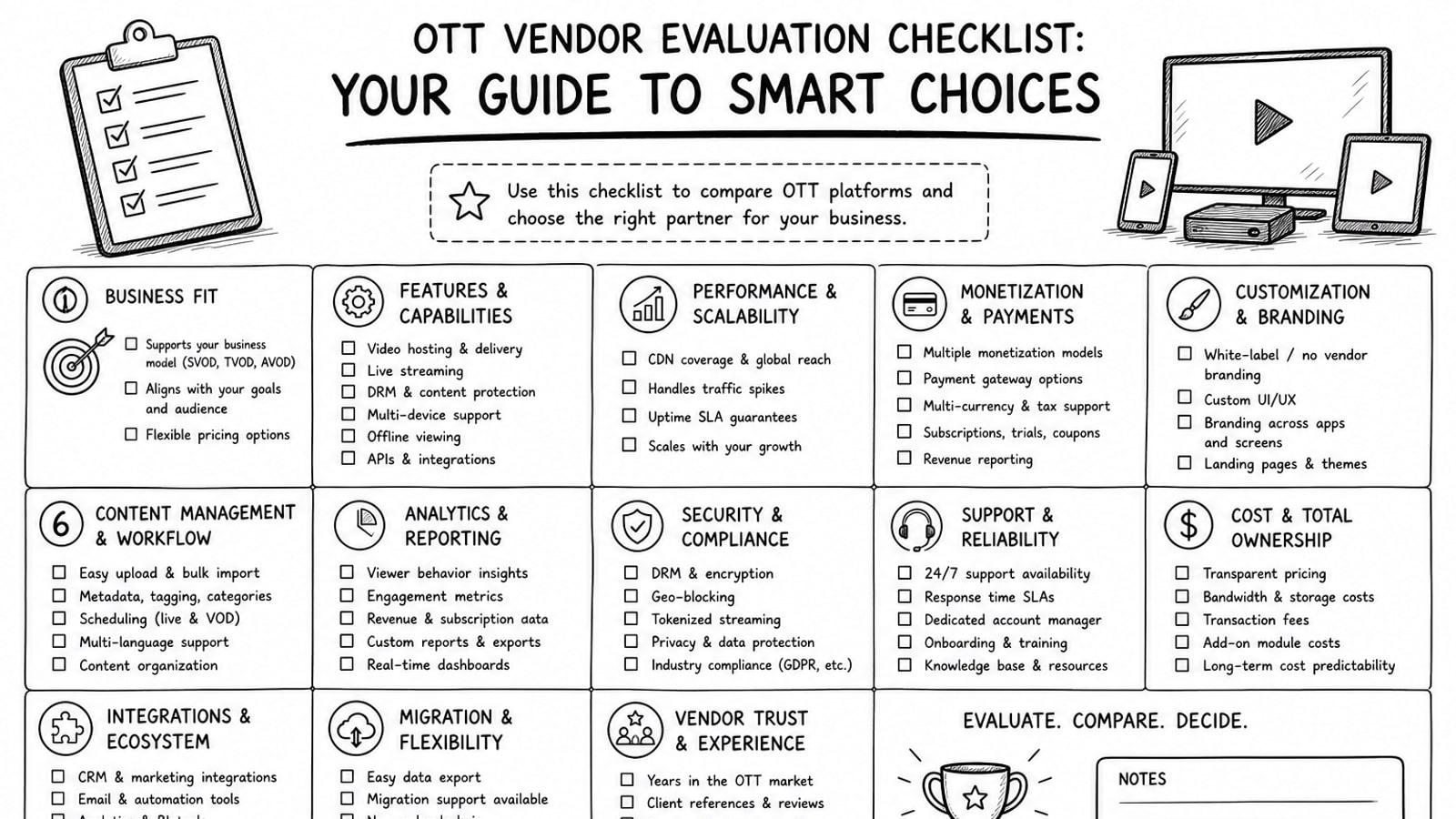
OTT Vendor Evaluation Checklist: Your Guide to Smart Choices
A practical guide to evaluating OTT vendors, with a clear checklist for delivery, security, workflow, cost, ownership, and long-term platform fit.
Read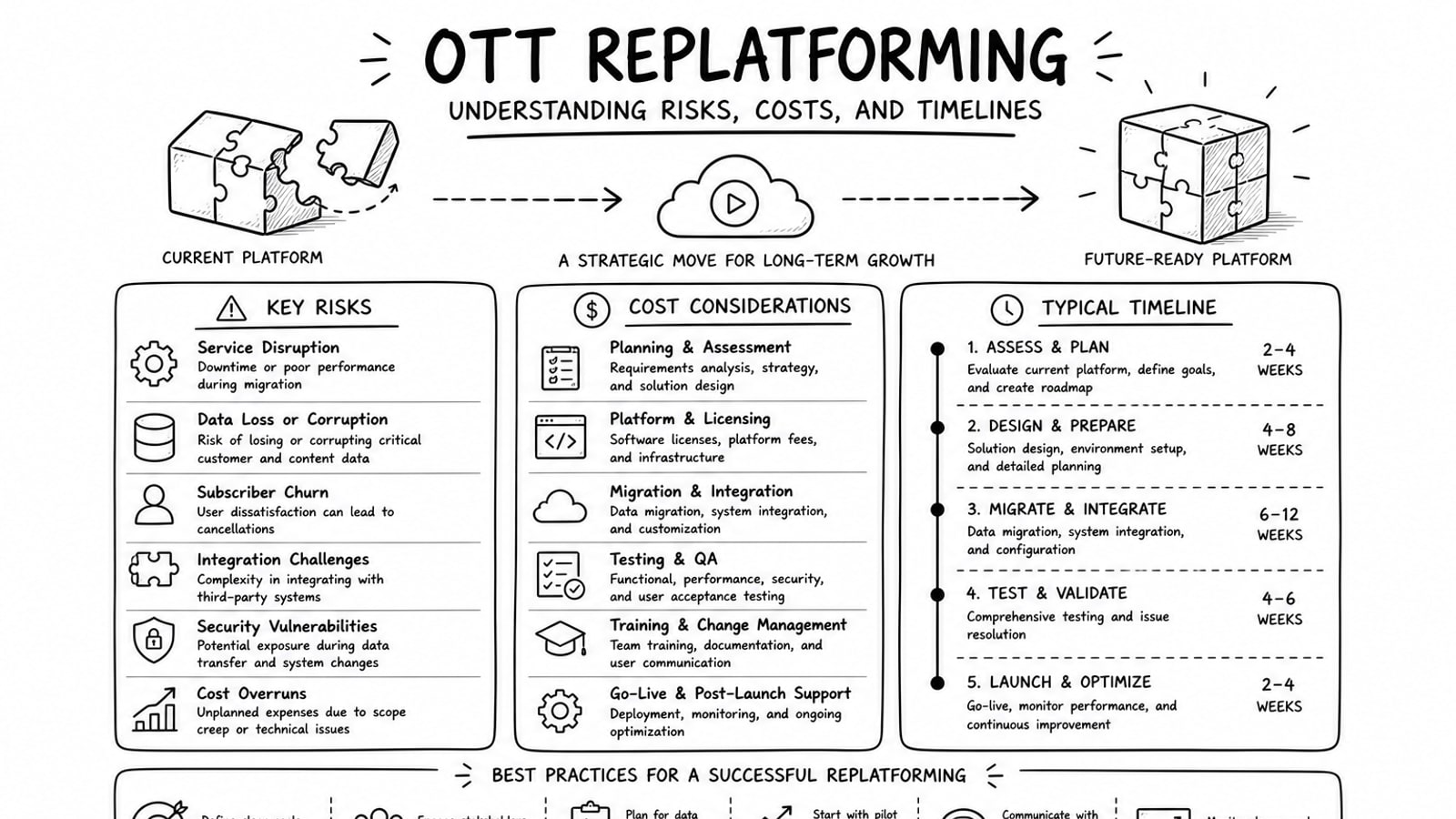
OTT Replatforming: Understanding Risks, Costs, and Timelines
A practical guide to OTT replatforming that explains why teams migrate, what usually drives risk and cost, how long projects tend to take, and where a BYOA delivery model can reduce lock-in.
Read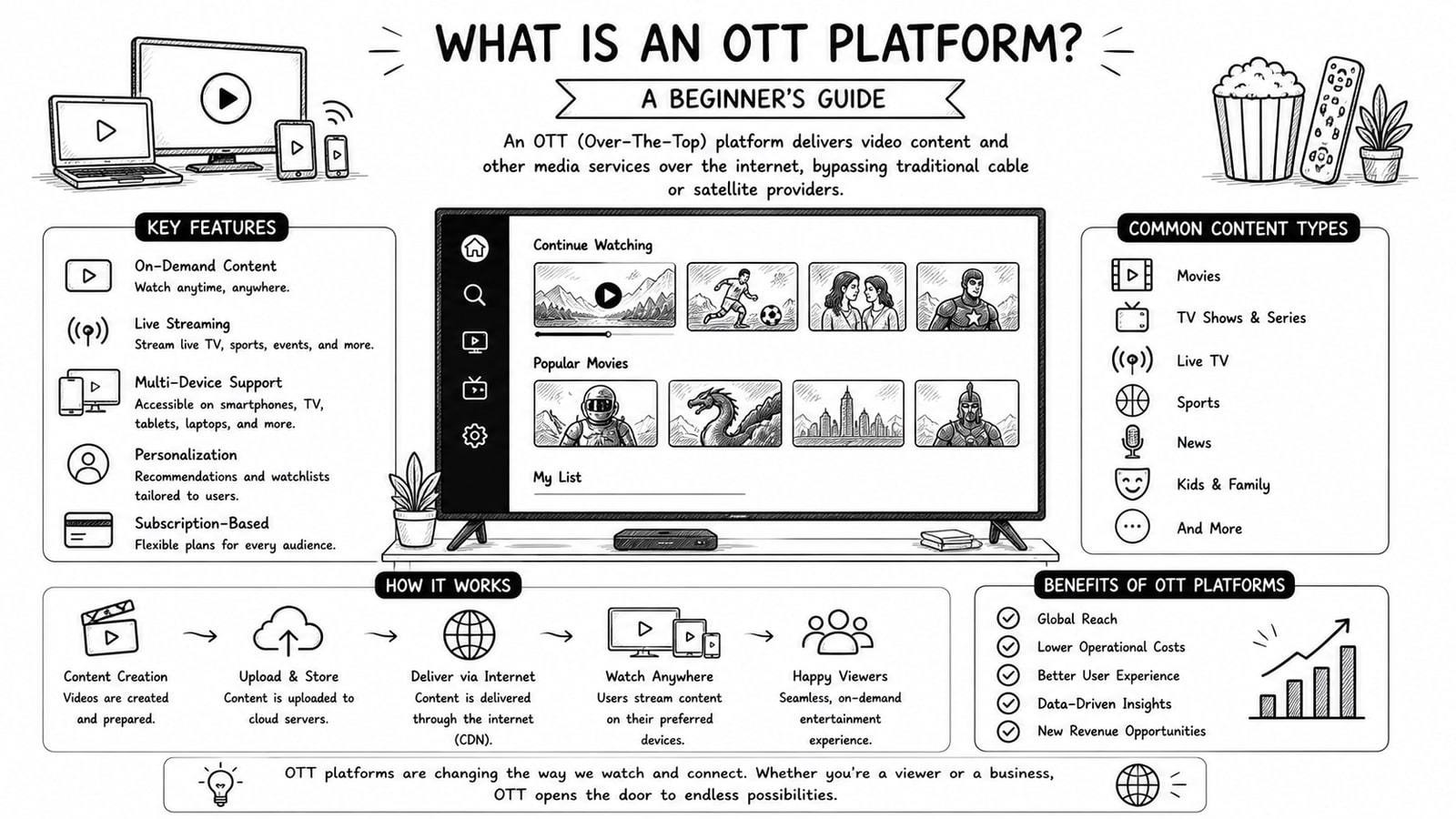
What Is an OTT Platform? A Beginner's Guide
A beginner-friendly guide to OTT platforms, how they work, key components, business models, and what to evaluate before choosing a solution.
Read