OTT
OTT Replatforming: Understanding Risks, Costs, and Timelines
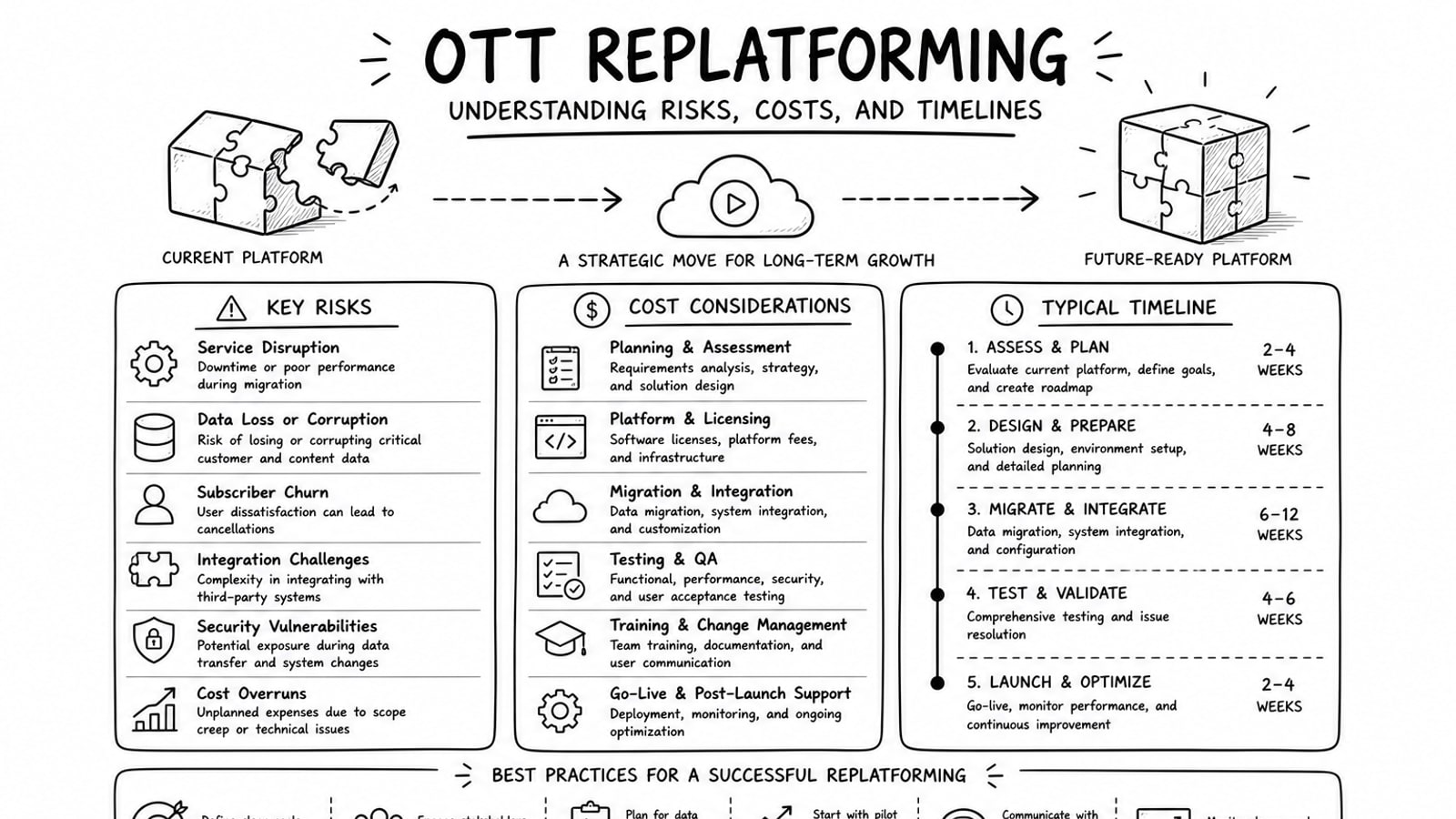
OTT replatforming is the process of moving a streaming service from one technology stack, vendor, or operating model to another without losing critical business capabilities. For media teams, education platforms, sports rights holders, and direct-to-consumer brands, it usually starts when the current platform becomes too expensive, too rigid, too slow to improve, or too dependent on vendor-controlled infrastructure.
A successful migration is not just a content copy job. It touches video ingestion, transcoding, playback, CMS workflows, subscriptions, analytics, user identity, apps, CDN behavior, and support operations. That is why replatforming often creates anxiety inside product, engineering, and operations teams. The move can unlock lower costs and more control, but only when the scope is planned carefully.
Quick Answer
OTT replatforming is worth considering when your current setup limits growth, raises delivery costs, or slows product changes. The biggest risks are service disruption, broken integrations, rushed data migration, and underestimating the operational work after launch. Costs usually come from engineering effort, app updates, migration tooling, QA, and parallel platform spend during cutover. Small migrations can take weeks, while complex multi-app or subscription-heavy projects often take several months.
Key Takeaways
OTT replatforming is usually driven by cost pressure, limited flexibility, product roadmap constraints, or ownership concerns.
The highest-risk areas are billing continuity, playback quality, app release coordination, DRM or entitlement logic, and analytics consistency.
Migration budgets often miss hidden work such as content cleanup, metadata mapping, support training, and running old and new systems in parallel.
A phased rollout with clear rollback rules is safer than a single large cutover for most OTT businesses.
A BYOA model can reduce vendor lock-in by letting the client keep ownership of core cloud services such as video and image accounts.
What OTT Replatforming Actually Means
In cloud migration language, replatforming means moving to a new environment while changing part of the application or operating model along the way. In OTT, that usually means more than moving files. A platform might switch video infrastructure, replace its CMS, change its player stack, adopt a different app framework, move analytics vendors, or redesign how subscriptions and access control work.
That distinction matters because OTT platforms are highly interconnected. A change in one part of the stack can affect playback URLs, entitlement checks, app store releases, customer support flows, content publishing routines, and finance reporting.
Why Teams Start an OTT Replatforming Project
Costs are rising faster than revenue, especially when storage, delivery, or platform fees grow with audience scale.
The current vendor does not support needed workflows, integrations, monetization models, or UI changes.
The business wants more infrastructure ownership, better data portability, or less dependency on bundled services.
Product teams need faster release cycles across web, mobile, and TV applications.
A merger, content expansion, regional launch, or rights change makes the old stack harder to manage.
The Biggest OTT Replatforming Risks
1. Playback disruption
The most visible failure is simple: users press play and something breaks. Problems often come from incorrect manifests, CDN configuration, player mismatches, token logic, subtitle handling, or device-specific issues that appear only after release.
2. Broken subscriptions and entitlements
For subscription or pay-per-view services, entitlement errors can be more damaging than a design bug. If account states, plans, receipts, or region logic are migrated incorrectly, paying users can lose access or receive the wrong level of access.
3. Metadata loss and content mismatches
Large libraries often contain inconsistent titles, categories, artwork, tags, seasons, cue points, and legacy custom fields. If that data is not normalized before migration, the new platform can inherit years of hidden mess.
4. Analytics discontinuity
Replatforming often changes event names, session models, or attribution logic. That can make before-and-after performance comparisons unreliable unless your measurement model is mapped in advance.
5. Team overload during launch
Migration work rarely stays inside engineering. Editorial teams, support agents, QA, finance, and marketing all feel the change. When rollout training is skipped, small operational errors turn into customer-facing problems.
OTT Replatforming Costs: What You Are Really Paying For
Most teams first compare vendor pricing, but the real cost picture is wider. OTT replatforming budgets usually include direct platform costs, internal labor, external implementation help, QA, and parallel-run overhead while both systems are live.
Direct cost buckets
Implementation and integration work
Video migration or re-ingest workflows
Application updates across web, iOS, Android, Apple TV, Android TV, Roku, Fire TV, or smart TV environments
DRM, SSO, payment, analytics, and ad-tech integration changes
Test environments, monitoring, and launch support
Hidden cost buckets
Cleaning and mapping legacy metadata
Running both old and new systems during transition
App store review delays or resubmission cycles
Customer support volume after launch
Rebuilding dashboards or finance reports when event schemas change
Infrastructure pricing also matters. For example, Cloudflare Stream documents separate usage dimensions for minutes stored and minutes delivered, with encoding and ingress included in its model. That kind of pricing structure can be easier to forecast than bundled platform contracts, but it still needs to be modeled against your audience patterns, retention windows, and content library size.
Typical OTT Replatforming Timelines
There is no universal schedule, but planning ranges help set expectations. A focused migration with limited integrations and one or two client applications may move in roughly 6 to 10 weeks. A mid-range project with subscription logic, several apps, and a meaningful content library often lands closer to 3 to 5 months. A large, custom OTT replatforming program with multiple territories, legacy contracts, advanced entitlement rules, and broad device support can take 6 months or longer.
Those are practical planning ranges, not guaranteed benchmarks. The main schedule drivers are content volume, app complexity, third-party dependencies, data quality, approval cycles, and how much work is being done while the existing service stays live.
A simple phase model
Discovery and audit: inventory content, apps, integrations, analytics, access rules, and contract constraints.
Architecture and mapping: define the target stack, migration rules, ownership boundaries, and rollback options.
Build and integration: connect video, CMS, identity, payments, analytics, apps, and monitoring.
Migration and QA: move sample content first, validate edge cases, and test playback and entitlements across devices.
Cutover and hypercare: release in phases, monitor closely, and keep rollback decisions explicit.
A Practical OTT Replatforming Framework
The safest migrations are clear about what must stay identical, what can improve during the move, and what should wait until after launch. That sounds simple, but it keeps teams from turning a migration into a full rebuild with no guardrails.
Separate must-not-break workflows from nice-to-have improvements.
Create a source-of-truth map for content, metadata, identity, billing, analytics, and media assets.
Migrate a pilot batch before moving the full catalog.
Test on real devices, not only in browsers or emulators.
Agree on rollback criteria before launch day, not during incident response.
Where a BYOA Model Can Fit
Some OTT buyers are not only comparing features. They are trying to reduce long-term dependency on a single vendor-controlled billing model. That is where a BYOA, or Bring Your Own Account, approach can fit.
Based on your brief, Bitbyte3 positions its OTT solution around a better-price model and a BYOA operating approach. In practice, that means clients use their own service accounts for components such as video and image infrastructure, instead of being locked into all storage and usage fees under a provider-owned account. For teams that want clearer ownership and more direct cost visibility, that can be an attractive model to evaluate.
One example is Cloudflare Stream, which provides managed upload, storage, encoding, and delivery through a single API and publishes its own usage-based pricing model. A BYOA setup does not automatically make a migration cheaper, but it can make infrastructure ownership and forecasting easier to understand.
Common OTT Replatforming Mistakes
Treating the migration as only a video transfer project
Ignoring billing, entitlement, or app-store dependencies until late in the schedule
Skipping metadata cleanup before migration
Testing only the happy path instead of device-specific and account-state edge cases
Assuming the new reporting numbers will match the old analytics model automatically
Experience and Outcomes
How to Decide if Now Is the Right Time
A replatforming project usually makes sense when the current stack is blocking revenue, product speed, or operational control. If the business case depends only on a vague promise of modernization, the project may need more discovery before it starts. The strongest cases are usually tied to clear outcomes such as cost visibility, faster releases, easier scaling, or ownership of key infrastructure accounts and data.
For teams exploring providers, this is also the stage to compare full-service platforms against modular delivery partners. If Bitbyte3's BYOA model fits your operating goals, review it in the context of your real app matrix, subscription rules, support needs, and cloud cost assumptions.
Conclusion
OTT replatforming can create a healthier streaming business, but only when the migration is treated as an operational and product transition, not just a technical move. The teams that do this well define risk early, budget for hidden work, phase the rollout, and choose an operating model that matches how much control they want to keep.
If your current platform is becoming expensive, inflexible, or opaque, now is a good time to map your actual dependencies and compare them against a more modular setup. That comparison alone often reveals whether replatforming should happen now, later, or in stages.
FAQ Section
What is OTT replatforming?
OTT replatforming is the process of moving a streaming service to a new platform, infrastructure setup, or operating model while keeping core business functions working for viewers and internal teams.
How long does an OTT migration usually take?
A limited migration may take 6 to 10 weeks, while more complex projects often take 3 to 6 months or more. The biggest timeline drivers are app scope, subscription complexity, content volume, and third-party integrations.
What is the biggest risk in OTT replatforming?
The biggest risk is usually not one feature. It is the combined effect of playback issues, entitlement errors, analytics mismatches, and rushed operational change during launch.
Why do companies choose a BYOA model?
A BYOA model can give the client more direct ownership of cloud services, billing visibility, and portability. It may also reduce dependence on one vendor account for storage and usage-based charges.
Can OTT replatforming reduce costs?
It can, but only when the total operating model improves. Savings may come from infrastructure changes, contract changes, or reduced vendor lock-in, but migration labor and parallel-run costs need to be included in the calculation.
What should teams audit before replatforming?
Teams should audit content libraries, metadata quality, playback flows, subscriptions, app releases, analytics, customer support workflows, and every external integration that affects access or reporting.
Methodology / Editorial Note
This article is designed as an evidence-based overview for readers evaluating OTT replatforming. It combines general migration planning principles with vendor documentation related to streaming infrastructure and pricing. Company-specific performance claims, customer outcomes, and cost savings were not invented; explicit placeholders were used where proof was not supplied.
Sources and Further Reading
AWS Prescriptive Guidance: About the migration strategies - https://docs.aws.amazon.com/prescriptive-guidance/latest/large-migration-guide/migration-strategies.html
Cloudflare Stream Overview - https://developers.cloudflare.com/stream/
Cloudflare Stream Pricing - https://developers.cloudflare.com/stream/pricing/
Wowza Video Platform Options - https://www.wowza.com/lp/video-platform-options
Brightcove OTT Best Practices - https://old.brightcove.com/resources/blog/ott-best-practices/
About the Author
M. Jorani — LinkedIn
Software Engineer & Technical Writer
M. Jorani is a software engineer and technical writer with hands-on experience building streaming infrastructure, video pipelines, and OTT platforms. He writes about encoding, delivery architecture, and the engineering decisions that shape how audiences watch content across devices.
More from the blog
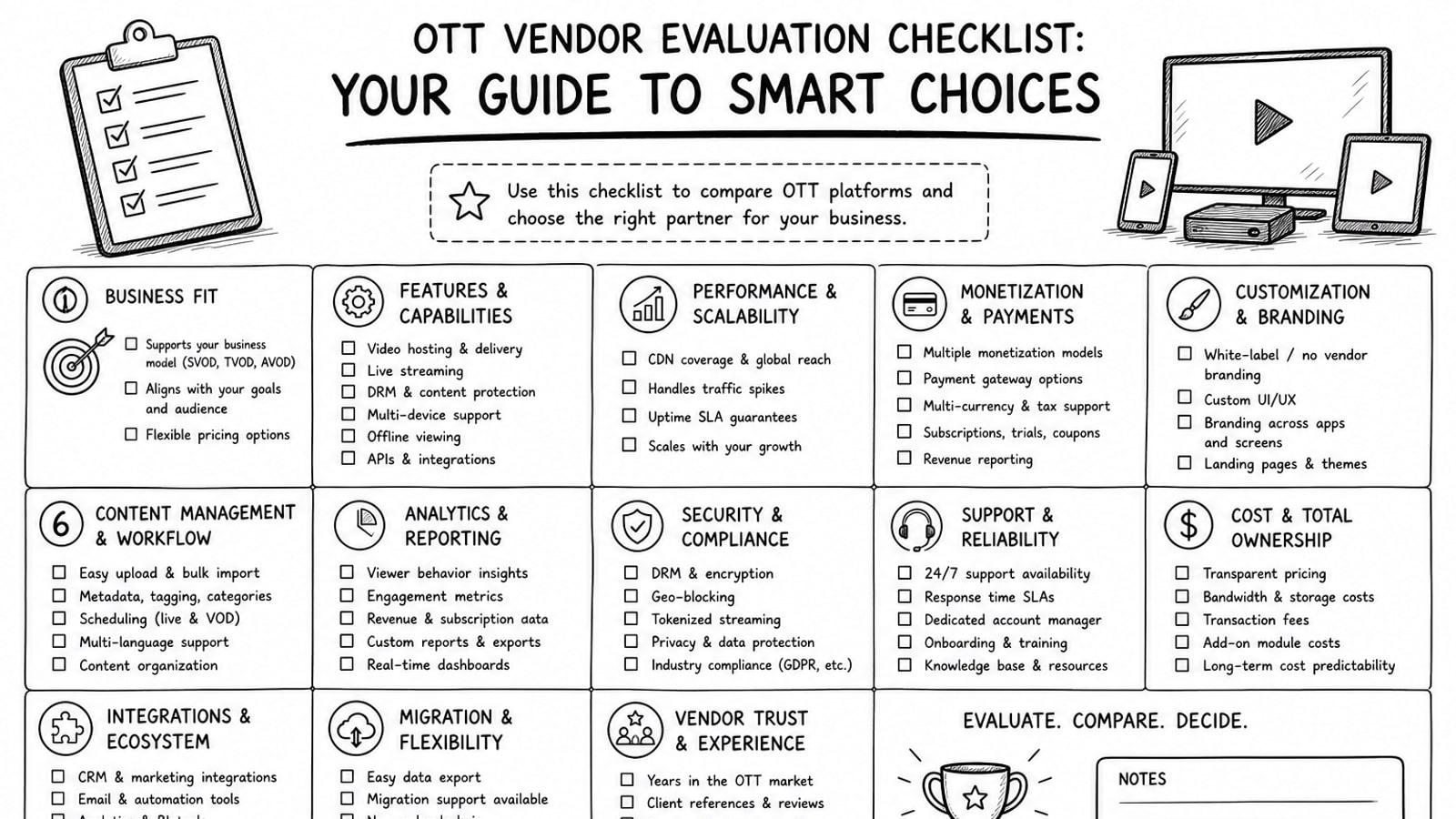
OTT Vendor Evaluation Checklist: Your Guide to Smart Choices
A practical guide to evaluating OTT vendors, with a clear checklist for delivery, security, workflow, cost, ownership, and long-term platform fit.
Read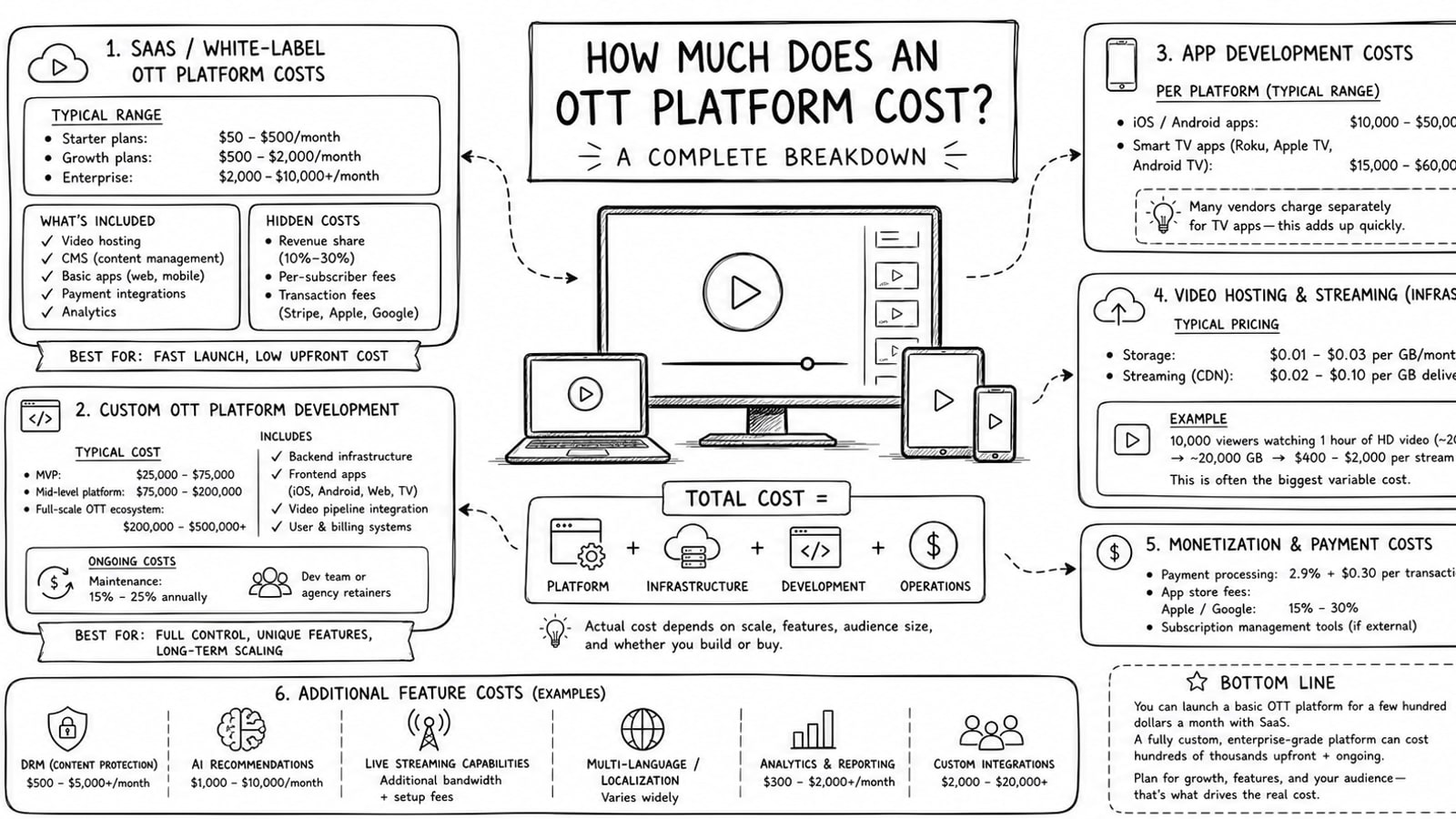
How Much Does an OTT Platform Cost? A Complete Breakdown
A practical breakdown of OTT platform costs, including launch expenses, recurring infrastructure costs, live and on-demand pricing examples, and how a BYOA model can improve cost control.
Read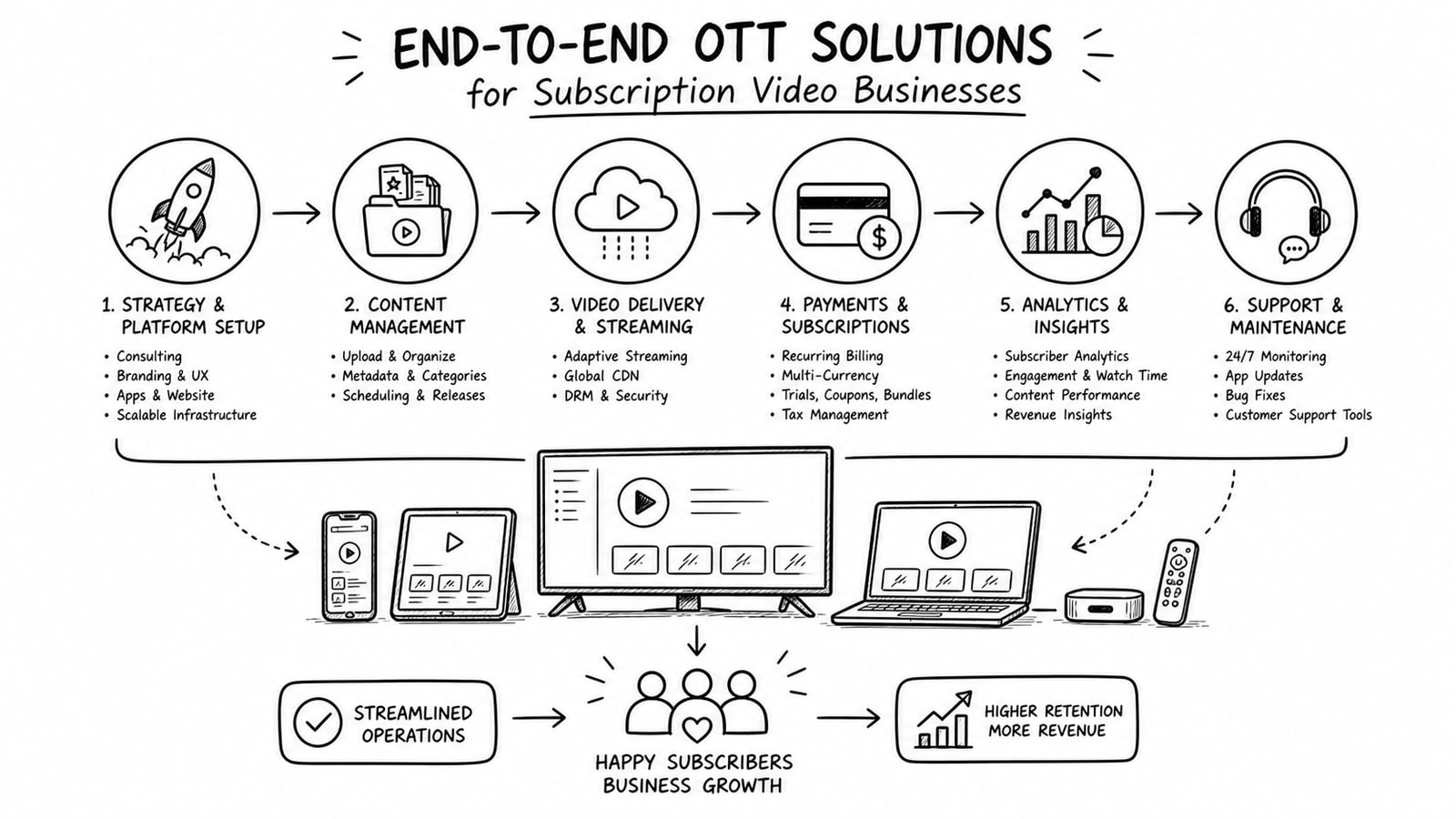
End-to-End OTT Solutions for Subscription Video Businesses: Streamline Your Operations
A practical guide to end-to-end OTT solutions for subscription video businesses, covering the operational layers that reduce complexity and where a bring-your-own-account approach from Bitbyte3 may fit.
Read