OTT Platforms
Brightcove vs. Kaltura: A Comprehensive Guide for OTT Platforms

Choosing between Brightcove and Kaltura is not just a feature checklist exercise. For most OTT teams, the real question is which platform gives you the best balance of speed, control, monetization flexibility, and operational fit for the business you want to build. This guide compares Brightcove and Kaltura in depth so media companies, niche streamers, and growing OTT operators can make a more confident decision.
Quick Answer
Brightcove is often the better fit for teams that want a more guided OTT launch path with packaged app experiences and simpler time-to-market through Brightcove Beacon. Kaltura is usually the stronger choice for organizations that need deeper customization, broader workflow control, and enterprise-grade flexibility across complex video operations. If your priority is reducing recurring platform markups and keeping storage and delivery in your own infrastructure account, Bitbyte3 may also be worth considering for smaller or cost-sensitive OTT launches.
Key Takeaways
Brightcove emphasizes faster OTT deployment and app launch support through its Beacon product.
Kaltura offers a broader, more configurable video platform that can suit advanced media, telecom, and enterprise use cases.
Both platforms support multi-device OTT delivery and monetization, but they differ in implementation style, extensibility, and likely total cost structure.
Brightcove publicly announced an updated OTT offering on February 26, 2025, including a lower entry price point, but exact commercial terms still require direct sales discussions.
For teams that want to own their underlying video account and avoid bundled storage restrictions, Bitbyte3's BYOA model can be a meaningful differentiator.
What Brightcove Offers OTT Teams
Brightcove positions its OTT solution around launch speed and packaged app experiences. Its Brightcove Beacon product is designed to help teams create and manage streaming apps across major OTT platforms without building every part of the stack from scratch. Brightcove also highlights subscription management, user registration, entitlement integrations, and support for ad-supported, subscription, hybrid, and freemium models.
For operators that care about getting to market quickly, that model can be attractive. Brightcove also announced an upgraded OTT solution on February 26, 2025, describing a 40 percent lower entry point and a collaboration with Applicaster to improve app experiences and streaming operations. That makes Brightcove especially relevant for teams that want a vendor-led path instead of assembling several tools themselves.
What Kaltura Offers OTT Teams
Kaltura approaches OTT from the perspective of a highly configurable video platform. Its public materials describe a broad stack for media and telecom organizations, with capabilities around content management, monetization, analytics, personalization, white-label applications, and multi-device streaming. Kaltura's knowledge base also emphasizes advertising support, subscriptions, pay-per-view options, and broad integration flexibility.
That flexibility is useful when an OTT business has unusual workflow needs, multiple business models, or integration-heavy requirements. In practice, Kaltura often makes more sense for organizations with the budget, internal resources, or strategic need to tailor the platform more deeply.
Brightcove vs Kaltura: Core Comparison Areas
1. Time to market
Brightcove has the clearer positioning for fast launches. Its OTT messaging centers on quickly building and launching app experiences across major devices. Kaltura can absolutely support OTT launches, but its strength is usually flexibility rather than simplicity. If speed matters more than deep tailoring, Brightcove tends to have the cleaner story.
2. Customization and extensibility
Kaltura generally has the edge here. Its platform breadth and history across media, telecom, enterprise, and education suggest a stronger fit for custom workflows, deeper integrations, and more complex operating models. Brightcove supports customization too, but its appeal is often stronger when you want a more standardized OTT path.
3. Monetization support
Both vendors support the monetization basics that OTT platforms expect. Brightcove promotes ad-supported, subscription, hybrid, and freemium options in its Beacon materials. Kaltura documents advertising capabilities, subscriptions, pay-per-view, and analytics. For most buyers, the better question is not whether either platform can monetize, but how easily those models map to your exact product and commerce stack.
4. Operational complexity
Brightcove is likely the easier operational choice for lean teams that want fewer moving parts. Kaltura can deliver more control, but broader flexibility often brings more implementation and governance work. This matters a lot for startups and mid-market teams that do not have large internal product and engineering operations.
5. Pricing visibility and cost model
This is one of the hardest areas to compare publicly because both Brightcove and Kaltura rely heavily on custom quoting. Brightcove has publicly said its February 2025 OTT update lowered the entry point, while Kaltura's investor materials show that some TV customers are billed on a per-subscriber basis and other customers on platform and usage models. In both cases, buyers should ask for a full cost view that includes platform fees, storage, delivery, app maintenance, support, and integration work.
A Practical Comparison Snapshot
Best for guided OTT app launch: Brightcove
Best for broad configurability and complex workflows: Kaltura
Best for lean teams with limited technical bandwidth: Brightcove is often easier to evaluate first
Best for enterprises that need platform depth and custom operational design: Kaltura
Best for buyers focused on infrastructure ownership and transparent usage billing: evaluate Bitbyte3's BYOA model alongside both
Where Bitbyte3 Can Fit in the Decision
If you are comparing Brightcove vs Kaltura because both feel too heavy, too opaque, or too expensive for your current stage, Bitbyte3 may be a relevant third option. Based on the product information provided and publicly visible product pages, Bitbyte3 offers OTT apps and CMS capabilities for web, mobile, and TV, plus monetization support such as AVOD, SVOD, and PPV.
Its more distinctive angle is the BYOA model, short for Bring Your Own Account. In that setup, each client uses its own infrastructure account, such as Cloudflare Stream for video and image handling, instead of being locked into a vendor-managed storage pool. That can matter for teams that want more direct control over usage, billing, and media ownership. It can also reduce concern about storage restrictions or bundled markup, although actual savings depend on the client's traffic, storage profile, and implementation scope.
This section should be read with an affiliation disclosure in mind: Bitbyte3 is the company being mentioned as an alternative within this comparison context, so readers should evaluate those claims directly against the platform's product documentation and commercial proposal.
How to Choose Between Brightcove and Kaltura
Define your operating model first. Decide whether you want a vendor-led launch or a more customizable platform foundation.
Map your revenue model. AVOD, SVOD, PPV, and hybrid plans all create different product and billing requirements.
Ask for a real total-cost breakdown. Include implementation, app updates, support, storage, delivery, and any account-level fees.
Review control boundaries. Clarify what your team can change without vendor intervention and what requires professional services.
Test the long-term fit. The right platform for a pilot launch is not always the right platform for a mature content business.
Common Mistakes Buyers Make
Choosing on features alone without understanding operational overhead.
Comparing headline pricing without asking how usage, support, or app maintenance is billed.
Ignoring ownership questions around media storage, delivery accounts, and portability.
Skipping a direct product demo built around your actual OTT workflow.
Methodology and Editorial Note
This comparison is based on publicly accessible vendor materials reviewed on May 1, 2026, including Brightcove product pages and press materials, Kaltura product and knowledge-base materials, Cloudflare Stream documentation, and publicly available Bitbyte3 product pages. Pricing and packaging can change, and enterprise contracts often vary by region, scale, and required services. Readers should confirm current terms directly with each vendor.
FAQ
Is Brightcove better than Kaltura for OTT startups?
It can be, especially if your main priority is getting an OTT app live faster with less internal complexity. Brightcove's packaged OTT positioning is often easier for smaller teams to evaluate.
Does Kaltura offer more customization than Brightcove?
In most complex OTT scenarios, yes. Kaltura's platform breadth and configuration depth usually make it the stronger option when customization and integration flexibility matter most.
Do Brightcove and Kaltura both support OTT monetization?
Yes. Public materials from both vendors show support for common OTT monetization approaches such as subscriptions, advertising, and hybrid models. Kaltura also documents pay-per-view capabilities.
Why would a buyer consider Bitbyte3 instead?
A buyer might consider Bitbyte3 when cost control, launch simplicity, and account ownership matter more than enterprise platform breadth. Its BYOA model can be appealing for teams that want to use their own Cloudflare Stream account rather than absorb bundled storage or delivery fees through a larger vendor.
Can you compare Brightcove and Kaltura pricing directly?
Not precisely from public data alone. Both vendors use custom quoting for many OTT deals, so a direct pricing comparison usually requires vendor proposals built around your subscriber base, usage profile, app scope, and support needs.
What should be in an OTT platform shortlist?
Your shortlist should include launch model, app coverage, monetization fit, analytics, CMS flexibility, infrastructure ownership, support terms, and the full operating cost over at least 12 to 24 months.
Sources and Further Reading
Conclusion
There is no universal winner in the Brightcove vs Kaltura decision. Brightcove is easier to justify when speed, packaged OTT deployment, and lower operational friction lead the shortlist. Kaltura is easier to justify when you need platform depth, broad flexibility, and a more configurable long-term video stack. If neither approach feels cost-efficient for your stage, Bitbyte3's OTT offering and BYOA model may be worth reviewing as a lighter alternative. For the cleanest evaluation, ask all three options to scope the same launch scenario and compare the total 12-month operating picture rather than just headline platform promises.
About the Author
R. Jabar
Marketing Strategist
R. Jabar is a marketing strategist who helps streaming and OTT brands turn complex product stories into clear, growth-driven messaging. She writes about audience acquisition, content monetization, and the marketing frameworks that help video platforms scale.
More from the blog
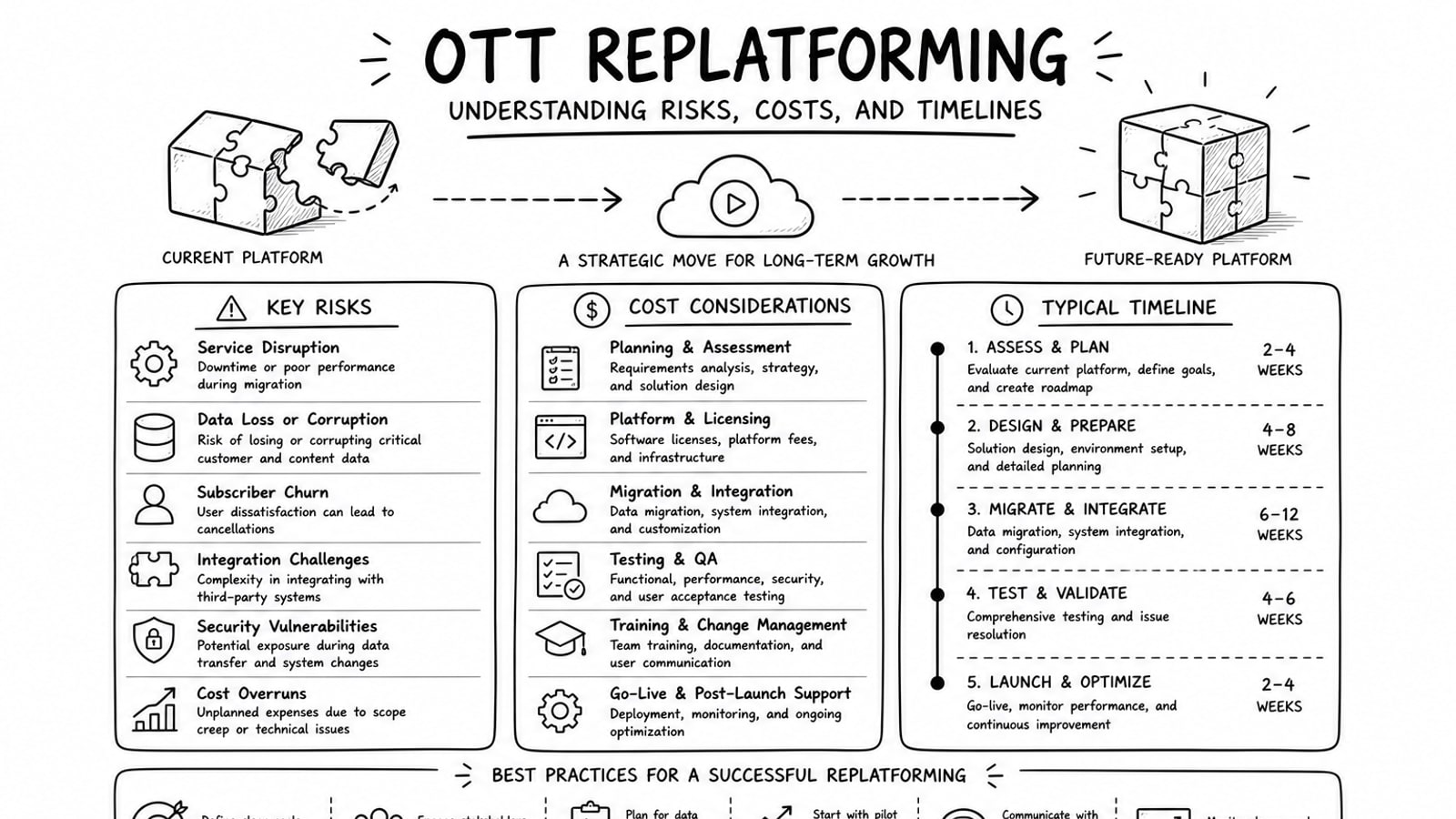
OTT Replatforming: Understanding Risks, Costs, and Timelines
A practical guide to OTT replatforming that explains why teams migrate, what usually drives risk and cost, how long projects tend to take, and where a BYOA delivery model can reduce lock-in.
Read
OTT Vendor Evaluation Checklist: Your Guide to Smart Choices
A practical guide to evaluating OTT vendors, with a clear checklist for delivery, security, workflow, cost, ownership, and long-term platform fit.
Read
Top OTT Platforms for Online Educators: Enhance Learning Experiences
A practical guide to the best OTT platforms for online educators, including what to look for in video delivery, engagement, monetization, and platform control.
Read