OTT
How to Choose the Right OTT Platform for Your Business: Key Considerations
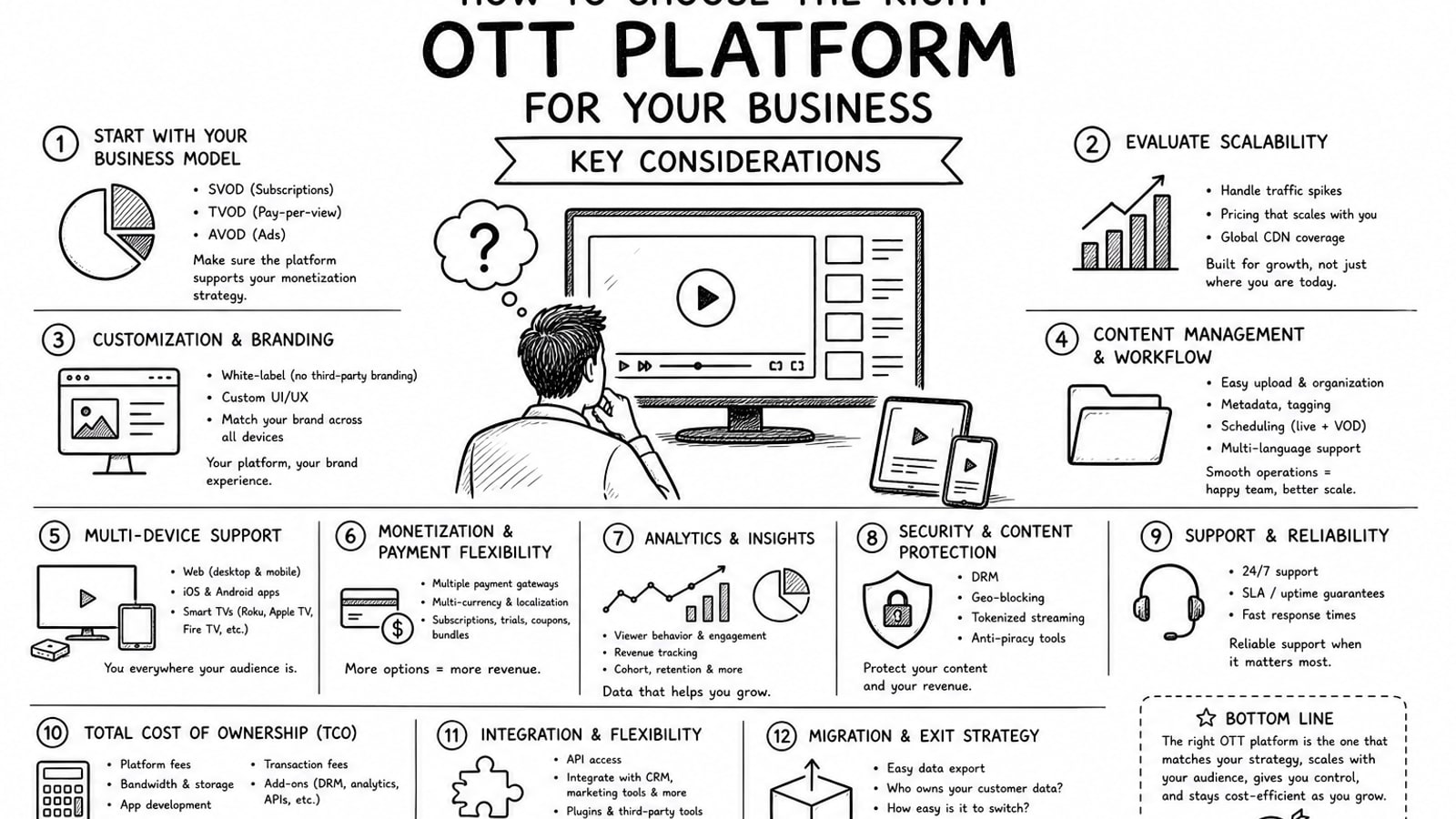
Choosing the right OTT platform for your business is not just a technology decision. It affects how quickly you launch, how reliably viewers can watch, how much control you keep over content and infrastructure, and how your costs scale as usage grows. The best choice is usually the platform that matches your content model, audience expectations, and operating team rather than the one with the longest feature list.
Quick Answer
The right OTT platform should fit your audience, support your content workflow, deliver stable playback across devices, protect premium content, give you useful analytics, and keep pricing understandable as viewership grows. If you want more direct control over infrastructure, it is also worth considering whether the vendor supports a BYOA model, where your business keeps ownership of core third-party accounts instead of being locked into a shared vendor account.
Key Takeaways
Start with your business model, audience, and content mix before comparing feature lists.
Check device coverage, adaptive streaming quality, and playback reliability across web, mobile, and TV environments.
Evaluate security, DRM, access control, and compliance needs early if you plan to distribute paid or restricted content.
Look closely at pricing structure, storage, delivery, and the cost of growth instead of focusing only on launch cost.
If ownership and transparency matter, prefer an OTT setup that lets you keep control of the underlying infrastructure accounts.
What an OTT Platform Really Needs to Do
An OTT platform should help you ingest, manage, publish, secure, distribute, and measure video content without creating unnecessary operational complexity. For some companies, that means an all-in-one managed stack. For others, it means a modular approach that connects to existing cloud services, apps, payment systems, and customer data tools.
Cloudflare describes Stream as a service that lets teams upload, store, encode, and deliver live and on-demand video through a single API. That is useful context because many OTT buying decisions come down to whether you want one managed platform to abstract the video workflow or a more flexible architecture that keeps the underlying services visible and under your control.
1. Start With Your Business Model and Audience
The right platform for an internal training library is different from the right platform for a subscription video service, a live sports product, or a niche media app. Before evaluating vendors, define what you are actually building.
Are you primarily publishing on-demand video, live streams, or both?
Will viewers watch on web, iOS, Android, smart TVs, or a mix of devices?
Do you need subscriptions, one-time purchases, advertising, or a hybrid monetization model?
Will your audience be local, regional, or global?
Do you expect a steady audience or sharp traffic spikes around events and launches?
A platform that looks affordable for a small VOD catalog can become expensive or operationally limiting if your roadmap later expands into live events, regional delivery, or premium content access.
2. Check Streaming Quality and Device Reach
Playback quality is not only about video resolution. It is about how consistently the platform adapts to real network conditions, how quickly video starts, and whether the experience holds up on the devices your customers actually use.
Apple describes HTTP Live Streaming, or HLS, as its adaptive streaming technology for delivering audio and video over standard HTTP connections. That matters because adaptive delivery is one of the core technical expectations for modern OTT experiences. If a platform does not handle adaptive playback well, viewers are more likely to see buffering, quality drops, or failed sessions.
Support for adaptive bitrate streaming such as HLS.
Consistent playback on web, mobile apps, and TV platforms.
Reliable handling of subtitles, captions, thumbnails, and poster images.
Low-friction playback for both live and on-demand video.
A player experience you can brand, customize, or embed without heavy engineering work.
3. Review Content Ownership and Operational Control
One of the most overlooked buying questions is who actually owns the infrastructure layer behind your OTT service. In some setups, the vendor manages everything inside its own accounts. In others, you keep ownership of the key cloud services and simply use the vendor as your implementation and management partner.
This is where BitByte3 can fit well for some businesses. BitByte3 positions its OTT solution as a more price-conscious option and offers a BYOA model, meaning Bring Your Own Account. In that setup, each client can use its own services for items such as video and image handling, including platforms like Cloudflare Stream where appropriate, instead of being limited by a pooled vendor-owned account. That can improve billing visibility, reduce dependence on vendor-managed quotas, and make future migration easier because the underlying account remains under the client's control.
If long-term ownership matters to your team, ask every vendor these questions directly: Who owns the video account, where is the content stored, who controls billing, and how hard is it to move if the relationship changes later?
4. Evaluate Security, Access Control, and Rights Protection
Security requirements vary widely. A free content brand may only need basic access controls, while a premium education, sports, or entertainment product may need signed playback links, regional restrictions, and DRM support.
Cloudflare highlights signed URLs as a way to restrict access to protected video content. Android's media documentation also shows that DRM-protected playback relies on the device and streaming stack supporting the correct DRM scheme. In practical terms, that means you should verify not just whether a vendor says it supports security, but how that support works across the specific apps and devices you plan to serve.
Signed URLs or token-based playback access.
DRM support if you distribute premium or licensed content.
Role-based permissions for internal teams and publishers.
Support for private libraries, subscriber-only areas, or geographic restrictions.
A clear process for moderation, takedowns, and content lifecycle management.
5. Look Beyond Dashboards and Check the Analytics Depth
A strong OTT platform should tell you more than total plays. You should be able to understand viewing behavior, engagement, drop-off points, and platform health in enough detail to improve both product and revenue decisions.
At minimum, look for analytics that help you answer practical questions: Which titles hold attention? Where do viewers stop watching? Which devices underperform? Which campaigns drive the highest-value users? Without that visibility, you are running an OTT product with very limited feedback.
6. Make Sure It Fits Your Existing Stack
Many OTT projects fail to scale smoothly because the platform works in isolation. The right choice should connect cleanly with the tools you already depend on, such as your CMS, CRM, payments, identity provider, marketing automation, or mobile apps.
API quality and documentation.
Webhook support for automation.
Integration with authentication, payments, and subscriber management.
Compatibility with your current website, app, or headless CMS approach.
A realistic handoff path for your internal developers or agency partners.
If you are comparing a fully managed OTT platform against a more flexible implementation partner, the question is not only features. It is also how much product freedom you want six or twelve months from now.
7. Compare Pricing the Right Way
OTT pricing gets confusing quickly because the headline price rarely shows the full operating cost. Some vendors bundle infrastructure into a simple monthly fee. Others split billing across storage, delivery, transcoding, support, and premium features.
Cloudflare's Stream pricing is a good example of usage-based billing: it charges for minutes stored and minutes delivered. That model can be attractive when you want transparent infrastructure economics, but it also means your finance team should forecast growth scenarios instead of comparing only the first-month quote.
A better pricing review includes:
Launch cost: setup, design, migration, and app delivery.
Usage cost: storage, streaming delivery, and live event spikes.
Feature cost: monetization, advanced analytics, security, and custom app support.
Control cost: what happens if you need to switch providers later.
Team cost: whether your staff can operate the platform without constant outside help.
If your company wants tighter ownership of spend, a BYOA approach can be worth serious consideration because it separates platform services from the infrastructure accounts themselves. That gives you a clearer view of what you are paying for and where your usage is actually growing.
OTT Platform Evaluation Checklist
Define your audience, content type, monetization model, and device priorities.
List the must-have workflows for publishing, security, analytics, and integrations.
Request a pricing breakdown that includes storage, delivery, support, and future growth scenarios.
Confirm who owns the infrastructure accounts, content assets, and billing relationships.
Test playback quality on the real devices and network conditions your audience uses.
Verify the migration path so you are not trapped if the product direction changes.
Common Mistakes Businesses Make
Choosing a platform based on features without mapping them to business goals.
Ignoring long-term infrastructure ownership and lock-in risk.
Underestimating the cost impact of video delivery and storage growth.
Treating analytics as optional instead of a core product requirement.
Assuming security claims apply equally across every device and app environment.
When BitByte3 May Be a Good Fit
BitByte3 may be a strong fit if your business wants OTT implementation help but also wants to keep more control over pricing and infrastructure ownership. Its BYOA model is especially relevant for companies that prefer to use their own accounts for video and image services instead of absorbing those costs through a vendor-managed black box.
That model can be useful for businesses that want clearer cost separation, fewer surprises around account limits, and more control over how storage and delivery scale over time. Before publishing, BitByte3 should add any verified proof points, real client outcomes, or implementation examples it is comfortable sharing so the article includes stronger first-hand evidence.
Conclusion
The right OTT platform is the one that supports your business model, protects the viewer experience, and lets you grow without losing control of cost or infrastructure. If you evaluate platforms through that lens, you are more likely to choose a solution that still fits when your catalog, audience, and technical needs become more demanding.
For businesses that want a practical OTT setup with room for ownership and cost visibility, BitByte3 is worth considering alongside larger managed platforms. The key is to compare not only what the platform can do today, but what it lets your business control tomorrow.
FAQ
What is the most important factor when choosing an OTT platform?
The most important factor is fit with your business model. Start with your audience, content type, monetization approach, and device needs. A platform that fits those realities will usually outperform a platform that simply has more features.
Why does infrastructure ownership matter in OTT?
Infrastructure ownership affects billing visibility, vendor lock-in, migration flexibility, and long-term control. If your vendor owns everything in its own accounts, moving later can be slower, riskier, and less transparent.
What does BYOA mean in an OTT setup?
BYOA means Bring Your Own Account. In an OTT context, it usually means the client keeps ownership of the underlying cloud or media-service accounts while a partner helps implement and manage the overall solution.
Do all OTT platforms support security and DRM equally?
No. Security claims can vary by device, app environment, and playback workflow. Always verify how signed access, DRM, and content restrictions work in the exact distribution channels you plan to use.
How should businesses compare OTT pricing?
Compare the full cost of ownership, not only the entry price. Include setup, usage-based streaming costs, storage, support, monetization features, and the cost of future migration or customization.
Can a lower-cost OTT option still be a good long-term choice?
Yes, if it supports the product requirements you actually need and gives you enough operational control to scale. Lower cost becomes a problem only when it hides limits, lock-in, or missing capabilities that matter later.
Methodology / Editorial Note
This article is written as decision-support content for businesses evaluating OTT platforms. It combines general platform-selection best practices with product and infrastructure considerations drawn from official vendor documentation on streaming delivery, pricing, security, and playback technologies. Where company-specific proof such as customer outcomes, reviewer credentials, or implementation results was not provided, the draft avoids inventing those details.
Sources and Further Reading
About the Author
R. Jabar
Marketing Strategist
R. Jabar is a marketing strategist who helps streaming and OTT brands turn complex product stories into clear, growth-driven messaging. She writes about audience acquisition, content monetization, and the marketing frameworks that help video platforms scale.
More from the blog
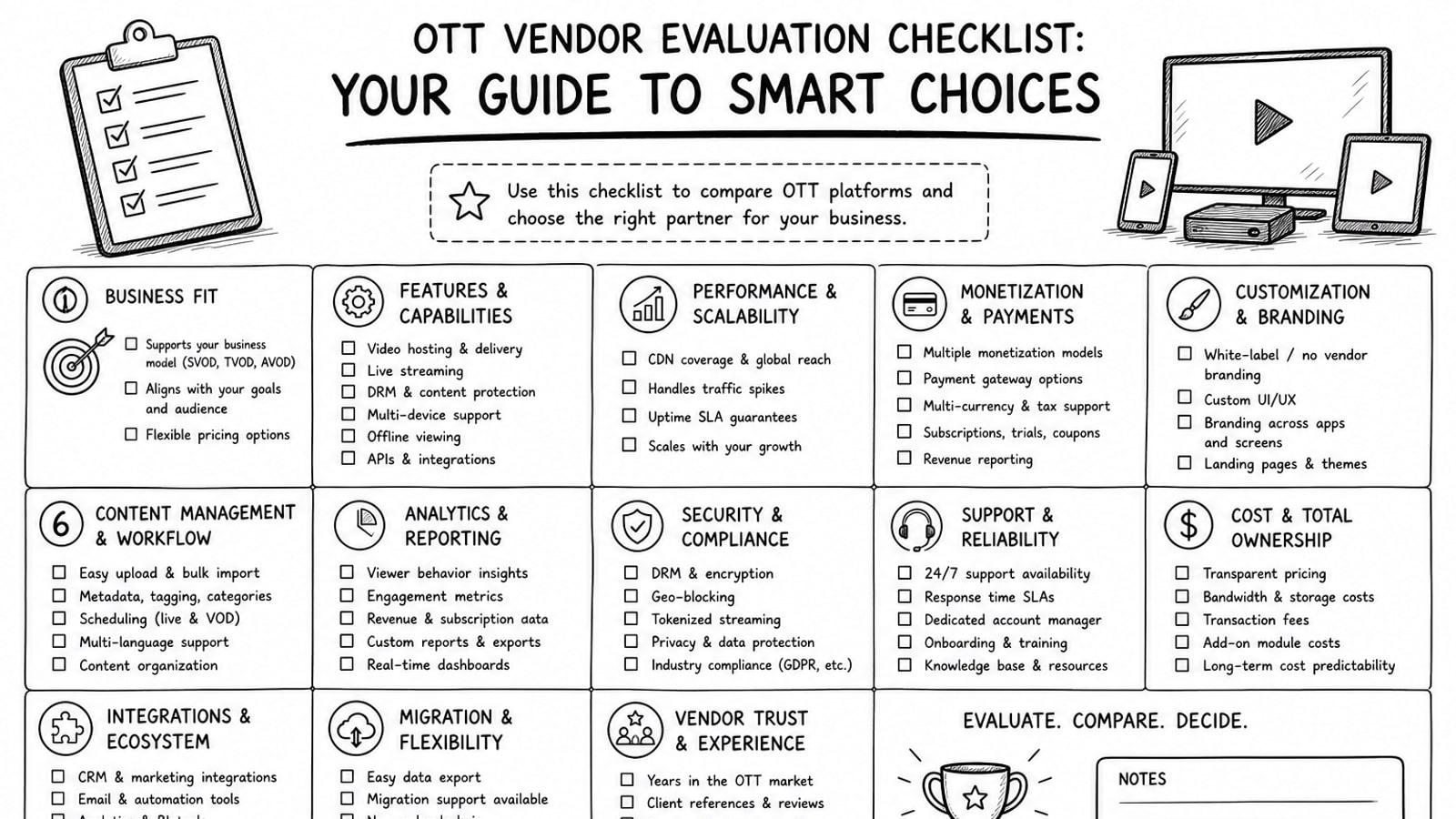
OTT Vendor Evaluation Checklist: Your Guide to Smart Choices
A practical guide to evaluating OTT vendors, with a clear checklist for delivery, security, workflow, cost, ownership, and long-term platform fit.
Read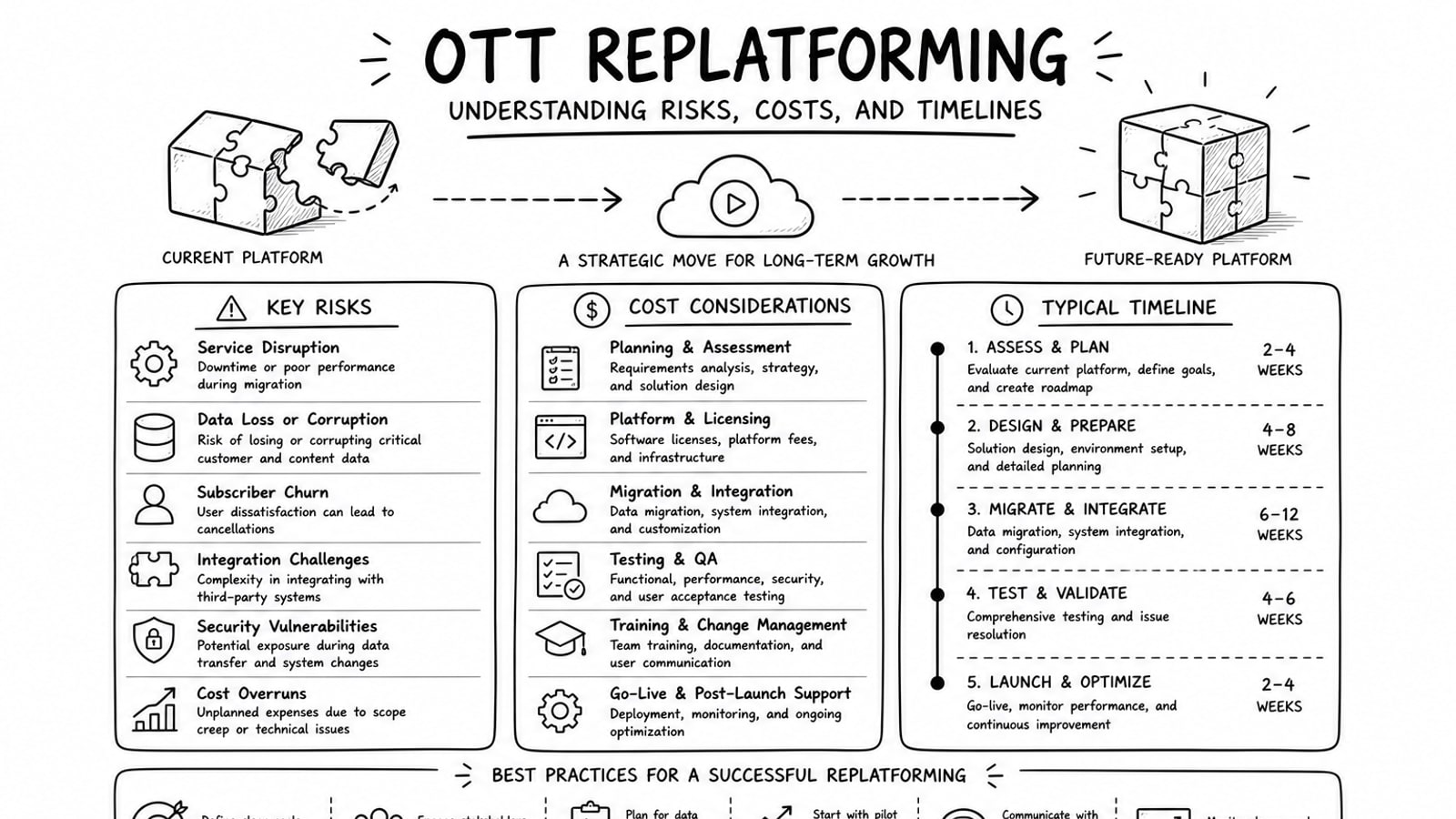
OTT Replatforming: Understanding Risks, Costs, and Timelines
A practical guide to OTT replatforming that explains why teams migrate, what usually drives risk and cost, how long projects tend to take, and where a BYOA delivery model can reduce lock-in.
Read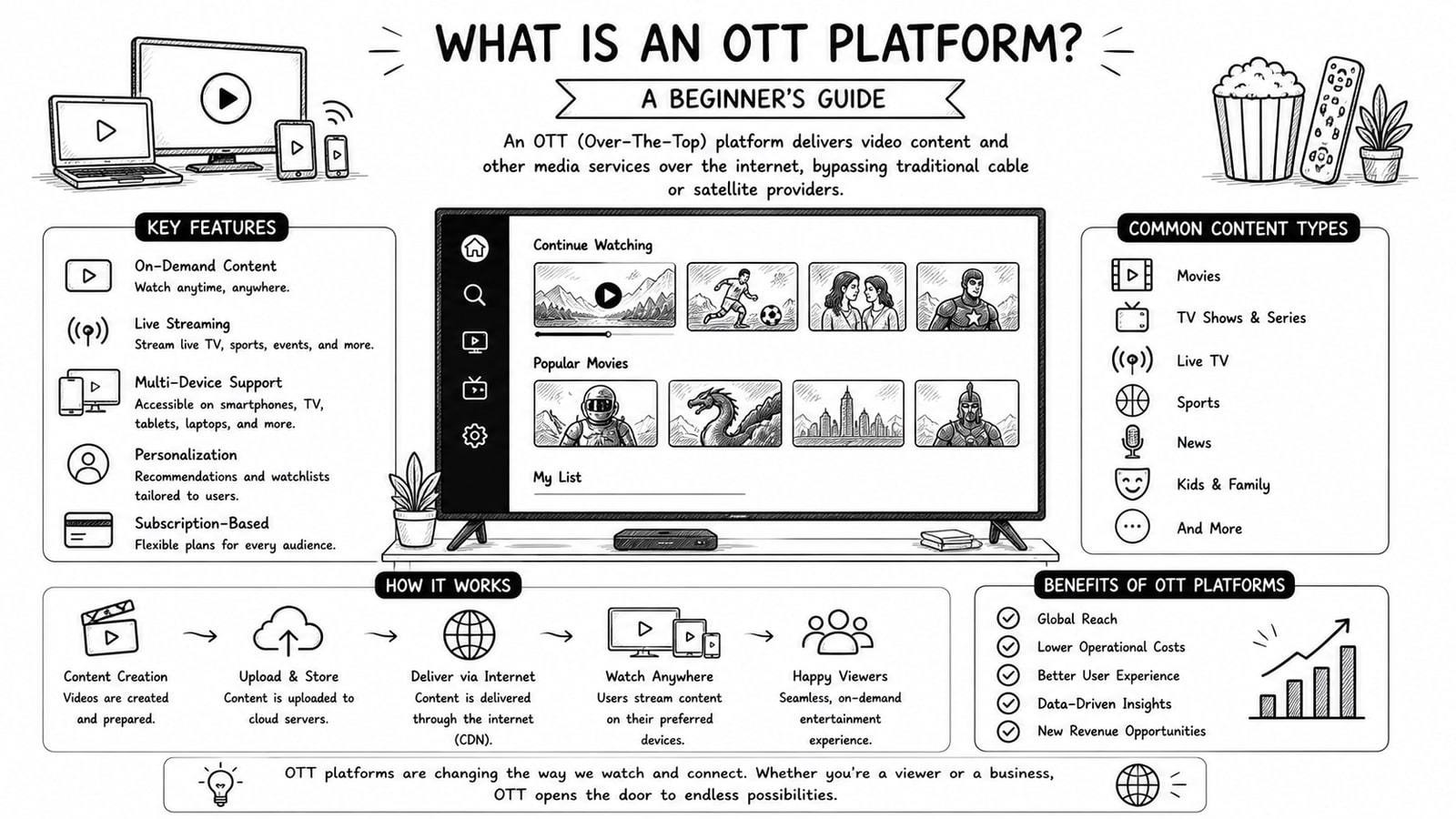
What Is an OTT Platform? A Beginner's Guide
A beginner-friendly guide to OTT platforms, how they work, key components, business models, and what to evaluate before choosing a solution.
Read