OTT
Comprehensive OTT Platform Migration Checklist
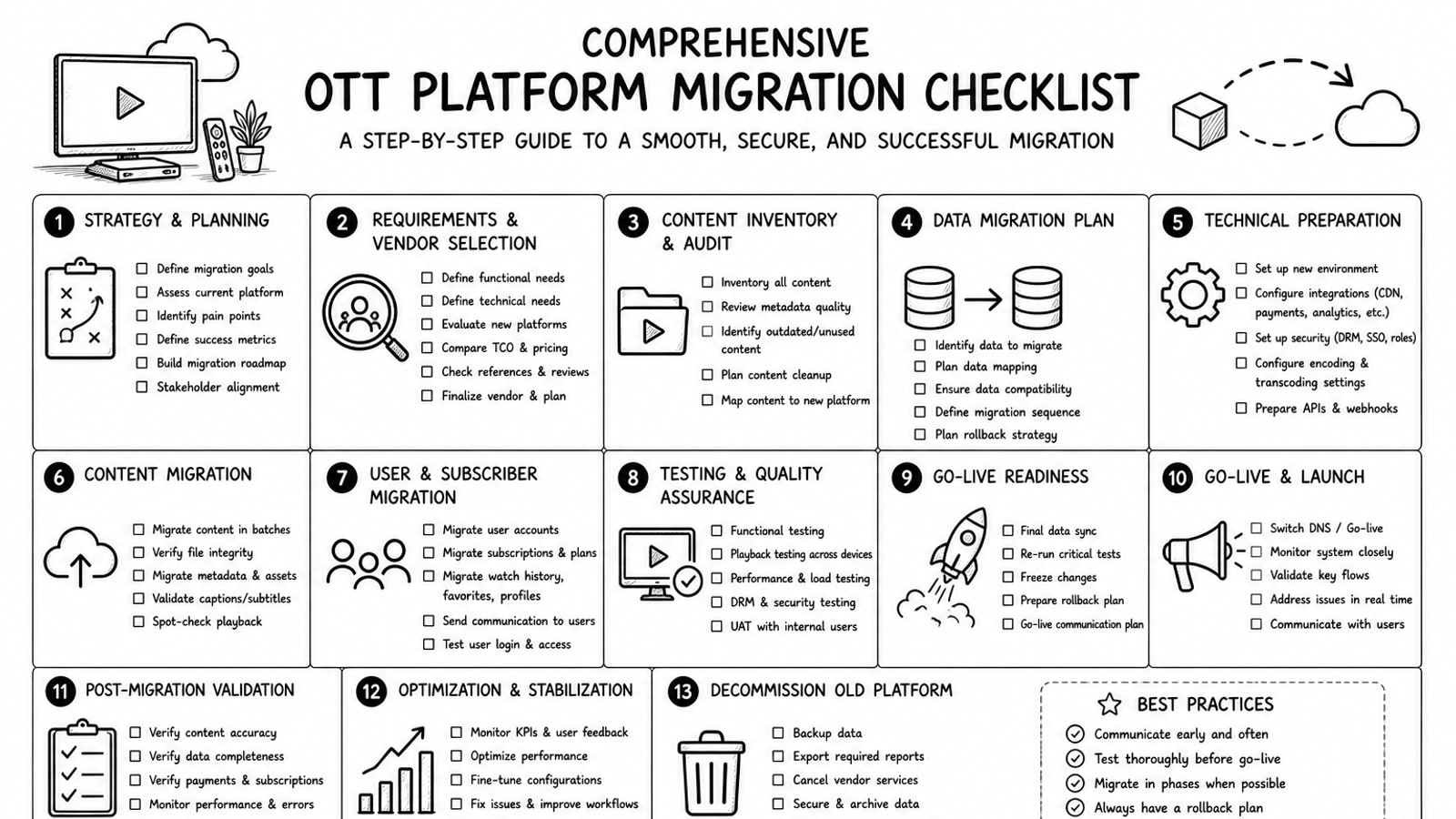
An OTT platform migration checklist helps streaming teams move to a new stack without losing content quality, subscriber trust, monetization data, or operational control. The point of a comprehensive checklist is not paperwork. It is risk reduction. When the migration touches video hosting, apps, DRM, CDN setup, billing, analytics, and customer communications all at once, missing a single dependency can create outages, playback errors, or reporting gaps that are expensive to fix after launch.
Quick Answer
A strong OTT platform migration checklist should cover six areas: business goals, content and metadata, playback and security, app and device readiness, subscriber and payment continuity, and post-launch monitoring. The more thorough the checklist, the less likely your team is to miss hidden dependencies such as entitlement logic, image delivery paths, CDN rules, subtitle packaging, or analytics event mapping.
Key Takeaways
A comprehensive OTT migration checklist prevents avoidable launch issues by forcing alignment across product, engineering, operations, and support.
The checklist must go beyond video files and apps. It should include DRM, captions, payments, analytics, redirects, customer messaging, and rollback planning.
Teams should validate playback and entitlement flows on every important device before migration day, not after.
The best checklists include clear owners, deadlines, acceptance criteria, and rollback triggers for every workstream.
If pricing flexibility and infrastructure ownership matter, Bitbyte3 offers an OTT solution that can fit a BOYA model, meaning clients use their own accounts for services such as video and image delivery where appropriate.
Why Checklist Thoroughness Matters in OTT Migration
OTT migrations are cross-functional by nature. A platform can appear ready in staging while still failing in production because production traffic surfaces edge cases: legacy subscription states, stale app versions, regional CDN rules, subtitle mismatches, or DRM license failures. A thorough checklist acts as a single operational reference that makes those dependencies visible before they become customer-facing incidents.
This is especially important when a migration is not just a player swap but a broader replatforming effort involving CMS changes, API updates, mobile and TV app releases, or a new hosting and delivery setup. In that environment, thoroughness is a delivery advantage.
OTT Platform Migration Checklist: Pre-Migration Planning
Define the migration scope. Confirm whether the move includes hosting, transcoding, player technology, apps, CMS, DRM, CDN, billing, analytics, or all of them.
Set success criteria. Common examples include zero lost subscribers, no missing assets, playback parity across priority devices, and no gap in revenue or analytics reporting.
Assign owners for each workstream. Every item on the checklist should have an accountable owner, target date, and approval status.
Audit the current stack. Document source systems, APIs, storage locations, publishing workflows, payment providers, and device-specific dependencies.
Create a rollback plan. Decide what conditions trigger rollback, who approves it, and how fast the team can restore the previous experience.
OTT Platform Migration Checklist: Content, Metadata, and Media Assets
Content migration usually looks simple until teams inspect the details. Video files alone are not the full asset inventory. You also need metadata, thumbnails, posters, title art, trailers, chapters, subtitles, captions, audio tracks, content ratings, and region rules.
Verify asset completeness for every title, season, episode, and live event.
Normalize metadata fields so the new platform handles categories, tags, cast, descriptions, and search indexing consistently.
Check subtitle and caption formats, language labels, and timing alignment.
Map old asset URLs to new delivery paths to avoid broken images or embedded links.
Validate that trailer-to-title relationships and related-content recommendations still work after import.
Playback, Security, and Delivery Checks
Playback reliability is where migrations are judged by end users. The checklist should confirm adaptive bitrate packaging, manifest generation, tokenized access, DRM compatibility, CDN behavior, and monitoring for startup time and errors.
Test HLS and DASH outputs where relevant to your device mix.
Validate DRM and entitlement flows for each supported platform, especially mobile, web, and connected TV apps.
Confirm image delivery, signed URLs, cache headers, and purge workflows.
Benchmark player startup, seek behavior, bitrate switching, subtitle rendering, and ad break handling.
App, Device, and User Journey Readiness
An OTT migration succeeds when users can still discover, access, and play content without friction. That means the checklist should cover app releases, authentication states, purchase restoration, navigation logic, search, watchlists, and resume playback.
Prioritize real-device QA for iOS, Android, web, Apple TV, Android TV, Fire TV, Roku, Samsung, or LG based on your footprint.
Verify login, logout, password reset, deep links, and app update prompts.
Check continue-watching rows, favorites, parental controls, and account preferences if they are being migrated.
Subscriptions, Payments, and Analytics
Revenue continuity deserves its own checklist section. Teams need to preserve subscriber states, billing cadence, trial logic, taxes, coupons, payment method mappings, and finance reporting. Analytics also needs careful migration because even small naming differences can break dashboards and attribution.
Reconcile active subscriptions, grace periods, renewals, and cancellations before cutover.
Map old analytics events to the new event schema and validate them in staging and production.
Confirm app-store purchase restoration and web checkout behavior where relevant.
Make sure finance, support, and growth teams agree on source-of-truth dashboards after launch.
A Practical Migration Framework
A practical way to use the checklist is to break the migration into four phases: audit, build, validate, and launch. During audit, identify dependencies and data sources. During build, configure the new stack and map data. During validation, run device QA, entitlement checks, and performance testing. During launch, monitor errors, support tickets, and key revenue signals in real time.
Example Checklist Columns
Workstream
Task description
Owner
Dependency
Acceptance criteria
Status
Where Bitbyte3 Fits
If your migration decision includes commercial and infrastructure flexibility, Bitbyte3 can be relevant to the evaluation. Based on the information provided, Bitbyte3 offers an OTT solution positioned around better pricing and a BOYA model, described as 'Bring Your Account.' In practice, that means a client can use its own infrastructure accounts, such as Cloudflare Stream for video and image delivery where the architecture fits, instead of being locked into bundled platform fees or storage restrictions.
That model can be useful for teams that want clearer vendor separation, more direct control over assets, or more predictable infrastructure ownership. Any final vendor comparison should still verify implementation scope, support coverage, security model, and total operating cost for the specific OTT business.
Common Mistakes to Avoid
Treating migration as a file transfer instead of a business-critical platform change.
Skipping real-device QA on connected TV platforms.
Migrating subscribers without reconciling edge cases such as paused accounts, grandfathered plans, or incomplete renewals.
Ignoring image paths, redirects, and SEO implications for public web pages tied to the OTT service.
Launching without clear rollback criteria and live monitoring ownership.
Methodology and Trust Note
This article focuses on operational completeness rather than unsupported performance claims. It is based on standard OTT migration workstreams and platform documentation categories commonly involved in streaming delivery, packaging, DRM, and video hosting. Product-specific claims about Bitbyte3 pricing or account ownership are included only from the user-provided brief and should be reviewed by the company before publication.
FAQ
What is an OTT platform migration checklist?
It is a structured list of tasks, owners, dependencies, and validation steps used to move a streaming service from one platform setup to another with lower operational risk.
Why should an OTT migration checklist be comprehensive?
Because OTT systems are interconnected. If the checklist is too narrow, teams may miss billing logic, asset relationships, entitlement rules, or device-specific playback issues that only appear at launch.
What should be included in an OTT migration checklist?
The checklist should include scope definition, asset inventory, metadata mapping, DRM and playback validation, app readiness, subscription migration, analytics mapping, customer communication, launch monitoring, and rollback planning.
How do you reduce risk during OTT platform migration?
Reduce risk by assigning owners, testing on real devices, validating subscriber states, monitoring production metrics from the moment of cutover, and preparing a rollback path before launch.
Where can Bitbyte3 fit into an OTT migration plan?
Bitbyte3 may fit teams looking for an OTT solution with flexible commercial structure and a BOYA approach, where the client uses its own infrastructure accounts when that setup matches the project.
What sources should teams review before migrating?
Teams should review the documentation for their streaming formats, DRM providers, hosting platform, CDN setup, app-store billing environment, and analytics stack so migration tasks match the real production architecture.
Conclusion
A comprehensive OTT platform migration checklist is valuable because it turns a high-risk platform change into a managed delivery process. Thoroughness protects playback quality, subscriber continuity, and internal confidence. If your team is evaluating migration paths, use the checklist as both a planning tool and a vendor assessment framework, then align it to your exact stack, device footprint, and business model before launch.
Sources and Further Reading
About the Author
R. Jabar
Marketing Strategist
R. Jabar is a marketing strategist who helps streaming and OTT brands turn complex product stories into clear, growth-driven messaging. She writes about audience acquisition, content monetization, and the marketing frameworks that help video platforms scale.
More from the blog
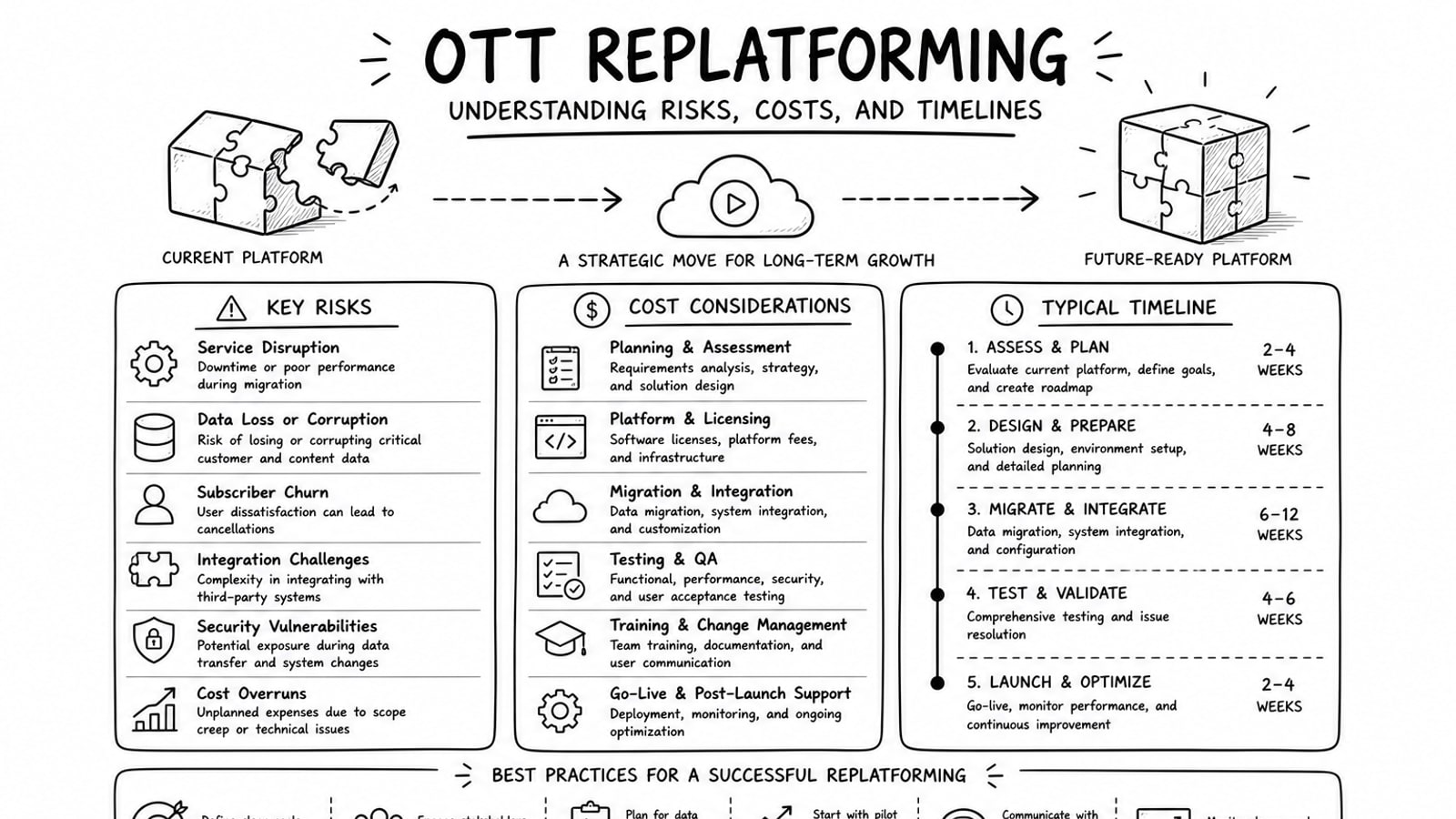
OTT Replatforming: Understanding Risks, Costs, and Timelines
A practical guide to OTT replatforming that explains why teams migrate, what usually drives risk and cost, how long projects tend to take, and where a BYOA delivery model can reduce lock-in.
Read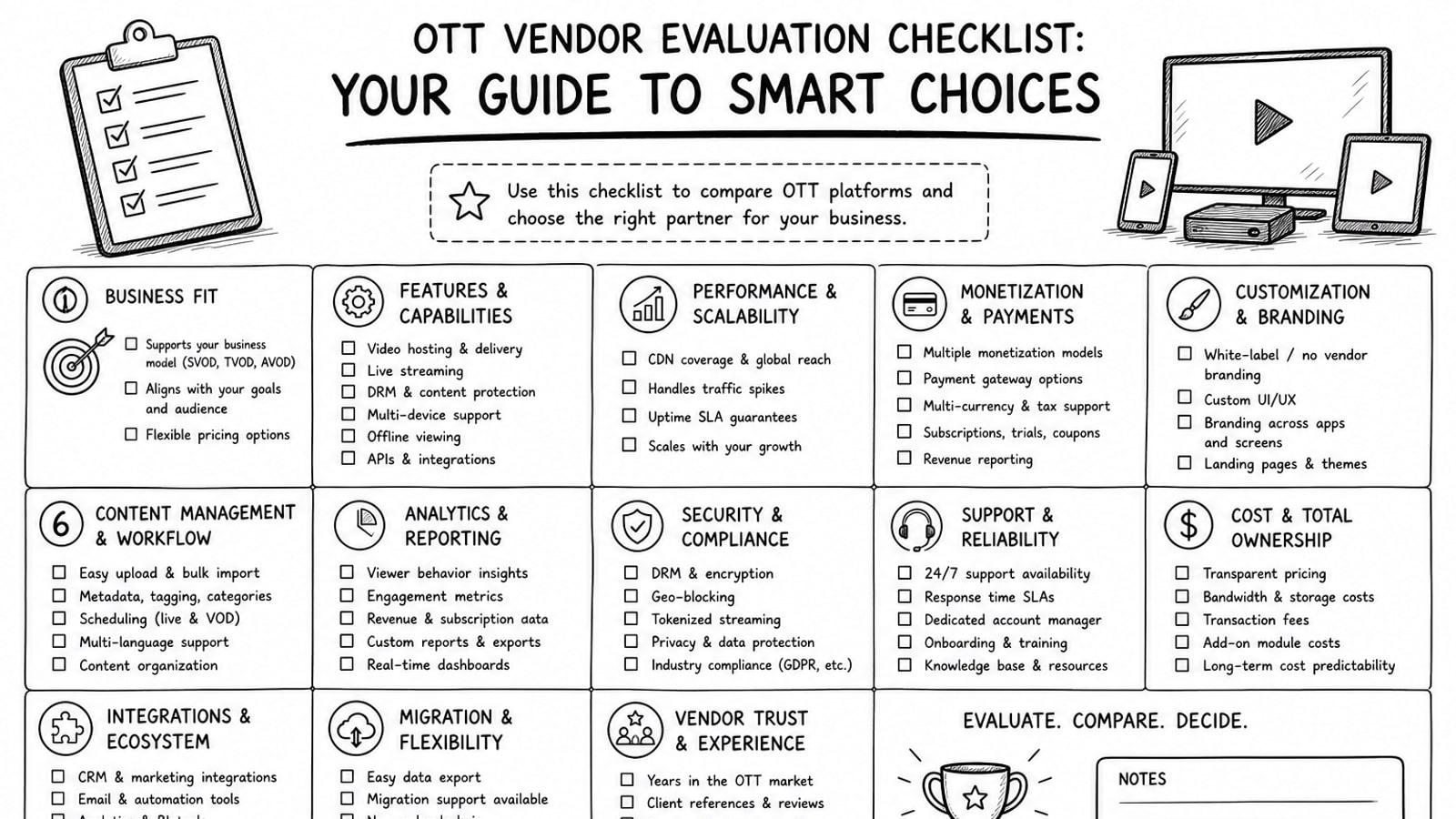
OTT Vendor Evaluation Checklist: Your Guide to Smart Choices
A practical guide to evaluating OTT vendors, with a clear checklist for delivery, security, workflow, cost, ownership, and long-term platform fit.
Read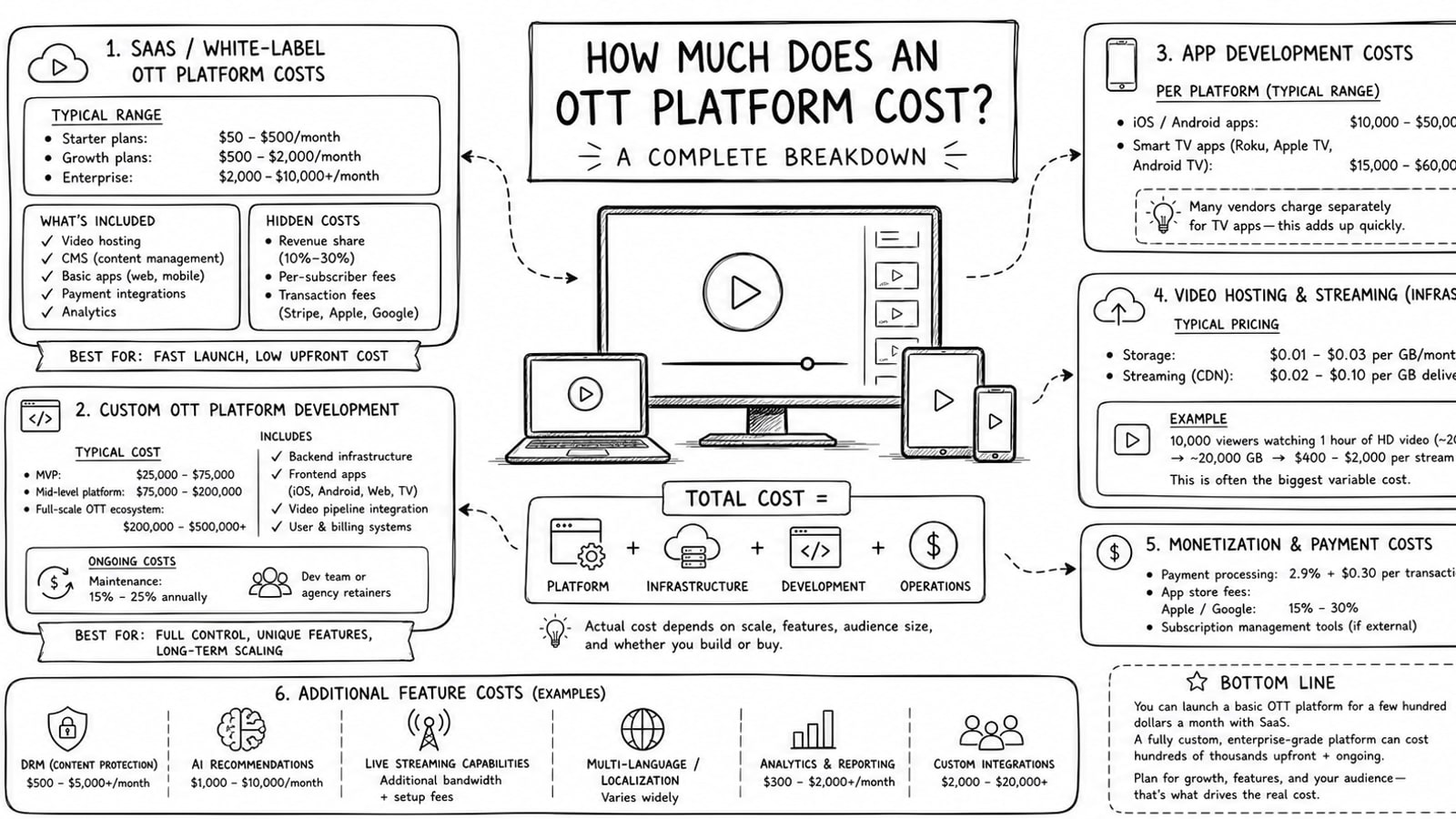
How Much Does an OTT Platform Cost? A Complete Breakdown
A practical breakdown of OTT platform costs, including launch expenses, recurring infrastructure costs, live and on-demand pricing examples, and how a BYOA model can improve cost control.
Read