Video Platform
Why Video Businesses Are Upgrading from Simple Hosting to Full Platform Solutions
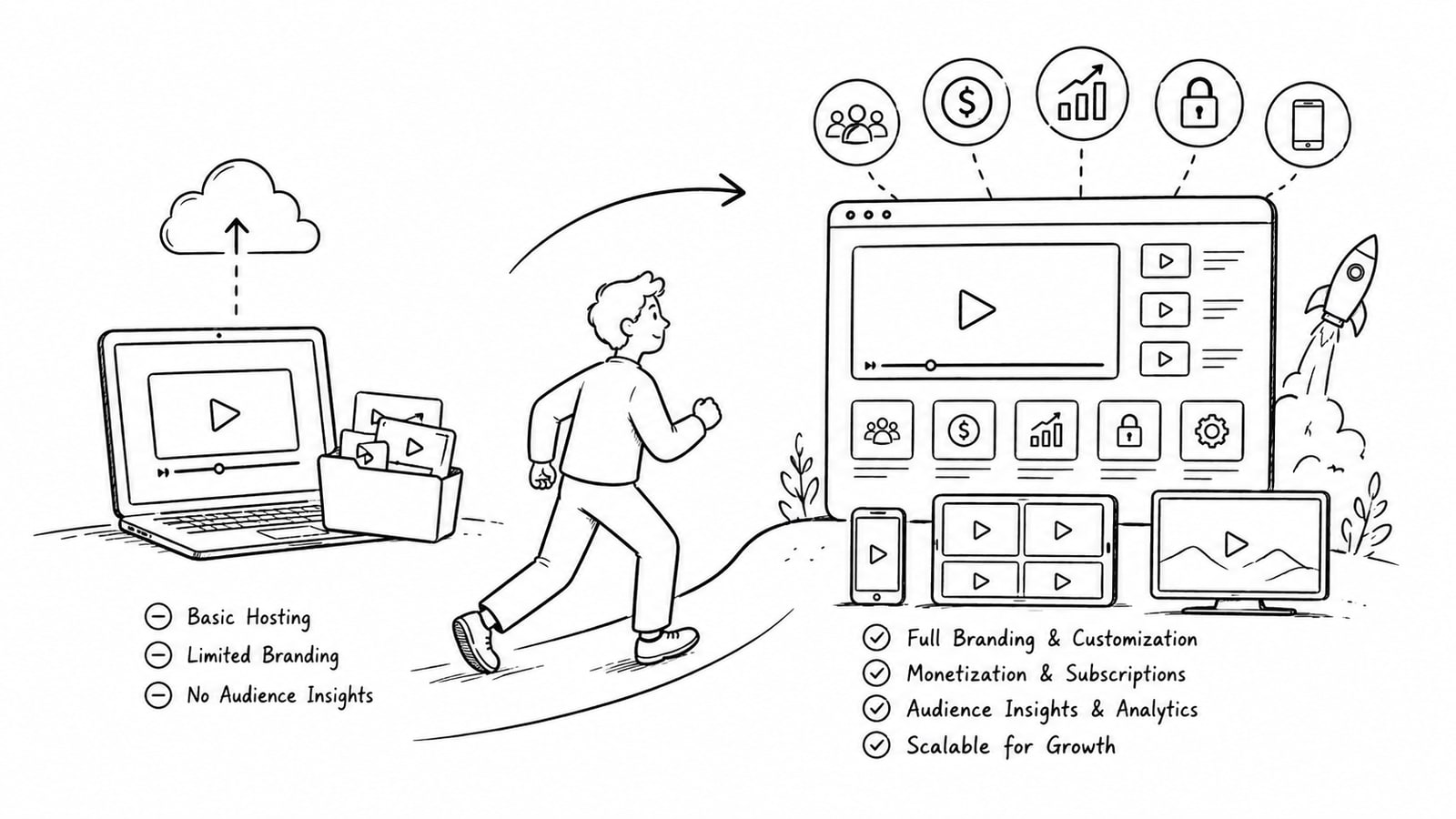
Why Video Businesses Are Upgrading from Simple Hosting to Full Platform Solutions
Video businesses are outgrowing basic hosting because simple storage and playback are no longer enough. As video volumes rise, teams need stronger security, clearer analytics, better monetization tools, and workflows that connect to the rest of the business. That is why more companies are moving from simple video hosting to full video platform solutions built for scale, control, and revenue.
Quick Answer
Simple hosting helps you upload and embed videos. A full platform helps you run a video business.
The difference matters once your team needs features like viewer-level analytics, subscription or ad monetization, DRM, single sign-on, API access, workflow automation, governance, and integrations with CRM, LMS, or BI tools. For many growing businesses, the upgrade is less about more features and more about fixing operational limits that basic hosting cannot solve well.
Key Takeaways
Basic hosting works for storing and sharing videos, but it usually falls short on governance, reporting, and monetization.
Growing video businesses need platforms that support security, analytics, integrations, and multiple revenue models.
Fragmented tool stacks create extra cost, data silos, and compliance risk.
Platform solutions help teams centralize video operations across marketing, training, events, support, and paid content.
The strongest upgrade case appears when video becomes a revenue channel or a business-critical workflow.
What Changed: Video Is Now a Business System
A few years ago, many companies treated video as a content format. Now they treat it as infrastructure.
That shift changes the requirements. Once video powers onboarding, sales enablement, customer education, internal communications, live events, paid memberships, or OTT offerings, the business needs more than a place to upload files. It needs reliability, controls, measurement, and ways to connect video data to business outcomes.
Market data points in the same direction. Grand View Research estimates the enterprise streaming media market reached USD 38.30 billion in 2024 and projects continued growth through 2030. Its analysis also highlights rising demand for cloud scalability, AI-driven analytics, and secure, high-quality platforms.
Vimeo’s 2025 enterprise report describes the same pattern from the operator side: more video volume, more fragmented stacks, and more pressure to unify workflows. In that report, 73% of enterprise leaders said video volume would keep accelerating, and large enterprises reported using an average of five different video platforms.
Simple Hosting vs. Full Platform Solutions
Simple hosting: upload, store, embed, and play videos with basic privacy controls.
Full platform solution: adds deeper analytics, governance, DRM, SSO, monetization, APIs, integrations, and workflow automation.
If your business only needs a clean video player on a few web pages, simple hosting may still be enough. If video touches revenue, compliance, training, or customer lifecycle, platform capabilities start to matter fast.
Why Full Video Platform Solutions Are Winning
1. Businesses Need More Than Views
The old question was whether people watched the video. The new question is what the video actually did for the business.
That is where full video platform solutions have an edge. Teams increasingly need to know who watched, how long they stayed, where they dropped off, and what happened next. If your stack cannot provide that level of visibility, it becomes hard to improve content or justify spend.
2. Security and Governance Are No Longer Optional
As video moves deeper into operations, companies face more legal, compliance, and access-control pressure. Internal training, executive communications, healthcare information, customer data, premium content, and licensed media all raise the stakes.
Basic hosting may offer passwords or private links, but larger organizations usually need stronger controls such as role-based permissions, single sign-on, audit logs, and DRM.
3. Fragmented Video Stacks Create Hidden Costs
Many teams do not notice the problem at first because the stack grows one workaround at a time. They start with hosting, then add webinars, transcription, live streaming, analytics exports, paywall tools, app vendors, and manual compliance processes.
The result is a stack that technically functions but is expensive to maintain and hard to govern. Fragmented systems often lead to workflow inefficiencies, weak visibility, inconsistent user experiences, and siloed data.
4. Monetization Has Become More Sophisticated
For paid content businesses, simple hosting is rarely the end state. Once a company wants subscriptions, rentals, advertising, tiered memberships, branded apps, or direct-to-consumer streaming, it needs product and commerce capabilities that basic hosting platforms generally do not offer well on their own.
This is often the moment when a video business stops thinking like a media uploader and starts thinking like a platform operator.
5. Integrations Turn Video Into a System of Record
A full platform is not just about video features. It is about making video work with the rest of the business.
Sending viewing data into a CRM
Syncing training completion to an LMS
Exporting engagement data into BI tools
Triggering workflows through APIs and webhooks
Connecting marketing automation and audience segmentation
How Full Video Platform Solutions Support Different Business Models
Media and OTT brands need monetization flexibility, branded apps, DRM, retention analytics, and dependable streaming quality.
B2B marketing teams need gated video, engagement reporting, CRM integration, webinar support, and content performance data tied to pipeline.
Learning and training teams need viewer-level tracking, completion data, permissions, captions, searchability, and LMS integration.
Enterprise communications teams need internal distribution, governance, SSO, role controls, accessibility support, and auditability.
Product and support teams need searchable video libraries, reuse workflows, analytics, and the ability to turn video into self-service support content.
Signs You’ve Outgrown Simple Hosting
Your team uses multiple disconnected tools to publish, secure, measure, and monetize video.
Stakeholders ask for reporting that your current setup cannot provide.
You need viewer-specific tracking or compliance records.
You run paid content, memberships, or branded streaming apps.
Your legal or IT team is asking for stronger governance.
A Practical Upgrade Framework
Define the job video is doing. Decide whether video mainly supports brand awareness, paid distribution, internal training, customer education, or product usage.
Map the operational gaps. List what breaks today, such as weak analytics, no monetization support, poor permissions, too many vendors, missing integrations, or unreliable live delivery.
Prioritize business-critical capabilities. Focus on the features that directly support revenue, compliance, or efficiency.
Measure platform value beyond hosting cost. Compare platform investment against the combined cost of fragmented tools, manual work, lost insight, slower launches, and avoidable risk.
How to Migrate from Simple Hosting to a Full Platform Solution
Audit your current stack. Document where videos live, who owns them, what tools are attached, and where data flows break.
Segment your content. Separate public marketing videos, paid content, internal training, sensitive communications, and live events.
Identify required integrations such as CRM, LMS, CMS, analytics warehouse, or identity provider.
Pilot one high-value workflow where platform value is easiest to prove, such as compliance training, webinar-to-pipeline reporting, or subscription content.
Build governance early. Define permissions, taxonomy, retention rules, metadata standards, and reporting ownership.
Track business outcomes such as completion rate, subscriber retention, training compliance, content reuse, watch quality, conversion impact, and workflow time saved.
Common Mistakes Businesses Make
Buying for features instead of use cases
Underestimating metadata and governance
Treating migration as a technical project only
Ignoring monetization requirements too long
Keeping analytics disconnected from the business
Experience / Case Study Section
[Add real company example here]
Suggested structure: company type, original simple-hosting setup, operational pain points, why the team evaluated a full platform, capabilities selected, implementation timeline, measurable outcomes, and a stakeholder quote [Source needed].
Trust and Evaluation Criteria
What level of analytics is available: video-level, viewer-level, funnel-level, or subscriber-level?
Which security controls are native, and which require custom work?
Does the platform support DRM, SSO, audit logs, and role-based permissions?
What monetization models are supported today?
Which integrations are native, and which depend on APIs only?
Conclusion
The move from simple hosting to full platform solutions is happening because video is no longer a side channel. It is becoming part of how businesses sell, teach, support, communicate, and earn revenue.
For smaller or low-complexity use cases, simple hosting still makes sense. But once video becomes operationally important, the real issue is not where the file lives. It is whether your business has the control, insight, security, and monetization tools to turn video into a durable advantage.
The smartest next step is not a blind migration. It is an honest audit of where your current setup is costing you time, revenue, insight, or trust.
FAQ
What is the difference between video hosting and a full video platform?
Video hosting mainly covers storage, playback, and embedding. A full video platform adds business capabilities such as analytics, governance, integrations, monetization, security controls, workflow tools, and scalability for multiple teams or use cases.
When should a business upgrade from simple hosting?
A business should consider upgrading when video becomes important to revenue, compliance, training, customer education, internal communication, or large-scale audience engagement.
Are full platform solutions only for large enterprises?
No. Mid-market businesses also outgrow simple hosting when they add memberships, paid video, internal training, live events, or deeper analytics requirements.
Do full video platforms help with monetization?
Yes. Many support subscriptions, rentals, advertising, free tiers, branded apps, and other monetization models.
Why are analytics such a big reason to upgrade?
Teams need more than total views. They want to understand engagement, completion, drop-off points, subscriber behavior, training participation, and business outcomes tied to video.
What security features matter most in a video platform?
Common priorities include single sign-on, role-based permissions, audit logs, DRM, encrypted delivery, content privacy controls, and compliance-related governance features.
Can a business migrate gradually instead of replacing everything at once?
Yes. A phased rollout is often the best approach, starting with one high-value use case and then expanding.
About the Author
R. Jabar
Marketing Strategist
R. Jabar is a marketing strategist who helps streaming and OTT brands turn complex product stories into clear, growth-driven messaging. She writes about audience acquisition, content monetization, and the marketing frameworks that help video platforms scale.
More from the blog
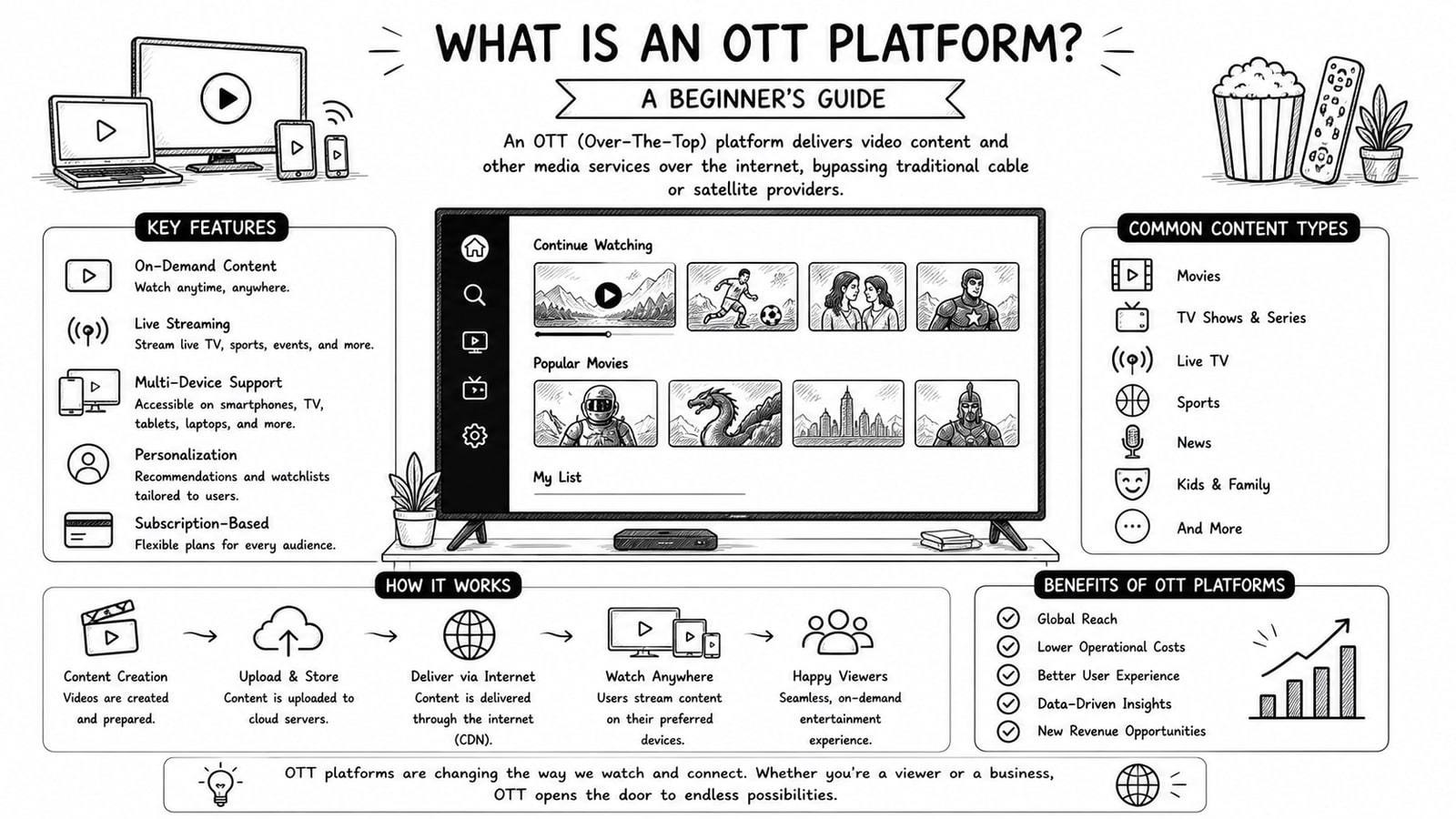
What Is an OTT Platform? A Beginner's Guide
A beginner-friendly guide to OTT platforms, how they work, key components, business models, and what to evaluate before choosing a solution.
Read
Launch Your Own Streaming Platform: No Code, No Hassle
A practical guide to launching a branded streaming platform without custom development, with advice on pricing, content packaging, platform selection, and subscriber experience.
Read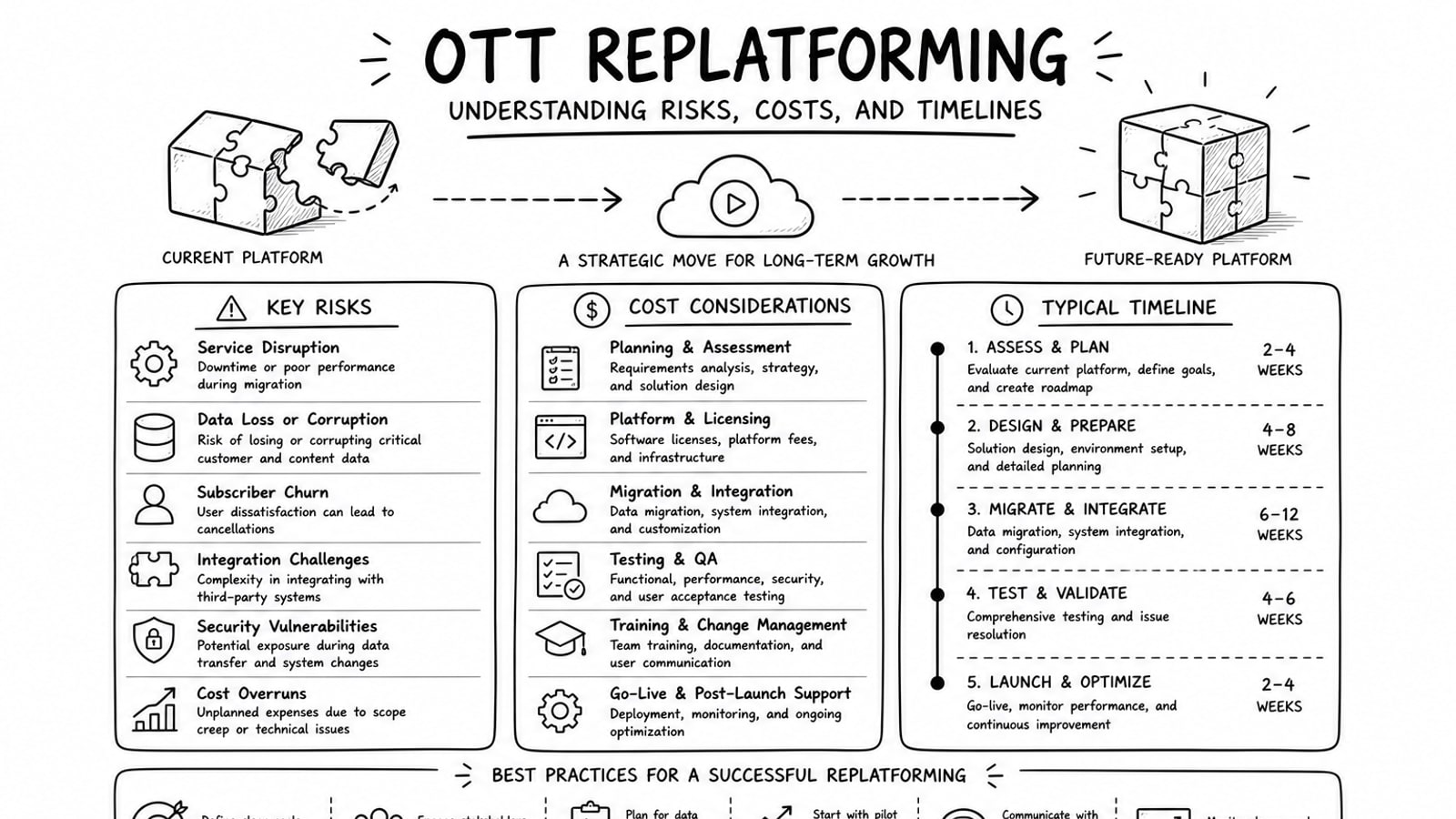
OTT Replatforming: Understanding Risks, Costs, and Timelines
A practical guide to OTT replatforming that explains why teams migrate, what usually drives risk and cost, how long projects tend to take, and where a BYOA delivery model can reduce lock-in.
Read