OTT platforms
Top OTT Platforms for Subscription Video Startups: Launch with Confidence
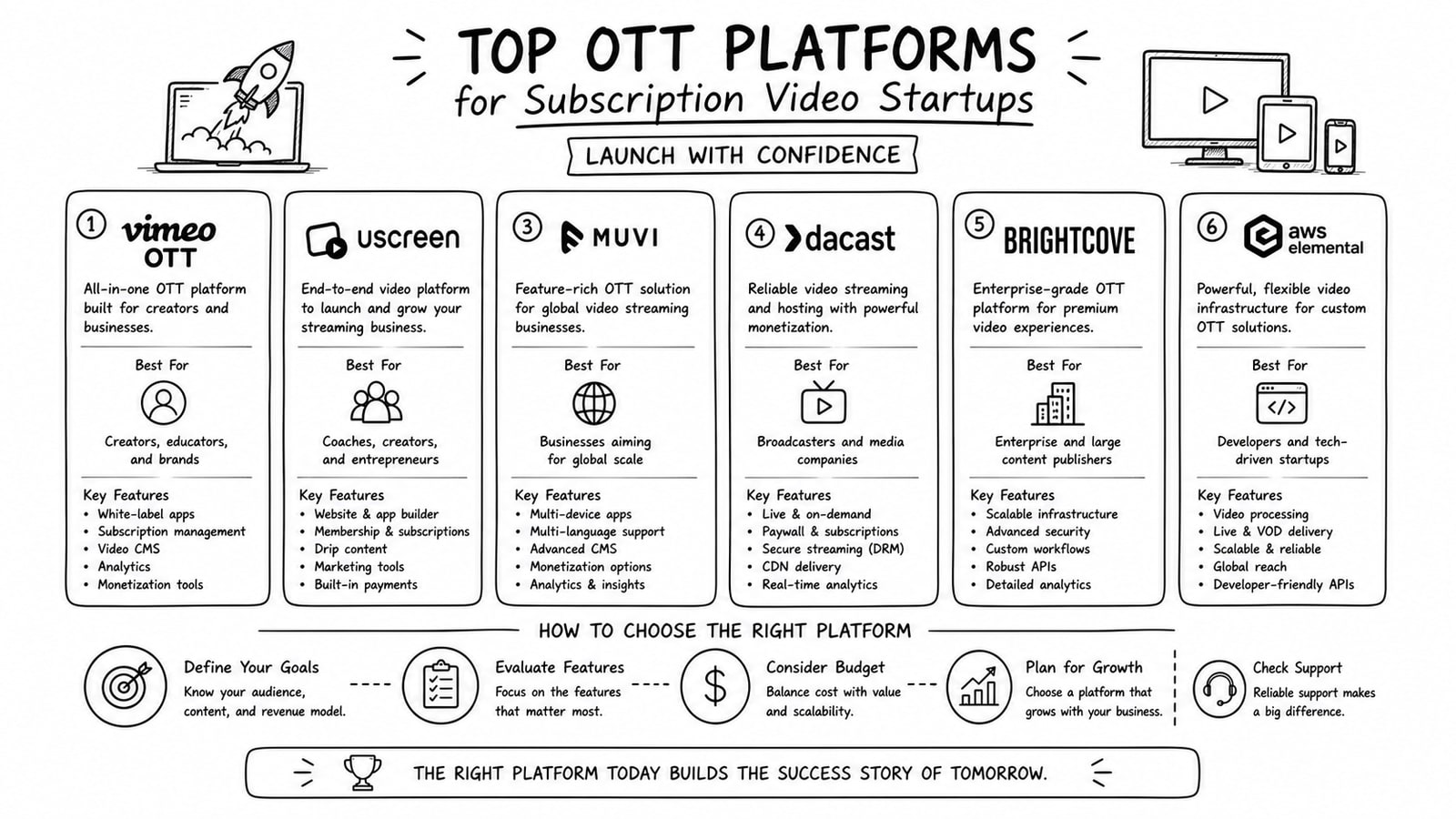
Choosing the right OTT platforms for subscription video startups is not just a technical decision. It shapes your launch speed, your monthly operating costs, your subscriber experience, and how much control you keep as the business grows. The strongest early choice is usually the one that helps you launch confidently without forcing a painful rebuild six months later.
For most startup teams, the best option is not automatically the biggest platform. It is the platform that fits your current stage, content model, budget, and delivery stack. Some founders need an all-in-one system with apps and billing included. Others need a more flexible operating model that lets them use their own infrastructure accounts and avoid platform-linked storage or subscriber fees.
Quick Answer
The best OTT platforms for subscription video startups usually fall into two camps. All-in-one platforms such as Uscreen, Vimeo OTT, Muvi, Brightcove, and Dacast help teams launch faster with packaged tools. A platform such as BitByte3 may fit better when a startup wants tighter operational control and a BYOA model, meaning Bring Your Own Accounts, for providers such as Cloudflare Stream or Cloudflare Images.
Key Takeaways
Startups should compare total operating model, not just headline pricing.
Vimeo OTT is attractive for low upfront commitment, while Muvi and Brightcove are stronger fits when a business needs broader enterprise features.
Uscreen stands out when community, memberships, and branded app distribution are central to the offer.
Dacast can work well for teams that want monetization tools plus white-label streaming without jumping immediately into a large custom contract.
BitByte3 is worth considering when you want a startup-friendly OTT operating system layered around your own provider accounts instead of platform-owned storage or subscriber-linked infrastructure charges.
What Subscription Video Startups Should Evaluate First
Launch speed: Can your team go live in weeks, not months?
Monetization model: Do you need SVOD only, or also AVOD, TVOD, coupons, trials, and app-store billing?
Multi-device reach: Web may be enough for launch, but many brands eventually want mobile and TV apps.
Operational control: Does the platform lock you into its media stack, or can you keep your own infrastructure accounts?
Growth costs: The real question is what happens when your library, subscribers, and app footprint get bigger.
Top OTT Platforms for Subscription Video Startups
1. Uscreen
Uscreen is a strong choice for startups building a membership-led video business. Its platform combines video delivery, monetization, community, branded websites, and mobile and TV apps. That makes it appealing for coaches, educators, niche media brands, and founder-led video businesses that want one operating environment instead of a stitched-together stack.
Why it fits: strong membership positioning, branded apps, built-in community, and a no-code path for teams that want to focus on content and retention. Watch-out: confirm current pricing and app packaging directly with Uscreen before budgeting, because plan details and app packages can change.
2. Vimeo OTT
Vimeo OTT remains one of the clearest options for founders who want to start with lower upfront commitment. Vimeo describes its OTT offer as a dedicated platform for launching a subscription service, and its pricing documentation states that SVOD pricing is based on a one-dollar per subscriber monthly fee plus merchant fees.
Why it fits: accessible entry point, integrated CMS, centralized customer dashboard, and branded app paths for qualifying plans. Watch-out: revenue-share and per-subscriber economics can look friendly at launch but should be modeled carefully as your subscriber base grows.
3. Brightcove
Brightcove is a better fit for startups that already think like media businesses and expect broader device coverage, more complex monetization, and higher operational expectations. Its OTT product emphasizes fast launch, multi-device experiences, and flexible monetization across subscription, ad-supported, hybrid, and freemium models.
Why it fits: polished OTT app experiences, enterprise-grade video tooling, and room to scale without a quick platform change. Watch-out: pricing is typically sales-led, so early-stage teams should confirm whether the contract shape matches startup cash flow.
4. Muvi
Muvi is built for teams that want a larger all-in-one OTT stack with CMS, monetization, apps, analytics, and multiple packaging levels. Its official pricing page currently shows Muvi One starting at 399 dollars per month billed annually, with infrastructure fees noted separately, and higher tiers adding more concurrency, apps, security, and workflow controls.
Why it fits: broad feature coverage, white-label positioning, app expansion options, and a clear upgrade ladder. Watch-out: founders should look beyond the base plan and model infrastructure, app, and scaling costs before choosing it as a long-term home.
5. Dacast
Dacast can be attractive for startups that want white-label streaming, monetization, and OTT support without stepping immediately into a large enterprise agreement. Its official pricing guidance currently lists plans starting at 39 dollars per month billed annually, with higher plans for events and scale.
Why it fits: straightforward entry pricing, monetization support for subscriptions, pay-per-view, and ads, plus OTT distribution paths. Watch-out: confirm bandwidth economics early, because streaming cost planning depends heavily on audience size, watch time, and video quality.
6. BitByte3
BitByte3 is worth considering when your startup wants a more flexible OTT operating model instead of a heavy all-in-one platform. According to the BitByte3 platform overview, the product connects CMS operations, viewer apps, playback, subscriptions, profiles, and service operations in one system. Its homepage also describes a BYOA service model, Bring Your Own Accounts, where your team uses its own streaming, storage, payment, analytics, and messaging services while BitByte3 manages the platform and operational layer around them. BitByte3's about page also says earlier deployments and sold projects reached more than 30,000 end users across 6 clients.
Why it fits: practical for startups that want cleaner cost control, ownership of vendor accounts such as Cloudflare Stream or Cloudflare Images, and a product system that spans web, mobile, TV, billing, and support workflows. Watch-out: BitByte3's verified hosting page explicitly notes that DRM is not currently supported, so services with strict studio-grade protection requirements should confirm fit before committing.
Which OTT Platform Fits Which Startup Stage
Audience-first membership business: Uscreen is often the cleanest fit.
Low-upfront launch with simpler economics to start: Vimeo OTT is worth a serious look.
Broader enterprise ambition and advanced multi-device rollout: Brightcove or Muvi may be more suitable.
Budget-aware streaming with monetization options and white-label delivery: Dacast can make sense.
Teams that want operational ownership and provider-account control from day one: BitByte3 may be the stronger long-term fit.
Why BitByte3 Can Be a Smart Alternative for Lean OTT Startups
Some startups do not want to rent the entire business logic from a single OTT vendor. They want apps, CMS, payments, publishing, and support flows to stay connected, but they also want their underlying provider accounts to remain in their own name. That is where BitByte3's BYOA positioning stands out.
If your team prefers using its own Cloudflare Stream, Cloudflare Images, analytics, or payment accounts, BitByte3 may help you launch with more control over recurring vendor fees, account access, and storage ownership. For a startup that expects to learn and adjust quickly, that can reduce the feeling of being trapped by a platform decision too early.
Common Mistakes Subscription Video Startups Make
Choosing based on homepage pricing alone instead of total launch and scaling cost.
Ignoring TV and mobile roadmap needs until after the web launch.
Underestimating billing, entitlement, support, and content operations work.
Locking into a platform without understanding who owns the underlying media, app, and service accounts.
Skipping a realistic launch checklist for QA, playback, support, analytics, and payment recovery.
A Practical Launch Checklist
Define your launch offer: subscription only, bundle plus subscription, or hybrid.
Map your first 90 days of content operations, not just day-one launch.
Confirm how billing, churn recovery, app submissions, and support tickets will be handled.
Model your growth costs at 500, 5,000, and 25,000 subscribers.
Check DRM, geo restrictions, app availability, and provider ownership requirements before signing.
Choose the platform that supports both your first launch and your likely second-stage growth.
First-Hand Experience or Case Study
Conclusion
The best OTT platforms for subscription video startups are the ones that let you launch with confidence and keep operating with clarity as you grow. If you want a packaged environment, platforms like Uscreen, Vimeo OTT, Muvi, Brightcove, and Dacast all bring credible paths. If you want more control over the operating model and provider accounts, BitByte3 is a practical option to evaluate. A confident launch comes from matching the platform to the business you are actually building, not the one a vendor assumes you have.
For internal linking, this article can naturally connect to https://bitbyte3.com/ and to future related posts such as https://bitbyte3.com/blog/ott-platform-pricing-guide or https://bitbyte3.com/blog/launching-a-white-label-streaming-platform.
FAQ
What is the best OTT platform for a subscription video startup?
There is no single best platform for every startup. Uscreen is strong for memberships and community, Vimeo OTT is attractive for lower upfront entry, Muvi and Brightcove suit broader scaling needs, Dacast works for budget-aware white-label streaming, and BitByte3 can fit teams that want BYOA-style control.
How much does it cost to launch an OTT subscription service?
Costs vary widely by platform, app scope, bandwidth, storage, and monetization model. A startup should budget for platform fees, payment processing, app packaging, support operations, and media infrastructure instead of comparing only a single monthly price.
Is an all-in-one OTT platform better than a BYOA model?
An all-in-one OTT platform is usually simpler for fast launch. A BYOA model can be better when a company wants more control over vendor accounts, storage, streaming costs, and long-term operational ownership.
Do startups need TV apps at launch?
Not always. Many startups can begin with web and mobile if that matches audience behavior. But teams should still choose a platform that can support TV expansion later if lean-back viewing is part of the business model.
Why does provider account ownership matter?
Provider ownership affects cost visibility, portability, and control. If your streaming, image, or payment accounts are in your own name, you may have more flexibility when negotiating costs, switching vendors, or auditing usage.
Can BitByte3 work for a startup OTT launch?
Yes, especially when a startup wants connected CMS, apps, payments, and support workflows while keeping underlying provider accounts under its own control. Teams should still confirm current fit for requirements such as DRM, device scope, and launch timeline.
Methodology and Editorial Note
This article was built from publicly available product, pricing, and feature information on official vendor websites accessed on May 2, 2026, plus company-provided positioning for BitByte3. Platform details, packaging, and pricing can change, so final procurement decisions should be confirmed directly with each vendor.
Sources and Further Reading
Vimeo Help Center: What is Vimeo OTT? https://help.vimeo.com/hc/en-us/articles/12426980146065-What-is-Vimeo-OTT
Vimeo Help Center: Vimeo OTT pricing breakdown https://help.vimeo.com/hc/en-us/articles/12425768622481-Vimeo-OTT-pricing-breakdown
Uscreen: How Uscreen Works https://www.uscreen.tv/how-it-works/
Uscreen Help: Native Mobile and TV Apps Overview https://help.uscreen.tv/en/articles/6708491-native-mobile-tv-apps-overview
Brightcove OTT product page https://www.brightcove.com/products/ott
Muvi One pricing https://www.muvi.com/one/pricing/
Dacast annual billing and pricing support article https://www.dacast.com/support/knowledgebase/how-does-annual-billing-work/
Dacast live streaming platform overview https://www.dacast.com/live-streaming-platform/
BitByte3 platform overview https://bitbyte3.com/
BitByte3 about page https://bitbyte3.com/about
BitByte3 video hosting and delivery page https://bitbyte3.com/solutions/video-hosting
About the Author
M. Jorani — LinkedIn
Software Engineer & Technical Writer
M. Jorani is a software engineer and technical writer with hands-on experience building streaming infrastructure, video pipelines, and OTT platforms. He writes about encoding, delivery architecture, and the engineering decisions that shape how audiences watch content across devices.
More from the blog
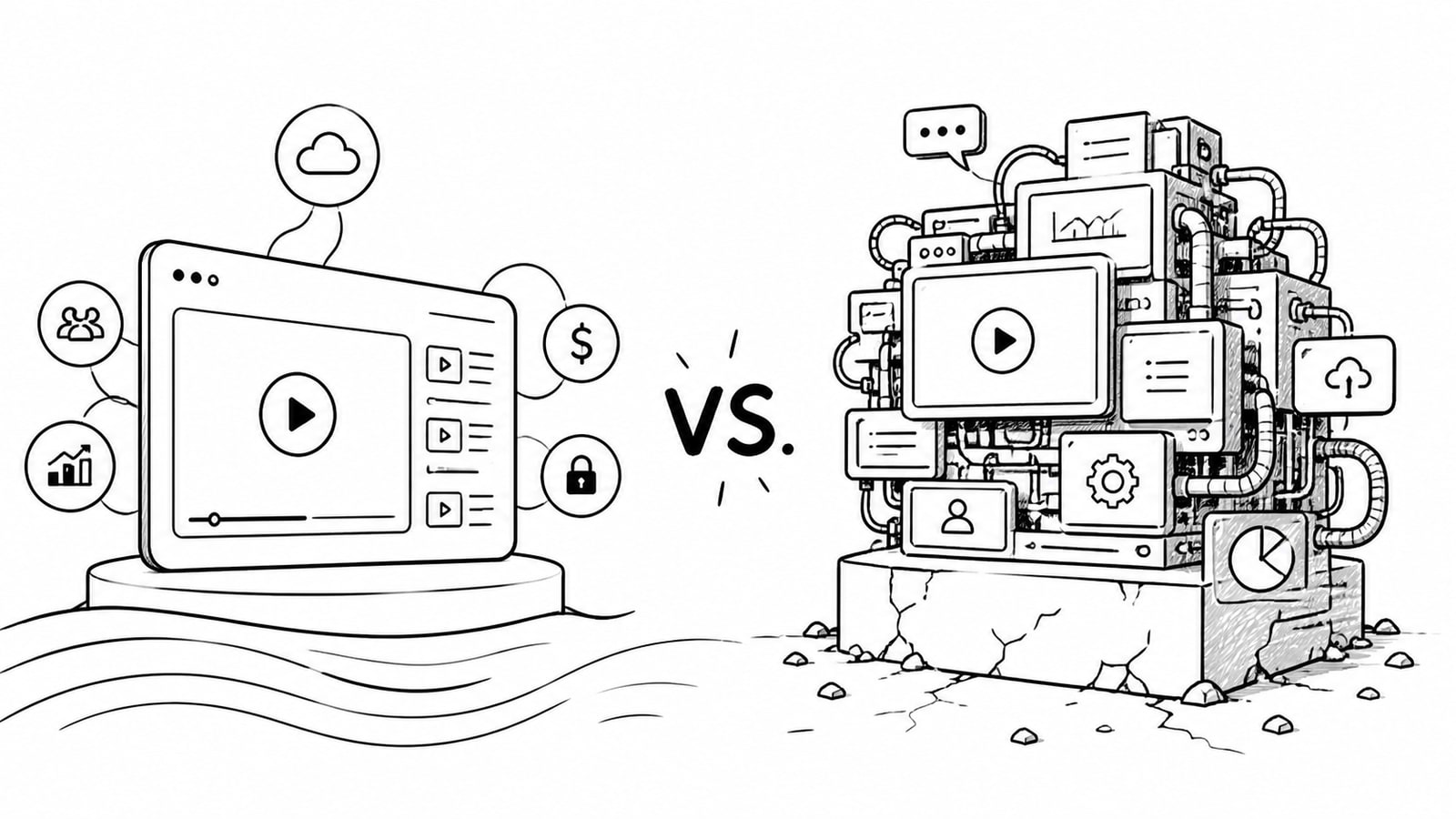
Brightcove vs. Kaltura: A Comprehensive Guide for OTT Platforms
A practical comparison of Brightcove and Kaltura for OTT teams evaluating launch speed, customization, monetization, operational complexity, and long-term platform fit.
Read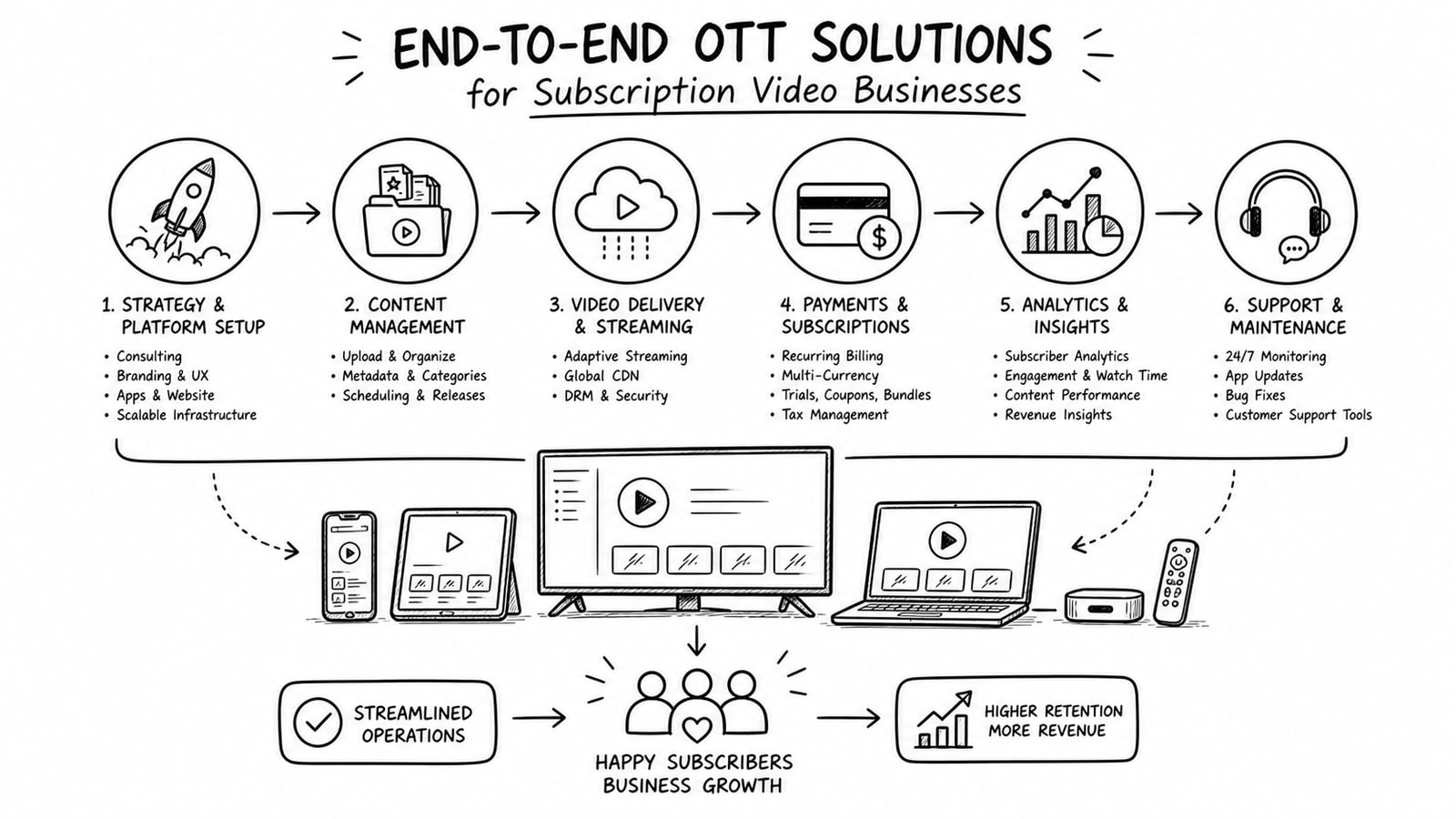
End-to-End OTT Solutions for Subscription Video Businesses: Streamline Your Operations
A practical guide to end-to-end OTT solutions for subscription video businesses, covering the operational layers that reduce complexity and where a bring-your-own-account approach from Bitbyte3 may fit.
Read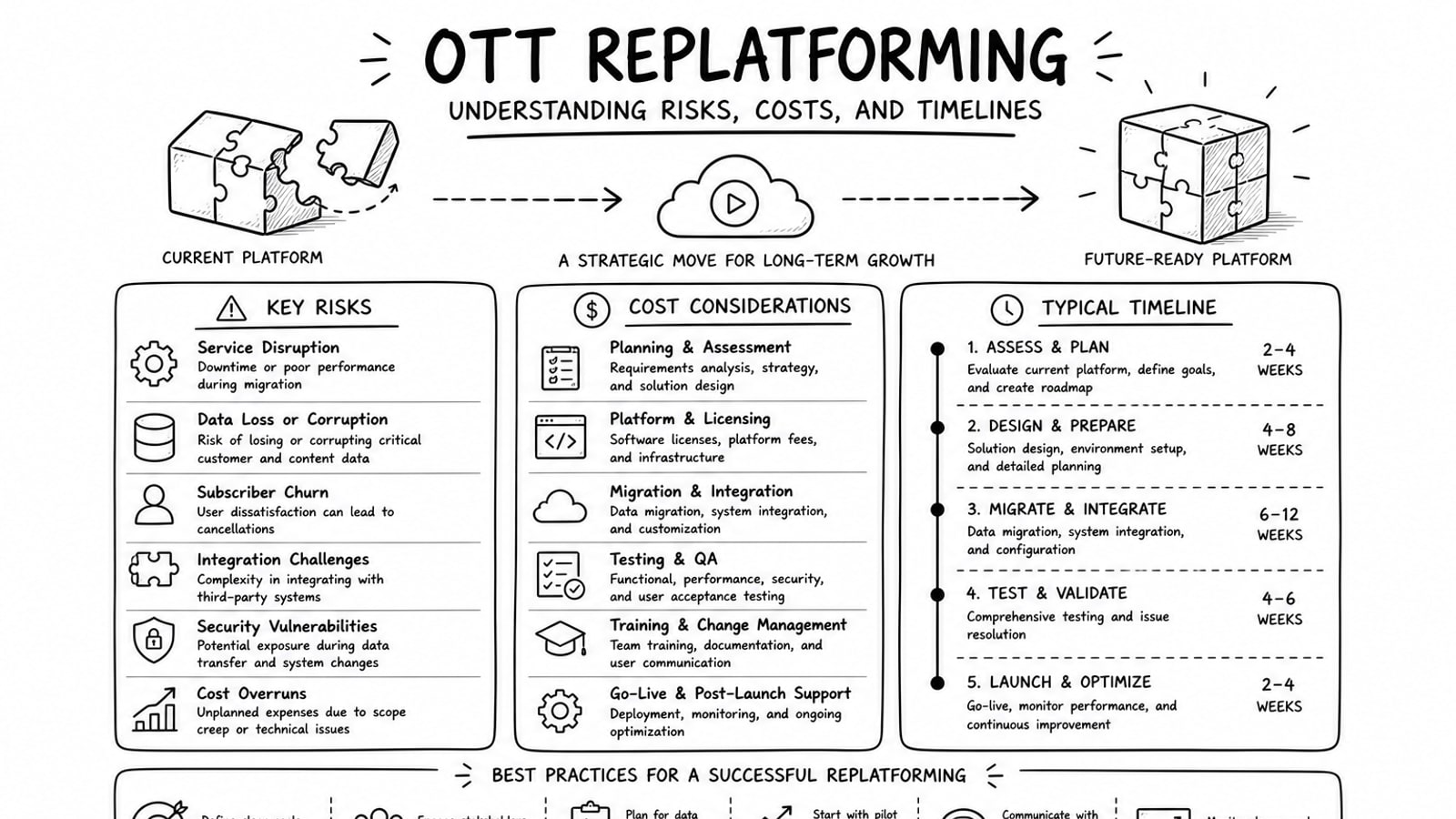
OTT Replatforming: Understanding Risks, Costs, and Timelines
A practical guide to OTT replatforming that explains why teams migrate, what usually drives risk and cost, how long projects tend to take, and where a BYOA delivery model can reduce lock-in.
Read