Subscriber Migration
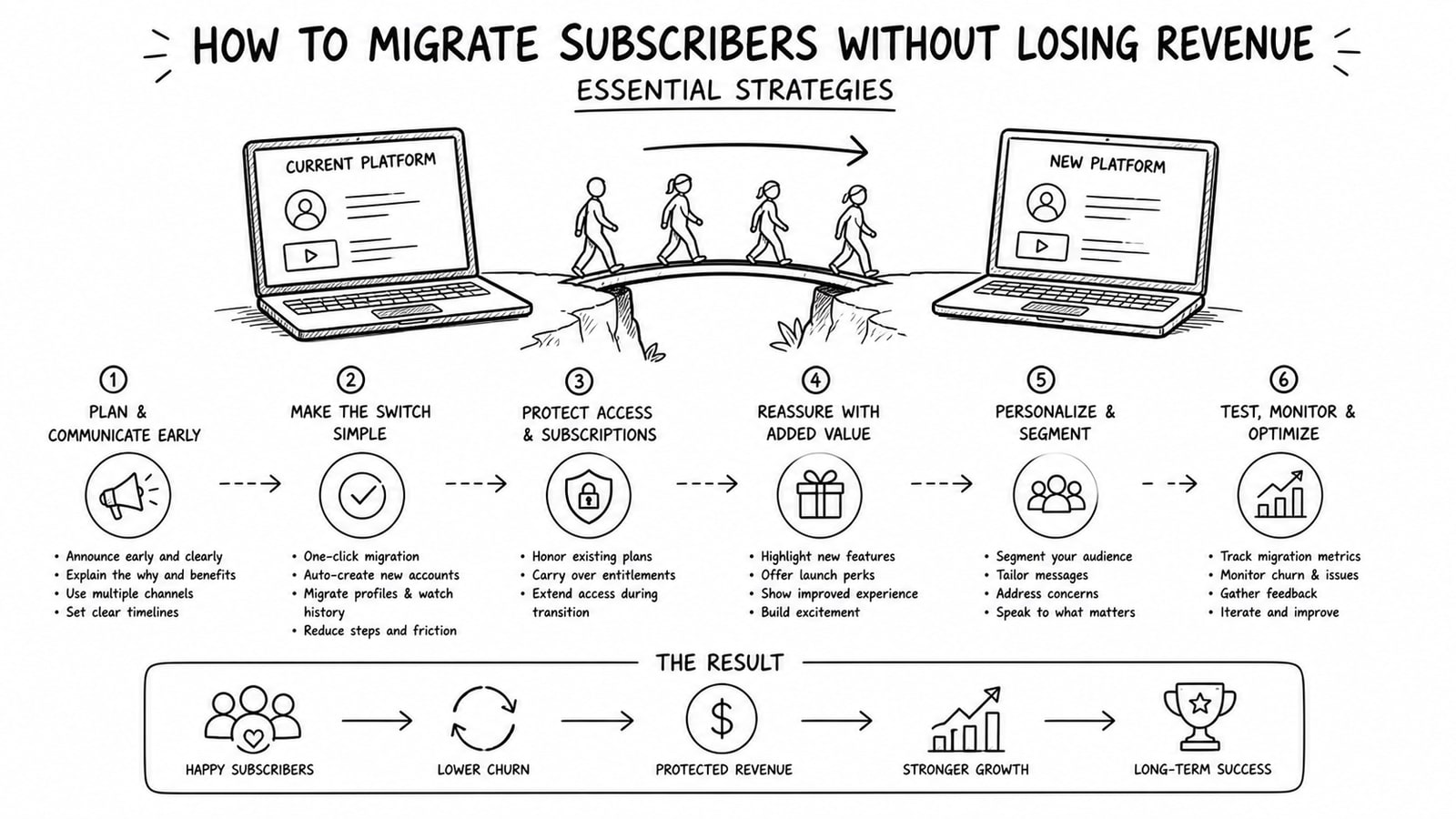
How to Migrate Subscribers Without Losing Revenue: Essential Strategies
Introduction
To migrate subscribers without losing revenue, you need to protect the moments where money is most likely to leak: renewals, payment credentials, access rules, customer communication, and reporting. A subscriber migration is not just a technical move from one platform to another. It is a revenue event. If billing dates change, entitlements break, or customers lose confidence, churn rises quickly.
The strongest migrations keep the customer experience stable while the backend changes underneath. That means mapping every active plan, preserving renewal logic, testing edge cases before launch, and giving support, finance, and product teams one shared playbook. For OTT and subscription businesses, the best outcome is simple: customers keep watching, paying, and renewing with as little friction as possible.
Quick Answer
The safest way to migrate subscribers without losing revenue is to audit your current subscriber base, preserve plan and renewal logic exactly, run parallel validation before cutover, communicate clearly before any billing-impacting change, and add payment recovery workflows for customers whose billing details need attention.
Key Takeaways
Treat subscriber migration as a revenue protection project, not just a platform project.
Map plans, coupons, billing cadence, trial status, taxes, and entitlements before moving any account.
Run reconciliation checks on subscriber counts, next renewal dates, and expected recurring revenue before launch day.
Prepare recovery workflows for failed payments and invalid payment methods so involuntary churn does not spike after migration.
For OTT businesses, infrastructure ownership and media-cost control can matter almost as much as billing continuity.
Why Subscriber Migration Threatens Revenue
Revenue loss during migration usually comes from a handful of preventable failures. Customers may be forced to re-enter payment details. Renewal dates may shift. Legacy plans may not map cleanly into the new catalog. Users may lose access because entitlements are tied to the old system. Finance teams may also lose confidence if dashboards stop matching booked recurring revenue.
In OTT, there is another layer of risk: content delivery, app access, and media infrastructure. If playback, profiles, purchase history, or subscription access break during migration, customer frustration can turn into canceled renewals. That is why the migration plan has to cover billing, product access, support readiness, and cost control together.
A Comparison Framework for Subscriber Migration Decisions
Full cutover at once: Fastest timeline, but highest short-term revenue risk if plan mapping or payment recovery is incomplete.
Phased migration by segment: Slower, but easier to validate and safer for high-value subscribers, annual plans, and edge-case billing logic.
Front-end migration only first: Useful when you want to improve user experience without changing the billing engine immediately.
Billing migration first: Appropriate when revenue recovery, dunning, reporting, or pricing flexibility are the main business problems.
How to Migrate Subscribers Without Losing Revenue
1. Audit the current revenue base before touching production
Start with a migration inventory. Pull subscriber counts by plan, billing interval, geography, payment status, next renewal date, and entitlement type. Flag annual plans, paused accounts, grandfathered pricing, promotions, bundle logic, family profiles, and app-store subscribers. The goal is to know exactly what recurring revenue exists today and what must still exist after launch.
This step sounds operational, but it is actually strategic. If you cannot reconcile active subscribers and expected recurring revenue before migration, you will struggle to prove success after migration.
2. Preserve billing logic, not just customer records
A subscriber record without the right billing logic is not a successful migration. Preserve renewal dates, billing frequency, tax handling, currency, discounts, and access rights. If the new platform cannot support a legacy structure, decide whether to grandfather those users temporarily or move them through a carefully messaged transition path.
This is also where revenue leakage often begins. Even a small mismatch between old and new plan rules can create underbilling, double charging, or accidental cancellations.
3. Build a reconciliation layer and validate with a pilot group
Before full cutover, run a pilot migration with an internal test cohort or a low-risk subscriber segment. Compare the old and new systems line by line: active subscriber count, renewal calendar, trial status, entitlements, taxes, invoices, and expected recurring revenue. Reconciliation should continue after launch as well, especially across the first one to three billing cycles.
The best migrations create a temporary reporting layer that lets finance and operations teams answer one simple question every day: did we preserve the revenue base we expected to preserve?
4. Communicate before renewals are affected
Customers do not need every technical detail, but they do need confidence. Tell them what is changing, what is staying the same, whether they need to take action, and where to get help. Timing matters. Communication should go out before billing-impacting events, not after support tickets spike.
For subscribers with invalid or missing payment methods, use more than one channel when appropriate, such as email plus in-app messages or support outreach. Clear communication directly reduces involuntary churn.
5. Protect failed payments and involuntary churn
A migration often surfaces dormant billing problems, especially expired cards and missing default payment methods. If you do not have a recovery plan, these subscribers can quietly disappear over the next renewal cycle. Set up retry logic, customer reminders, and support escalation for high-value accounts before launch.
This matters because some revenue loss does not happen on migration day. It happens one or two billing cycles later when failed renewals go unrecovered.
A Revenue-Focused Checklist Before Launch
Confirm active subscriber counts match between source and destination systems.
Verify next billing dates, trial end dates, and coupon logic for each plan group.
Test account access, profile history, watchlists, and subscription entitlements on every supported device.
Prepare a support script for billing questions, access issues, and payment update requests.
Set daily reconciliation reporting for at least the first several renewal cycles after migration.
Cost Control Matters Too During Subscriber Migration
Protecting revenue is not only about preventing churn. It is also about avoiding new cost structures that erode margin after migration. Some teams move subscribers successfully but end up accepting higher infrastructure costs, new storage lock-in, or more complicated media workflows that reduce profitability.
For OTT businesses, this is where architecture decisions affect the business model. A migration may involve apps, CMS, content workflows, billing, analytics, and video delivery at the same time. If the new setup improves subscriber experience but adds rigid media ownership or hard-to-control storage spend, the revenue story is weaker than it looks.
Where Bitbyte3 Can Fit
Bitbyte3 may fit companies that are migrating not only subscribers, but also the OTT product around those subscribers. Based on the public Bitbyte3 site, the company offers OTT streaming solutions across web, iOS, Android, Android TV, Apple TV, CMS workflows, and monetization support for SVOD, AVOD, and PPV. That makes it relevant when revenue continuity depends on keeping the viewer experience stable across devices while the platform changes underneath.
For this draft, Bitbyte3 also asked to highlight its BYOA approach, meaning Bring Your Own Account. In that model, clients use their own infrastructure accounts, such as Cloudflare Stream for video and images, instead of being fully locked into a provider-controlled account structure. The practical benefit is that the client keeps direct ownership of the underlying account relationship and usage visibility. Review the exact commercial terms, storage responsibilities, and implementation details against current Bitbyte3 sales materials before publication.
Common Mistakes That Turn Migration Into Revenue Loss
Moving data without preserving plan logic, which creates billing errors after launch.
Ignoring annual subscribers, paused accounts, and grandfathered plans because they look like edge cases.
Failing to prepare for missing or invalid payment methods before the next renewal cycle.
Launching without cross-device entitlement testing for web, mobile, and TV apps.
Measuring only successful imports instead of measuring retained recurring revenue after cutover.
Case Study Placeholder
[Add a real migration case study here before publication: subscriber count, migration window, payment stack, device footprint, renewal retention, support ticket volume, and post-migration revenue outcome.]
Methodology and Editorial Note
This article was drafted to satisfy informational search intent around subscriber migration and revenue retention. It uses public vendor documentation and Bitbyte3's public website for product-context references. Any company-specific claims about pricing, BYOA implementation, subscriber outcomes, or deployment timelines should be reviewed against current internal sales and product materials before publishing.
FAQ
What is the biggest risk during subscriber migration?
The biggest risk is silent revenue leakage caused by broken renewal logic, failed payments, or access problems that trigger cancellations after launch.
How do you migrate subscribers without forcing everyone to re-enter payment details?
That depends on the payment provider and migration path. Some platforms offer migration tooling, but you still need validation and communication plans for customers with invalid or missing payment methods.
Should subscriber migration happen all at once or in phases?
Phased migration is usually safer because it lets teams validate billing, access, and support workflows on smaller cohorts before moving the full revenue base.
Why does OTT migration add more complexity than a normal billing migration?
OTT migration affects more than billing. It can also affect app access, watch history, profiles, media delivery, content entitlements, and perceived service quality across multiple devices.
What does BYOA mean in an OTT migration context?
BYOA means Bring Your Own Account. In practice, it usually means the client keeps ownership of core third-party infrastructure accounts rather than relying entirely on vendor-controlled accounts.
What should teams measure after subscriber migration?
Track retained recurring revenue, renewal success rate, payment recovery rate, support volume, subscriber access issues, and churn across the first several billing cycles.
Conclusion
If you want to migrate subscribers without losing revenue, the real job is preserving trust and continuity. Keep renewals stable, protect entitlements, reconcile the numbers daily, and communicate clearly before customers feel the change. When migration also includes your OTT product stack, choose an approach that protects both subscriber experience and long-term margin. For teams evaluating OTT migration paths, Bitbyte3 is one option to review, especially if infrastructure ownership and multi-platform delivery are part of the decision.
Sources and Further Reading
Stripe Documentation: Migrate subscriptions to Stripe Billing using toolkit - https://docs.stripe.com/billing/subscriptions/toolkit-reference
Stripe Documentation: Revenue recovery - https://docs.stripe.com/billing/revenue-recovery
Stripe Documentation: Automate payment retries - https://docs.stripe.com/billing/revenue-recovery/smart-retries
Cloudflare Stream Documentation: Overview - https://developers.cloudflare.com/stream/
Cloudflare Stream Documentation: Pricing - https://developers.cloudflare.com/stream/pricing/
Bitbyte3: OTT Streaming Solutions - https://bitbyte3.com/
Bitbyte3: Streaming Platform - https://bitbyte3.com/solutions/streaming-platform
About the Author
M. Jorani — LinkedIn
Software Engineer & Technical Writer
M. Jorani is a software engineer and technical writer with hands-on experience building streaming infrastructure, video pipelines, and OTT platforms. He writes about encoding, delivery architecture, and the engineering decisions that shape how audiences watch content across devices.
More from the blog
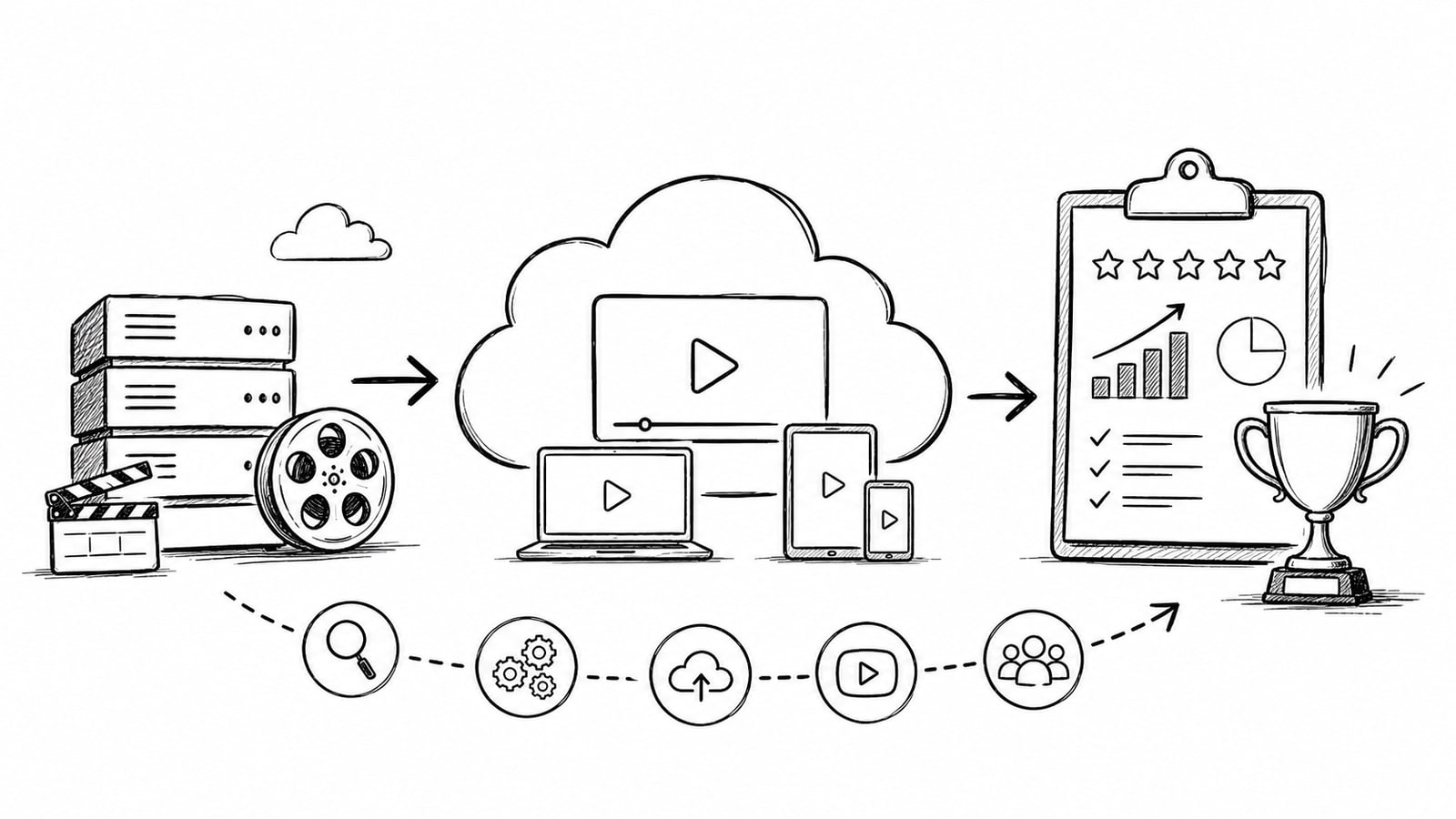
OTT Platform Migration Case Study Template: Documenting Success
A practical template for documenting OTT platform migration success, including goals, milestones, technical decisions, outcomes, and lessons learned.
Read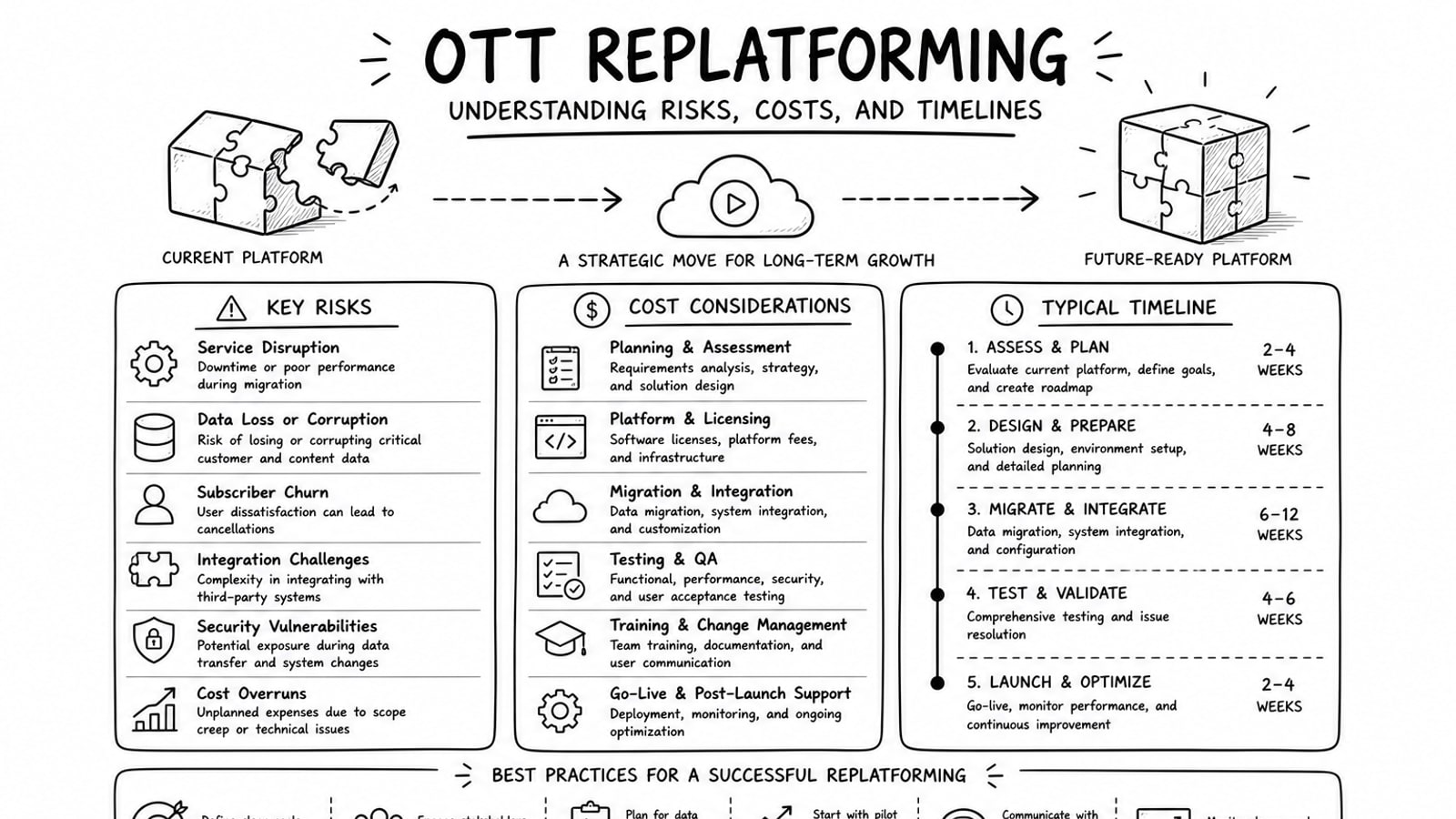
OTT Replatforming: Understanding Risks, Costs, and Timelines
A practical guide to OTT replatforming that explains why teams migrate, what usually drives risk and cost, how long projects tend to take, and where a BYOA delivery model can reduce lock-in.
Read
What Is an OTT Platform? A Beginner's Guide
A beginner-friendly guide to OTT platforms, how they work, key components, business models, and what to evaluate before choosing a solution.
Read