OTT
The Most Important OTT Metrics to Track for Success

OTT metrics are the signals that tell you whether your streaming product is healthy, growing, and worth paying for. The right dashboard helps you catch playback issues before viewers leave, understand which content keeps attention, and see whether your subscription model is actually improving over time.
Quick Answer
The most important OTT metrics to track are startup time, rebuffering rate, playback failures, watch time, completion rate, concurrent viewers, subscriber churn, active subscribers, ARPU, and lifetime value. Together, these metrics show both viewer experience and commercial performance, which is why successful OTT teams track them in one reporting rhythm rather than in separate silos.
Key Takeaways
OTT success depends on balancing viewer experience metrics with subscription and revenue metrics.
Startup time, rebuffering, and playback failures usually explain why viewers abandon a stream before content quality gets a chance to matter.
Watch time, completion rate, and concurrent viewers help you understand audience behavior and programming performance.
Churn, retention, active subscribers, ARPU, and LTV show whether the business model is durable.
Metric definitions must be consistent. If teams define a view, churn event, or watch time differently, decisions become noisy fast.
Why OTT Metrics Matter
An OTT platform can look busy on the surface and still underperform underneath. You may be attracting installs, promoting strong content, or spending on acquisition, but if playback is slow or subscribers leave after the first month, growth becomes expensive and fragile. Metrics are what separate surface activity from real progress.
The best OTT teams use metrics for three jobs at once: improve streaming quality, improve engagement, and improve unit economics. That means engineering, product, content, and commercial teams all need a shared view of the same funnel.
The Most Important OTT Metrics for Viewer Experience
1. Video Startup Time
Startup time measures how long it takes from a viewer pressing play to the first frame appearing. Bitmovin defines video startup time as the interval between play intent and the first frame event, while Mux tracks startup time as a core quality-of-experience metric. This is one of the first OTT metrics to watch because viewers are highly sensitive to delay at the beginning of a session.
If startup time worsens, marketing performance can appear to decline even when acquisition quality has not changed, because new users simply leave before the stream begins.
2. Rebuffering Rate
Rebuffering rate shows how much viewing time is lost to buffering. Mux measures current rebuffering percentage as time spent buffering divided by total watch time, and explicitly includes startup, rebuffering, and active watching in that total watch-time definition. This metric matters because a stream that starts quickly can still feel broken if playback repeatedly stalls.
Track rebuffering by device type, geography, ISP, CDN, and stream type. The average alone rarely tells the full story.
3. Playback Failure Rate
Playback failures capture fatal errors that stop a viewer from continuing the session. They are critical because failure events directly damage trust and increase abandonment. If failure rate rises during a release, content event, or traffic spike, that issue deserves immediate attention.
4. Exits Before Video Start
This metric shows how many viewers abandon before the stream actually begins. Mux treats it as a separate monitoring metric, which is useful because it isolates frustration that happens at the very top of the viewing funnel. If this number spikes, investigate startup time, authentication flow, manifest availability, and ad loading.
5. Average Bitrate and Video Quality
Average bitrate is a useful proxy for the visual quality viewers actually receive. It should not be read in isolation, though. Higher bitrate can improve picture quality, but only if it does not create extra buffering or unstable adaptation on weak networks. Good OTT reporting pairs bitrate with startup time and rebuffering so teams can see the trade-offs clearly.
The Most Important OTT Metrics for Engagement
6. Watch Time
Watch time tells you how much time viewers spent watching or attempting to watch content. According to Mux, watch time includes active playback as well as startup, rebuffering, and seeking time. This definition matters because it reminds teams not to confuse elapsed session time with satisfied viewing time.
Use watch time to compare content categories, acquisition channels, user cohorts, and release windows. A title with moderate traffic but very strong watch time may deserve more promotion than a title with high starts and weak completion.
7. Completion Rate
Completion rate shows how often viewers finish a piece of content. It is especially useful for episodic content, sports highlights, education, and premium VOD. When completion rate drops, look at where viewers leave, whether the drop aligns with ad breaks, and whether the playback experience degrades at the same timestamp.
8. Concurrent Viewers
Concurrent viewers are essential for live OTT services. Mux defines current concurrent viewers as people currently watching, waiting for the stream to start, rebuffering, or just experiencing a playback failure. This makes CCV useful not only for audience sizing but also for operational awareness during major live events.
The Most Important OTT Metrics for Revenue and Retention
9. Active Subscribers
Active subscribers tell you how many paying customers are currently on the platform. Stripe describes this as one of the most important subscription metrics because it provides a direct view of whether acquisition and churn-reduction efforts are working. For OTT businesses, this should be segmented by plan, market, billing cycle, and acquisition source.
10. Subscriber Churn Rate
Subscriber churn rate measures how many subscribers are lost over a period. Stripe defines subscriber churn rate as churned subscribers in the past 30 days divided by active subscribers 30 days ago plus new subscribers added during that window. Churn should be reviewed alongside cancellation reasons, failed payments, viewing activity, and support history so the team can separate content problems from billing or experience problems.
11. ARPU and ARPS
Average revenue per user and average revenue per subscriber help you understand monetization quality. Stripe defines ARPU as average MRR per paid subscriber, while Cleeng defines ARPS as total recurring revenue divided by active paid subscribers. In practice, these metrics help OTT operators evaluate pricing, packaging, upsells, bundling, and discount strategy.
12. Lifetime Value
Lifetime value estimates how much subscriber revenue a customer relationship is likely to produce. Stripe presents LTV as ARPU divided by subscriber churn rate. It is not a perfect metric, but it gives teams a practical way to compare customer value against acquisition cost and to prioritize retention initiatives.
A Simple OTT Metrics Framework
Acquisition layer: starts, sign-ups, trial starts, new subscribers.
Experience layer: startup time, rebuffering, playback failures, exits before video start, bitrate.
Engagement layer: watch time, completion rate, session frequency, concurrent viewers.
Commercial layer: active subscribers, churn, ARPU, LTV, revenue retention.
This structure helps teams avoid a common mistake: optimizing one metric while damaging another. A lower bitrate may reduce rebuffering, for example, but it can also hurt premium viewing experience. A discount campaign may boost sign-ups while weakening ARPU. A useful dashboard shows those trade-offs together.
Where Bitbyte3 Fits
If your OTT roadmap includes cost control and infrastructure flexibility, platform design matters as much as the dashboard. Bitbyte3 offers OTT solutions that can fit operators who want more control over delivery and storage rather than being locked into a single vendor stack.
One example is Bitbyte3's BOYA model, short for Bring Your Own Account. In that setup, each client uses its own service accounts, such as Cloudflare Stream for video and images, which can make storage and platform fees more transparent and give the client direct control over the underlying account relationship. For OTT businesses tracking margin alongside growth, that model can be worth evaluating.
Common Mistakes When Tracking OTT Metrics
Relying on averages only. Median and percentile views often reveal problems averages hide.
Treating technical and business metrics separately. Poor playback usually shows up later as poor retention.
Ignoring segmentation. Device, ISP, CDN, country, and plan type often explain performance differences.
Using inconsistent definitions for views, churn, or watch time across teams.
Tracking everything with the same urgency. Live events need operational monitoring, while churn and LTV need trend analysis.
How to Build a Better OTT Metrics Dashboard
Start with a small executive scorecard: startup time, rebuffering, active subscribers, churn, ARPU, and watch time.
Add segmentation by device, market, plan, content type, and acquisition source.
Set alert thresholds for live operations, especially startup failures, playback failures, and rebuffering spikes.
Review trends weekly, but investigate anomalies in real time for high-value live windows.
Tie every metric to an owner so the dashboard leads to action instead of passive reporting.
Conclusion
The most important OTT metrics are the ones that help you answer two simple questions: are viewers having a good experience, and is the business getting stronger? Startup time, buffering, failures, watch time, churn, and ARPU are not just dashboard numbers. They are operating signals. Track them consistently, define them clearly, and review them together so product, engineering, content, and revenue teams can move in the same direction.
If you are planning a new OTT product or reworking an existing one, this is also the right moment to review how your platform is structured. A solution such as Bitbyte3 can help teams pair the right metrics strategy with an OTT implementation model that gives them more visibility into both technical performance and cost control.
FAQ
What are OTT metrics?
OTT metrics are the performance, engagement, and business measurements used to evaluate a streaming platform. They usually include playback quality metrics such as startup time and buffering, audience metrics such as watch time and completion rate, and subscription metrics such as churn and ARPU.
Which OTT metric should I track first?
Start with startup time, rebuffering rate, playback failures, watch time, active subscribers, and churn. That set covers the core viewing experience and the core business outcome.
Why is startup time so important for OTT?
Startup time shapes the first impression of the stream. If viewers wait too long before the first frame appears, they are more likely to exit before content begins, especially on mobile or during casual viewing sessions.
How do OTT metrics affect churn?
Poor playback quality often lowers satisfaction, reduces repeat viewing, and increases cancellations over time. That is why technical metrics and retention metrics should be reviewed together rather than in separate dashboards.
What is a good OTT dashboard structure?
A strong OTT dashboard usually has four layers: acquisition, experience, engagement, and commercial performance. That makes it easier to see how operational issues affect subscriber and revenue outcomes.
How can Bitbyte3 help OTT platforms?
Bitbyte3 provides OTT solutions that can support teams looking for operational flexibility and clearer control over infrastructure choices. Its BOYA approach lets clients use their own service accounts, which can be attractive for teams that want direct ownership of storage and delivery relationships.
Methodology and Editorial Note
This article was written using publicly available metric definitions and analytics documentation from video and subscription platforms including Mux, Bitmovin, Stripe, and Cleeng. The goal is to provide a practical overview of the OTT metrics most teams should review regularly. Product-specific decisions should still be validated against your own instrumentation, billing setup, and audience behavior.
Sources and Further Reading
Bitmovin, Which metrics related to the startup time are collected by Bitmovin Analytics?: https://developer.bitmovin.com/playback/docs/which-metrics-related-to-the-startup-time-are-collected-by-bitmovin
About the Author
M. Jorani — LinkedIn
Software Engineer & Technical Writer
M. Jorani is a software engineer and technical writer with hands-on experience building streaming infrastructure, video pipelines, and OTT platforms. He writes about encoding, delivery architecture, and the engineering decisions that shape how audiences watch content across devices.
More from the blog
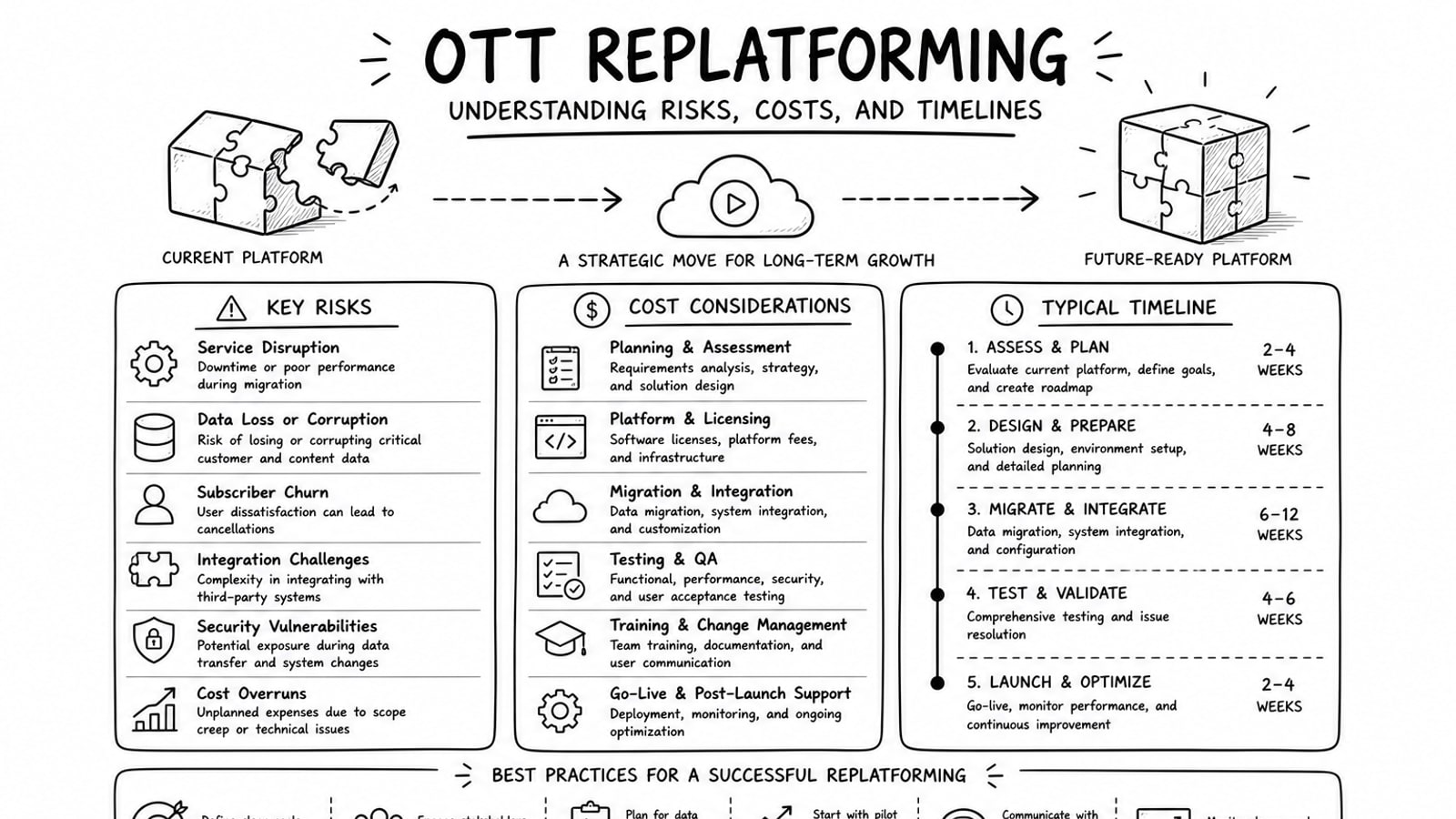
OTT Replatforming: Understanding Risks, Costs, and Timelines
A practical guide to OTT replatforming that explains why teams migrate, what usually drives risk and cost, how long projects tend to take, and where a BYOA delivery model can reduce lock-in.
Read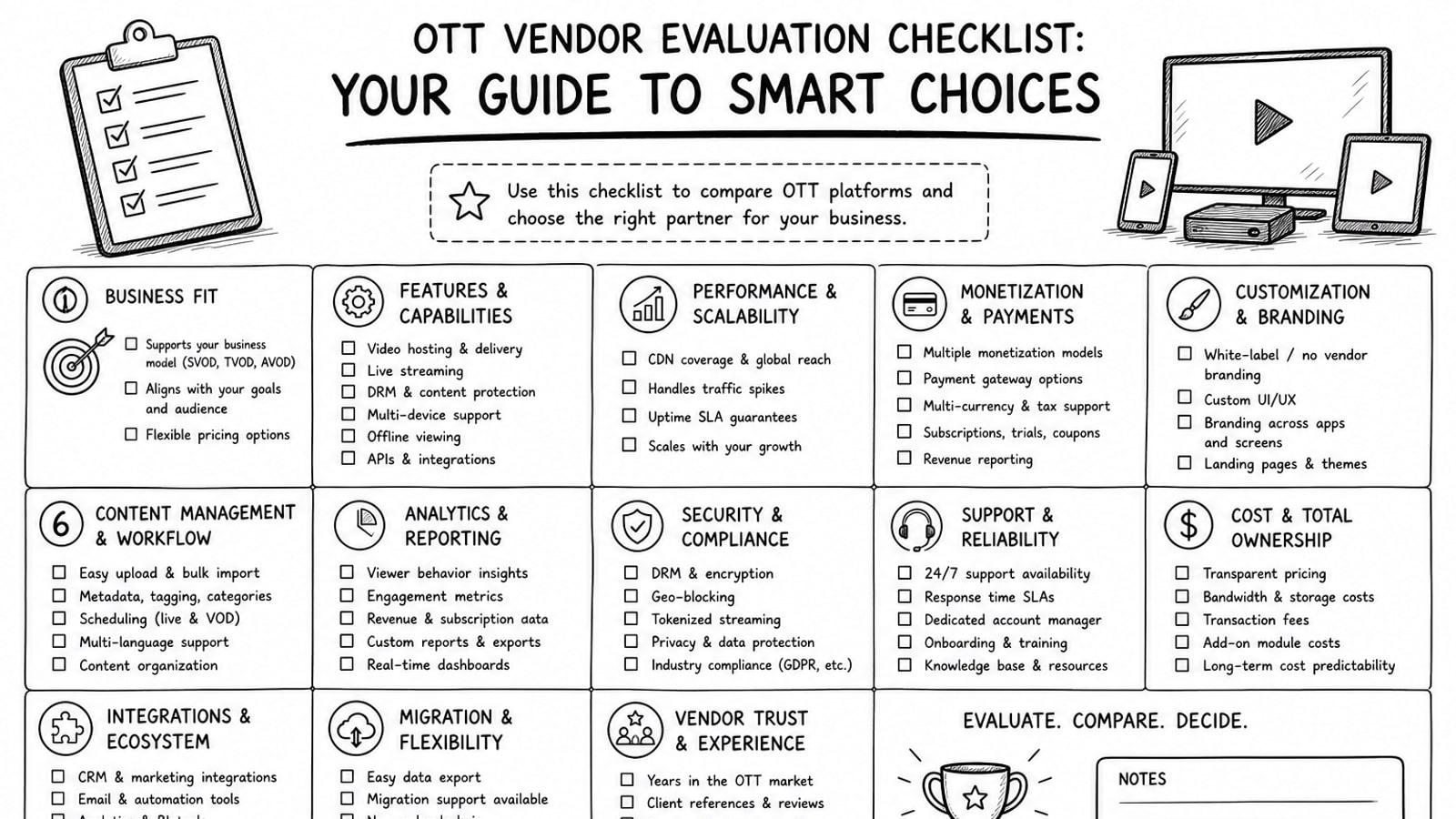
OTT Vendor Evaluation Checklist: Your Guide to Smart Choices
A practical guide to evaluating OTT vendors, with a clear checklist for delivery, security, workflow, cost, ownership, and long-term platform fit.
Read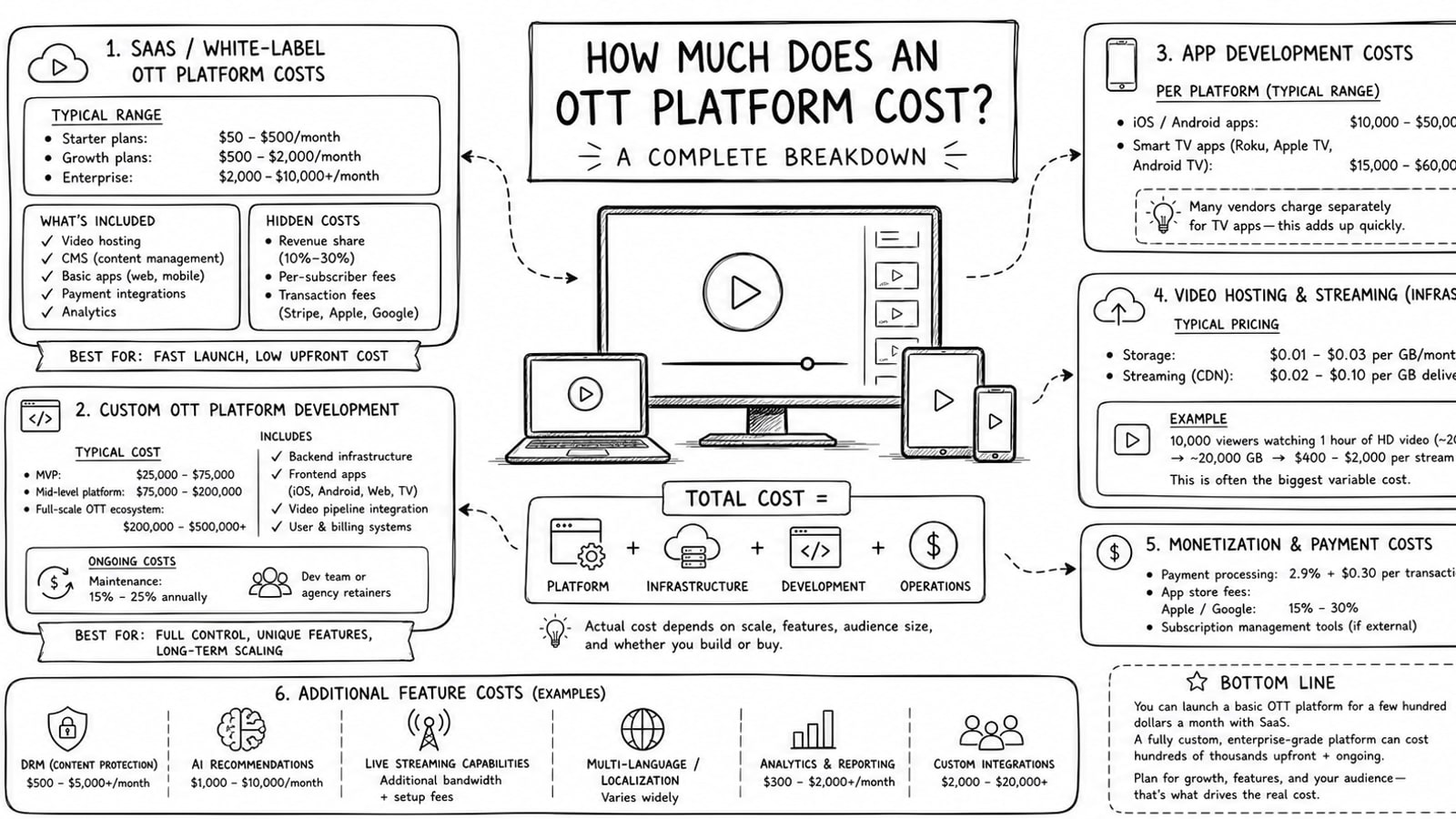
How Much Does an OTT Platform Cost? A Complete Breakdown
A practical breakdown of OTT platform costs, including launch expenses, recurring infrastructure costs, live and on-demand pricing examples, and how a BYOA model can improve cost control.
Read