OTT Platform
Build vs. Buy: Deciding the Best Approach for Your OTT Platform
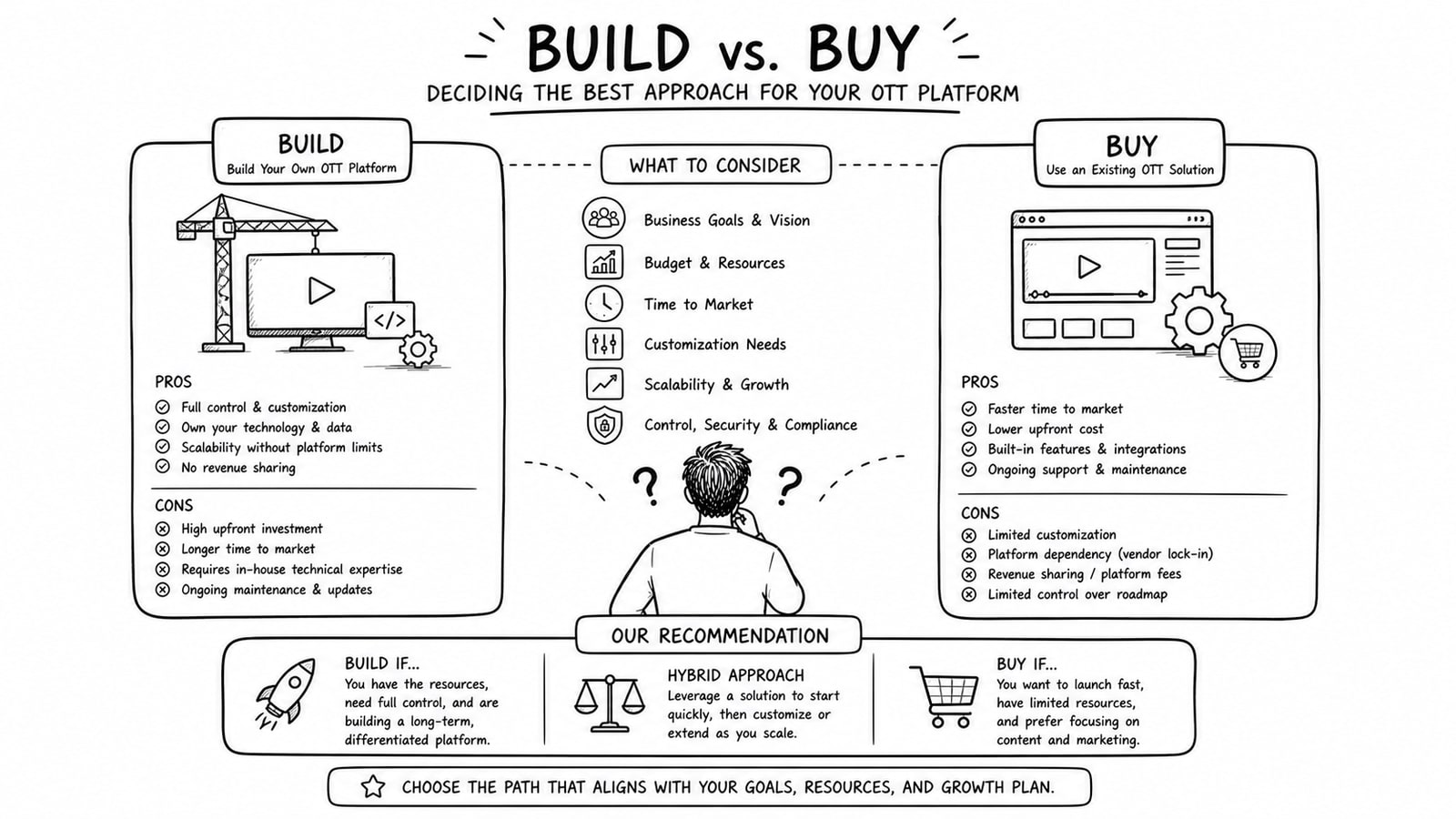
Choosing whether to build or buy an OTT platform is not just a technical decision. It shapes your launch timeline, operating costs, product flexibility, and your ability to scale video delivery without creating a long list of hidden dependencies. For most teams, the right answer is not purely build or purely buy. It is a decision about which layers create competitive advantage for your business and which layers are better handled by proven infrastructure or implementation partners.
Quick Answer
Build your OTT platform when your product needs are deeply differentiated, your team can own video operations long term, and custom workflows will create measurable business value. Buy when speed, predictable delivery, and lower implementation risk matter more than owning every layer. For many organizations, a hybrid approach works best: buy the heavy video infrastructure, keep your brand and product logic custom, and avoid unnecessary lock-in where possible.
Key Takeaways
A build-first approach offers maximum flexibility, but it also expands your responsibility for ingestion, encoding, playback, analytics, security, app updates, and uptime.
A buy-first approach reduces time to market and operational burden, but you need to examine pricing logic, roadmap control, data ownership, and switching costs.
The best decision framework compares six areas: business differentiation, launch urgency, total cost of ownership, internal expertise, monetization needs, and lock-in risk.
Hybrid models often outperform extremes because they let you keep control over customer experience while relying on established media infrastructure for delivery.
If vendor lock-in is a concern, look for partners that support account ownership, direct billing with infrastructure providers, and clean migration paths.
What Build vs. Buy Means for an OTT Platform
In OTT, building means your team creates and maintains a larger share of the product and delivery stack yourself. That can include CMS and catalog management, user identity, subscription logic, video ingestion, transcoding workflows, playback, DRM, analytics, smart TV apps, mobile apps, and ad or subscription monetization.
Buying means adopting a vendor platform, managed service, white-label product, or implementation partner for some or all of that stack. In practice, most OTT businesses buy more infrastructure than they first expect because video delivery is operationally demanding. AWS, for example, documents video-on-demand workflows as a combination of ingest, storage, processing, playback preparation, and global delivery rather than a single simple feature.
How to Decide Between Build vs. Buy for an OTT Platform
A useful decision process is to score each option against the same business criteria. That keeps the conversation grounded and stops the team from defaulting to whichever option sounds more modern, cheaper, or more flexible in the abstract.
1. Start with differentiation
Ask what truly makes your OTT product different. If your advantage comes from proprietary viewer experiences, highly specific content workflows, unusual rights rules, or custom monetization logic, building more of the stack may be justified. If your advantage comes from content, audience access, or partnerships, you may not need to build core streaming infrastructure yourself.
2. Measure time to market honestly
A custom OTT build often takes longer than the first roadmap suggests because platform work expands. Teams discover additional needs such as playback optimization, signed access, viewer analytics, app store release cycles, live stream resilience, and support operations. If launch timing matters for revenue, investor pressure, or content windows, buying can protect the schedule.
3. Compare total cost of ownership, not just vendor fees
The build option can look cheaper if you compare it only against vendor license fees. That comparison is incomplete. Real OTT cost includes engineering time, QA, DevOps, monitoring, streaming expertise, incident response, support, third-party services, and the cost of delayed launches. Vendor pricing also needs scrutiny, but internal labor and maintenance usually become the larger blind spot.
4. Check whether your team can operate video infrastructure long term
Owning a custom OTT stack is not just about launching version one. It is about running it continuously. That includes encoding decisions, CDN behavior, player issues across devices, content security, analytics quality, and scaling for traffic spikes. If your team is strong in product development but thin in media operations, buying can be the more disciplined choice.
5. Map monetization and rights complexity
Subscription, advertising, rentals, bundles, territory restrictions, and partner revenue splits all change the build-vs-buy equation. If your monetization model is straightforward, buying is easier. If revenue logic is unusual or central to your business model, more custom control may be worth the effort.
6. Evaluate lock-in before you sign or architect
Build does not eliminate lock-in, and buy does not automatically create it. The question is where lock-in lives. AWS notes that lock-in risk appears when you commit to technology without preserving practical freedom to change later. For OTT, that can show up in proprietary video pipelines, billing dependencies, content portability, app ownership, or limited access to raw audience data.
When a Build-First OTT Platform Strategy Makes Sense
You need custom viewer journeys that standard OTT products cannot handle cleanly.
Your team already has strong backend, app, and media engineering capacity.
The product itself, not just the content on it, is your main competitive moat.
You are prepared to fund ongoing operations after launch, not only initial development.
A build-first strategy can pay off when your roadmap depends on product behavior that vendors treat as edge cases. But the business should choose it with open eyes. You are committing to continuous ownership, not a one-time project.
When Buying an OTT Platform Is the Better Move
You need to launch quickly and start testing market demand.
Your team wants to focus on content, audience growth, or monetization rather than video infrastructure.
Operational predictability matters more than deep customization in phase one.
The vendor gives you strong control over branding, data access, and migration options.
Buying is often the stronger business decision when the priority is traction, not technical purity. A managed or semi-managed approach lets teams learn what viewers actually want before making expensive platform bets.
Why a Hybrid Model Often Wins
Many OTT teams do best with a hybrid model. They keep ownership of the customer experience, business logic, and brand while relying on specialized infrastructure for video processing and delivery. Cloudflare Stream, for example, is positioned as a serverless way to upload, store, encode, and deliver live and on-demand video without maintaining that infrastructure yourself. Its documentation also makes pricing dimensions explicit, which helps when forecasting usage-based cost.
This is where implementation partners can fit well. If your business wants faster execution without giving up too much control, a partner can assemble the right stack and leave the business-facing layers in your hands.
Where Bitbyte3 Fits in the Decision
If your team wants an OTT solution without fully surrendering infrastructure ownership, Bitbyte3 can fit into the hybrid path. Based on the information provided, Bitbyte3 offers an OTT solution with a BYOA model, meaning Bring Your Own Account. In that setup, each client uses its own service accounts for core media services instead of being forced into a vendor-controlled billing structure.
That model can be attractive for organizations that want clearer cost visibility, direct access to their own infrastructure dashboards, and fewer restrictions around storage or service ownership. For example, a client may prefer to use its own Cloudflare Stream account for video delivery and keep direct control over usage and billing. Any pricing advantage should be validated against your actual traffic, feature needs, and support scope rather than assumed in advance.
Step-by-Step OTT Decision Checklist
Define the business outcome you need in the next 12 to 18 months.
List which product capabilities are truly differentiating and which are commodity infrastructure.
Estimate full ownership cost for both options, including support, operations, and roadmap change requests.
Stress-test each option against scale, security, device coverage, and monetization requirements.
Review lock-in points such as data export, app ownership, contract terms, and billing control.
Choose the option that best fits your current stage, then revisit the decision once you have real user and revenue data.
Common Mistakes Teams Make
Treating launch cost as the same thing as total cost of ownership.
Underestimating the operational complexity of video playback across devices and network conditions.
Buying a platform without checking contract limits, export paths, or direct access to usage data.
Building too much too early before proving audience demand and monetization fit.
Case Study / Experience Placeholder
Insert a real Bitbyte3 or client example here if available. A strong version of this section would explain the client type, business goal, chosen architecture, implementation timeline, measurable result, and why build, buy, or hybrid was the right fit. No performance claims are included here because verified case-study details were not provided.
Conclusion
The best OTT decision is the one that matches your stage, your internal capabilities, and the parts of the product that actually matter to customers. Build when ownership of the product stack creates real strategic value. Buy when speed and operational stability matter more. Choose a hybrid path when you want a tailored experience without rebuilding the full media layer from scratch.
If your team is comparing custom development, managed platforms, and hybrid delivery models, map the decision to business outcomes first. Then pressure-test the architecture, the cost model, and the lock-in risk before moving forward. For organizations that want implementation support while keeping control over their own infrastructure accounts, Bitbyte3 is one path worth evaluating.
FAQ
Is it cheaper to build or buy an OTT platform?
It depends on your timeline, scale, and team structure. Buying often lowers early delivery risk, while building can make sense if your product needs are highly specialized and you can support long-term maintenance.
What is the biggest hidden cost in a custom OTT build?
The biggest hidden cost is usually ongoing operations. Video workflows require continuous attention after launch, including playback quality, device support, monitoring, support, and scaling.
When does a hybrid OTT model make the most sense?
A hybrid model works well when you want custom branding and workflow control but do not want to build core video infrastructure from the ground up.
What does BYOA mean in an OTT solution?
BYOA means Bring Your Own Account. Instead of running everything through a vendor-owned media account, the client uses its own infrastructure accounts for services such as video delivery, storage, or CDN tooling where applicable.
Does buying an OTT platform always create vendor lock-in?
No. Lock-in depends on contract terms, data portability, account ownership, app ownership, and whether you can migrate your content and workflows later without major disruption.
How should teams evaluate Bitbyte3 for OTT delivery?
Teams should compare Bitbyte3's implementation scope, support model, account ownership approach, and total cost against both fully managed OTT vendors and an internal build. The BYOA model is especially relevant if infrastructure control is a priority.
Methodology / Editorial Note
This article is designed for decision-stage readers evaluating OTT platform delivery models. It prioritizes practical tradeoffs over promotional claims and uses vendor and infrastructure documentation for general technical grounding. Any company-specific pricing, outcomes, testimonials, or performance claims should be inserted only after verification.
Sources and Further Reading
AWS Architecture Blog, Let’s Architect! Understanding the build versus buy dilemma: https://aws.amazon.com/blogs/architecture/lets-architect-understanding-the-build-versus-buy-dilemma/
AWS Elemental MediaTailor overview for OTT monetization context
About the Author
M. Jorani — LinkedIn
Software Engineer & Technical Writer
M. Jorani is a software engineer and technical writer with hands-on experience building streaming infrastructure, video pipelines, and OTT platforms. He writes about encoding, delivery architecture, and the engineering decisions that shape how audiences watch content across devices.
More from the blog
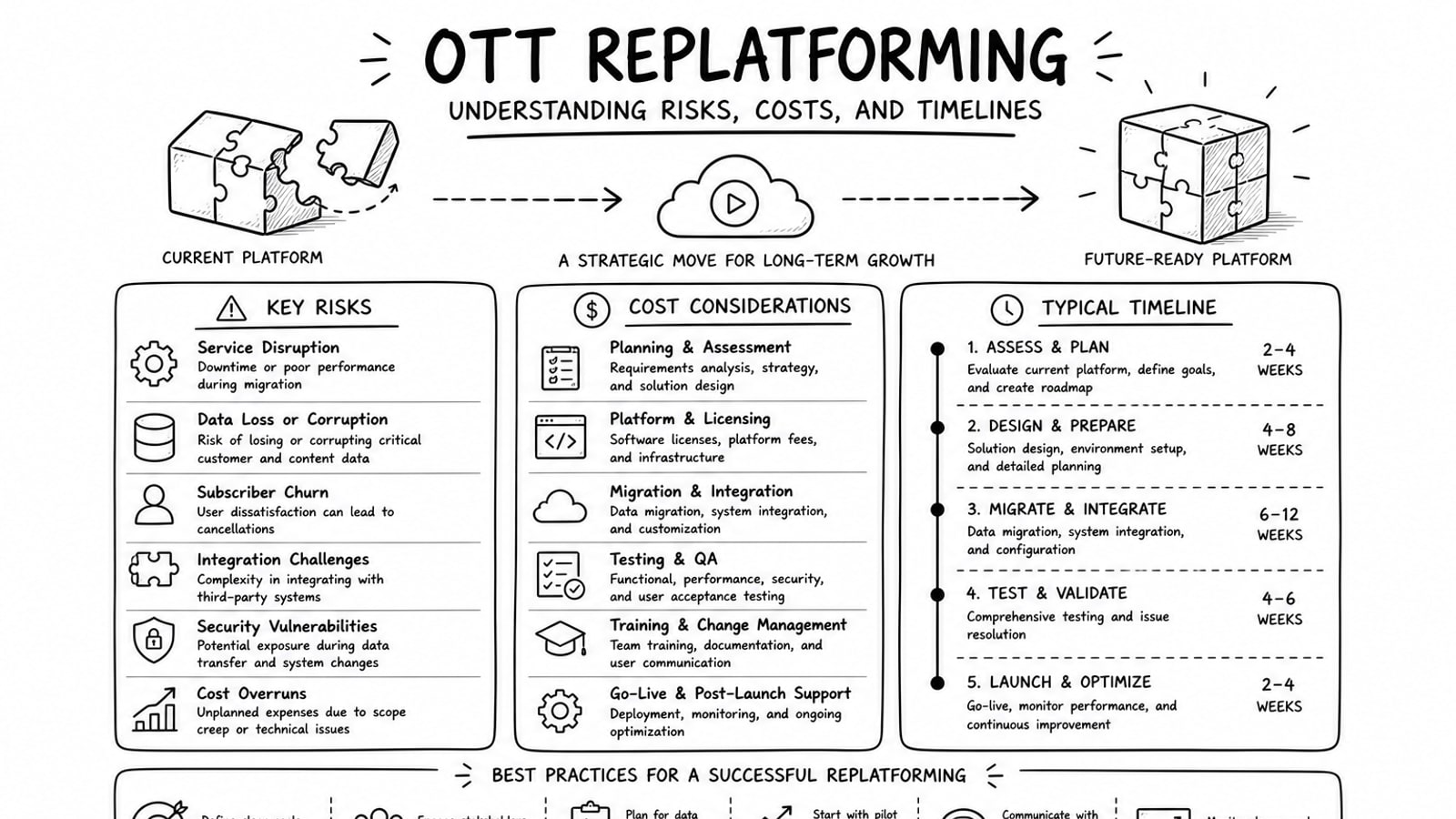
OTT Replatforming: Understanding Risks, Costs, and Timelines
A practical guide to OTT replatforming that explains why teams migrate, what usually drives risk and cost, how long projects tend to take, and where a BYOA delivery model can reduce lock-in.
Read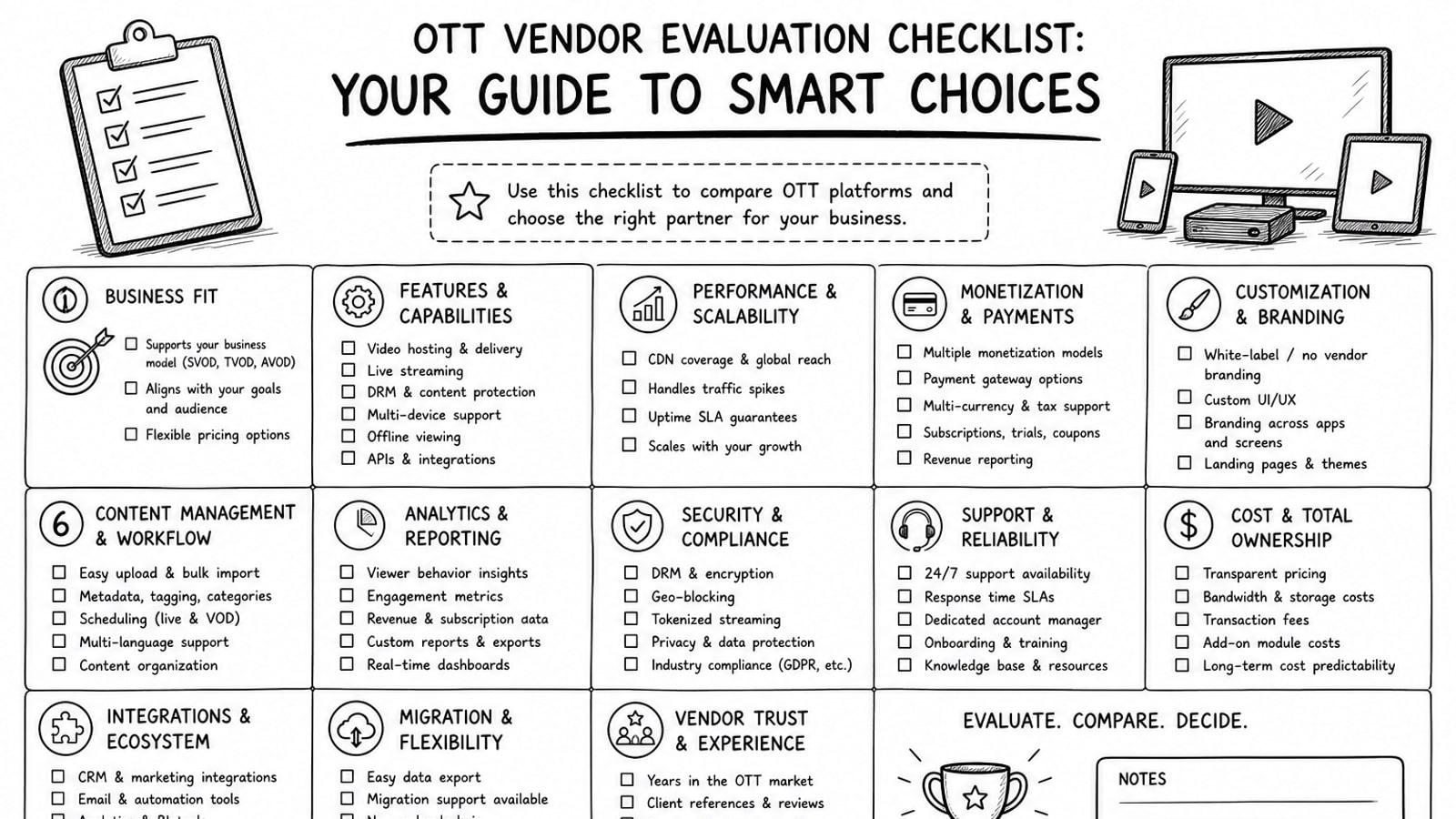
OTT Vendor Evaluation Checklist: Your Guide to Smart Choices
A practical guide to evaluating OTT vendors, with a clear checklist for delivery, security, workflow, cost, ownership, and long-term platform fit.
Read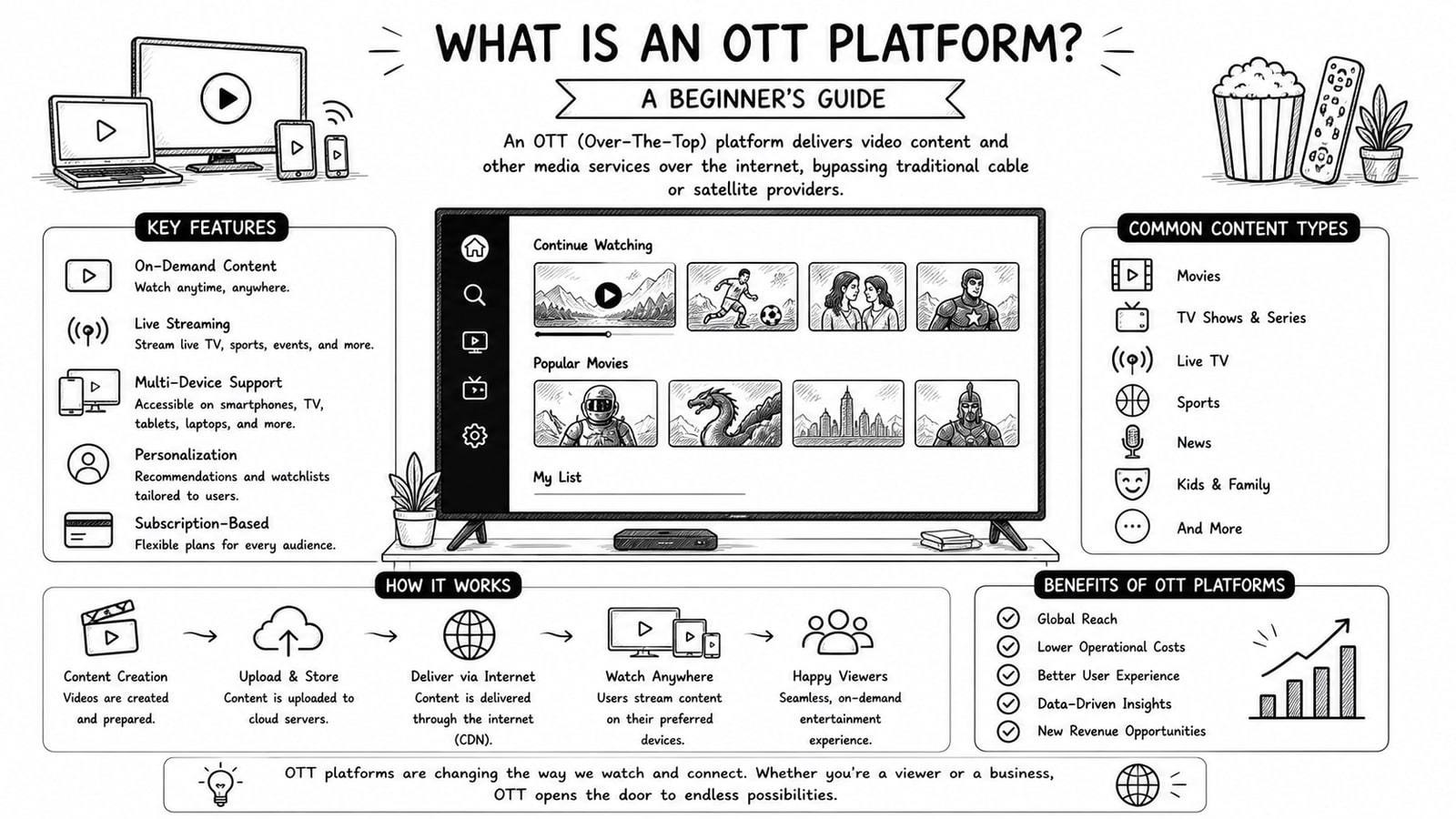
What Is an OTT Platform? A Beginner's Guide
A beginner-friendly guide to OTT platforms, how they work, key components, business models, and what to evaluate before choosing a solution.
Read